
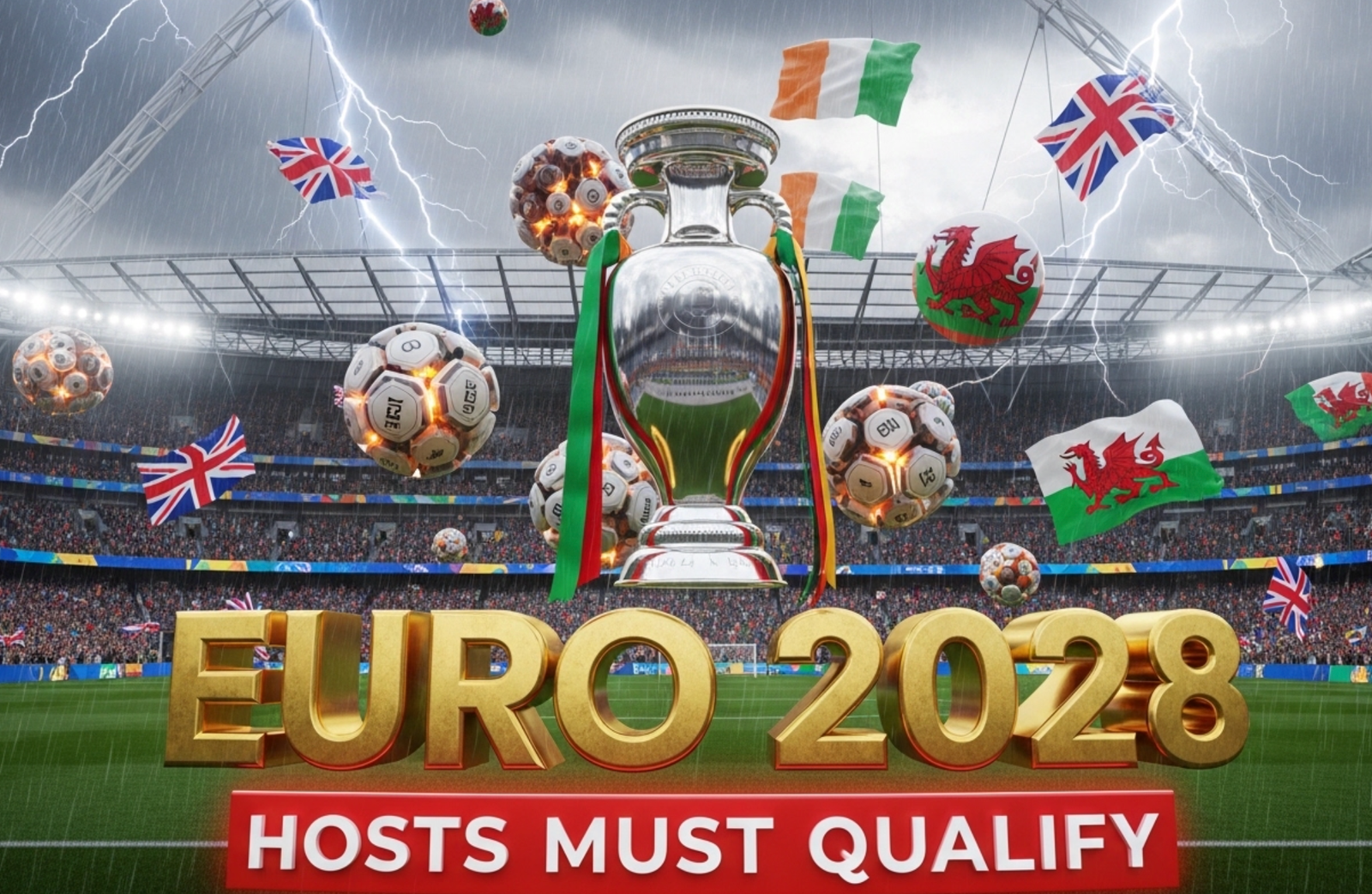
UEFA has delivered a bombshell that has sent shockwaves through British and Irish football: the five host nations for Euro 2028 — England, Scotland, Wales, Northern Ireland, and Republic of Ireland — will NOT receive automatic qualification. Instead, they must fight through the regular qualifying groups, with only a limited safety net if they fall short. This marks a dramatic departure from tradition and guarantees the road to the home tournament will be brutally competitive.
Why UEFA Scrapped Automatic Qualification
For decades, host nations have walked straight into major tournaments. Germany strolled into Euro 2024 without kicking a ball in anger. Euro 2020 gave 11 of its 12 hosts guaranteed spots. Even Euro 2016 handed Ireland and Northern Ireland automatic entry alongside France.
That era is over.
UEFA’s executive committee decided in 2023 that five automatic places would distort competitive balance too severely. With 24 finalist spots and five hosts, handing out free passes would have left only 19 places for 48 other nations. The governing body called it “unacceptable.”
The new rule forces the hosts to prove they belong, while still protecting the tournament’s hosting rights.
How the Qualifying System Actually Works
Qualifying begins in March 2025 and runs until November 2025, followed by playoffs in March 2026.
Here are the key pathways to Germany… wait, to the UK and Ireland in 2028:
- 12 group winners qualify directly
- 8 best runners-up qualify directly (total: 20 teams)
- 2 reserved spots go to the two highest-ranked host nations that failed to finish in the top two of their groups
- Remaining places (usually 2-4 depending on host performance) decided by Nations League playoffs in spring 2026
The five hosts will be placed in separate groups of five teams each, meaning they play only eight matches instead of ten. This gives them a slight scheduling advantage while keeping them in the competitive fire.
The Safety Net Explained With Examples
Imagine the group stage ends and these are the outcomes for the hosts:
Scenario 1: England win their group, Scotland finish second — both qualify normally. The two reserved spots disappear, and four playoff places open up.
Scenario 2: Only England qualifies directly. The second reserved spot goes to the best-performing remaining host (measured by points per game in the group stage). Wales, say, edge out Ireland and Scotland on that metric and take the place.
Scenario 3: None of the five hosts finish in the top two. The two best-performing hosts (again by points per game) take the reserved spots. The three left behind must pray for Nations League playoffs.
In other words, at least three host nations are guaranteed to reach Euro 2028, but all five could still make it — or as few as three.
What This Means for the Home Nations
England remain overwhelming favorites to top their group. The real drama is behind them.
Scotland proved they can qualify the hard way by reaching Euro 2020 and Euro 2024 through playoffs and groups. Steve Clarke’s side will fancy their chances of direct qualification again.
Wales reached the Euros in 2016 and 2020 but missed 2024. Rob Page (or his successor) knows the margin is razor-thin.
Republic of Ireland have not appeared at a European Championship since 2016. A new manager will be appointed soon, and the pressure is enormous.
Northern Ireland face the toughest task. They have not qualified for a Euros since 2016 and currently sit in League C of the Nations League.
The prospect of a “Home Nations + Ireland” group at the finals is mouthwatering — but now hangs by a thread.
Reactions Across the Five Nations
English media have largely welcomed the rule. “We want to earn it,” is the dominant tone from players and pundits.
Scottish fans are split — many love the romance of qualifying on merit, others fear missing out on a home tournament.
Welsh supporters remember the magic of 2016 and desperately want another shot on home soil.
Irish fans, both north and south, are nervous but proud that UEFA trusts their teams to compete rather than gift them places.
One thing unites everyone: summer 2028 will feel very different if familiar flags are missing from the stands.
The message from UEFA is clear — hosting is a privilege, but playing is earned.
Whether that makes Euro 2028 the fairest tournament ever or the cruelest summer in British and Irish football history will be decided over the next 18 months.
The battle starts soon. And for the first time ever, the hosts are right in the thick of it.