
 Ishan Crawford
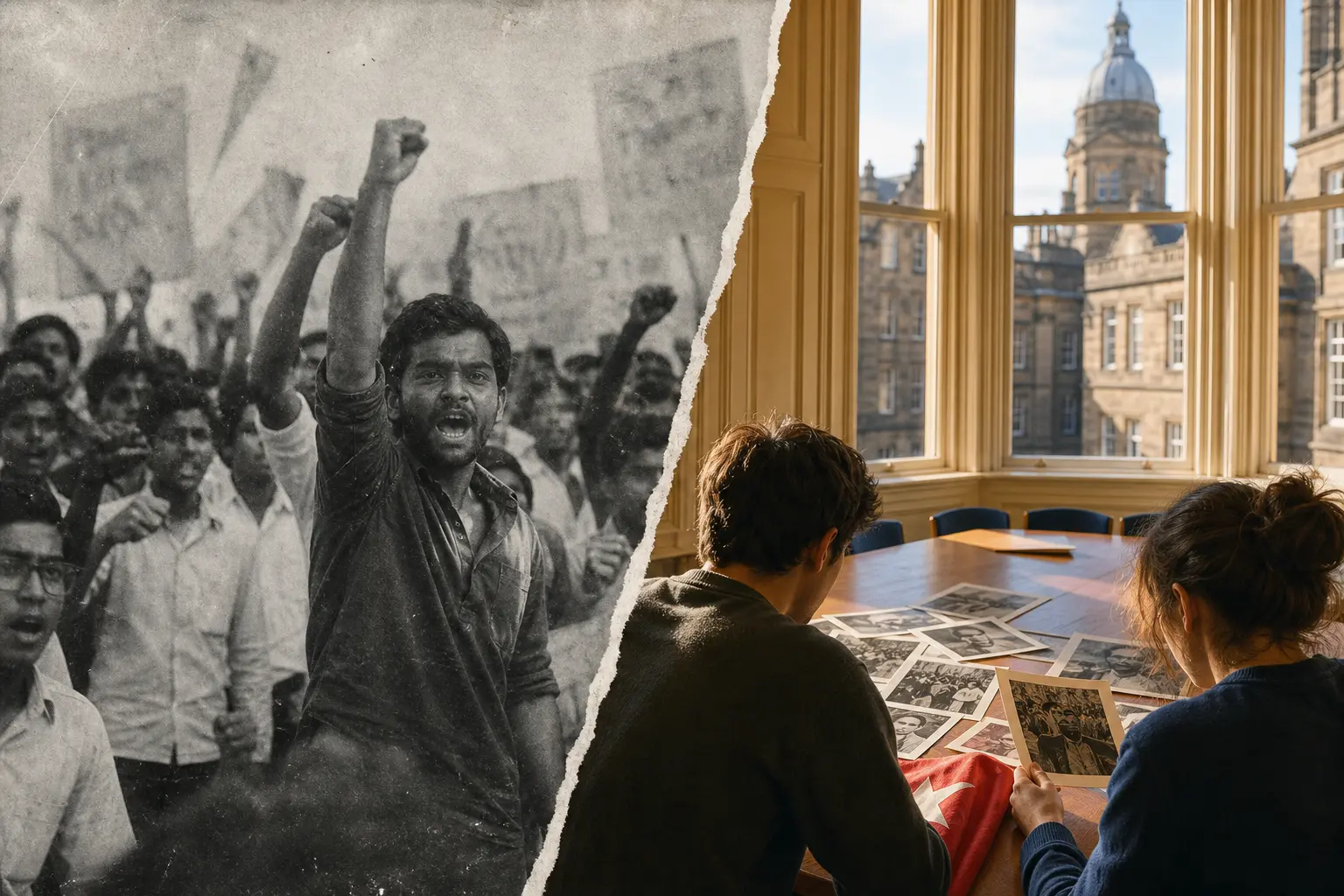
 A free workshop at the University of Edinburgh this Sunday retraces fifty years of Indian Left history. It covers Emergency-era crackdowns, the economic reforms of the 1990s and the rise of Hindu nationalist politics. The session lands three months after the Indian Left lost the only state government it still held anywhere in the country.
Organisers built the workshop around a single open question: where does the Indian Left go from here, and what should Scotland’s own fractured left take from the answer? Kerala’s election result this spring gave that question an edge nobody could have planned for.
A Sunday Session Built Around Six Decades of Struggle
The workshop runs from 11am to 2pm this Sunday, 26 July, in Room 2.14 of St Leonard’s Land at the University of Edinburgh. Lunch is included, places are capped, and organisers are asking attendees to reserve a seat in advance rather than arrive on the day.
The Students’ Federation of India’s Edinburgh branch is running the session with Cat’s Cradle, an Edinburgh collective better known for training community organisers than for teaching history seminars. Together they have built a syllabus with four distinct parts.
- The 1975 to 1977 Emergency – when India’s government suspended civil liberties and jailed opposition leaders
- 1990s economic liberalisation – the market reforms the organised Left fought hardest against
- The rise of Hindutva politics – the Hindu nationalist movement that eclipsed the Left’s national influence
- A small-group re-enactment exercise – attendees act out protest moments from the movement’s history using original source material
No background in Indian history is required. Organisers say the session is pitched equally at people who have never encountered this history and people who could teach it themselves, with a limited number of free tickets still open through Eventbrite.
What Just Happened to Kerala’s Left?
Kerala’s Congress-led United Democratic Front won 102 of the state assembly’s 140 seats in results declared in early May, its best mandate since 1977. The Communist Party of India (Marxist), or CPI(M), led the Left Democratic Front (LDF) that had governed Kerala for a decade. It fell to 35 seats, one of the party’s heaviest defeats in the state’s history.
Thirteen of the 21 sitting LDF ministers lost their own seats, including Health Minister Veena George. Dissident candidates broke from the party and stood as rebels, breaching CPI(M) strongholds in Kannur district. A regional news outlet pointed to anti-incumbency after ten years under Chief Minister Pinarayi Vijayan, layered on top of what it called organisational problems inside the party itself.
The defeat reaches further than Kerala’s borders. This is the first time in fifty years that no Indian state has a Communist party in government on its own.
| Metric | 2021 Election | 2026 Election |
|---|---|---|
| LDF seats (of 140) | 99 | 35 |
| Governing coalition | LDF, second consecutive term | UDF, best mandate since 1977 |
| BJP-NDA seats | 1 (Nemom) | 3 (Nemom, Kazhakootam, Chathannoor) |
Kerala carries a specific weight in this history. It was here, under Chief Minister E.M.S. Namboodiripad, that Communists first won power anywhere in the world through an election rather than a revolution. That is the government Sunday’s workshop uses as its reference point for what the Indian Left built, and what it has now lost the ability to defend.
- 50 years – since India last had zero Communist-led state governments, until this spring
- 1936 – the year the All India Students’ Federation, the movement’s earliest organised ancestor, formed in Lucknow
- 1970 – when the Students’ Federation of India split off as the CPI(M)’s own student wing
- 21 months – the length of the national Emergency the Edinburgh workshop opens with
From a Lucknow Convention Hall to the Emergency’s Jails
The Students’ Federation of India, known as SFI, traces its own lineage further back than most attendees will expect. According to the federation’s own West Bengal history page, the line runs to 1828, when a young Hindu College teacher named Derozio helped found India’s first students’ group, the Academic Association.
The direct organisational thread starts in 1936. The All India Students’ Federation formed at a packed Lucknow hall that August, with 936 delegates attending. Jawaharlal Nehru opened the gathering; Muhammad Ali Jinnah, who would later found Pakistan, chaired it. Congress and the Communists were still, just about, building the same coalition against British rule.
That coalition did not survive independence. Communists who saw the parent Communist Party of India as too willing to compromise broke away in 1964 to form the CPI(M). The students followed six years later. Representatives of ten regional federations met in Thiruvananthapuram in December 1970 and founded the Students’ Federation of India under the slogan “Independence, Democracy, Socialism.”
That same generation of organisers was still finding its footing when a bigger storm arrived. Students in Bihar launched what became known as the JP movement in 1974 against corruption in the state government, led by the veteran socialist Jayaprakash Narayan and known also as Sampoorna Kranti, or Total Revolution. Narayan did not sugarcoat what he was asking of them.
You will have to make sacrifices, undergo sufferings face lathis and bullets and fill up jails.
Narayan told Bihar’s students, according to a contemporaneous account of the movement.
Indira Gandhi, then India’s prime minister, declared a national Emergency on 25 June 1975. Fundamental rights were suspended, the press was censored, opposition leaders were arrested and trade unions came under attack. The Emergency lasted 21 months, until March 1977, when Gandhi called elections she badly misjudged. The Janata Party swept to a landslide win, ending thirty years of unbroken Congress rule.
The same uprising the workshop credits with shaping the modern Indian Left also shaped its opposite number. Narendra Modi and Amit Shah, now India’s prime minister and home minister, both cut their political teeth in the JP movement. The Hindu nationalist party they lead today is the same force the Edinburgh syllabus names as the one that eclipsed the Left.
Training Organisers, Not Historians
Cat’s Cradle is not a conventional history society. The group’s own site describes its work as covering organising, pedagogy, strategy and organisation-building, much of it inside the cultural and education sector. Its stated method has members strategise together, reflect on past actions, assess risks and build tactics from direct experience, producing an organising culture built for the long haul.
That approach shapes Sunday’s format directly. Rather than sit through a straight lecture, attendees will split into small groups and re-enact moments from the movement’s history using original source material, the same rehearse-and-reflect method Cat’s Cradle uses in its own organiser training.
The Students’ Federation of India is still organising at scale even as its parent party loses ground in government. The federation held its 18th All India Conference in Kozhikode, Kerala, over four days last June, drawing delegates from across the country.
Scotland’s Splintered Left Looks for a Playbook
The workshop’s closing question, what Scotland can learn from India’s Left, lands at an anxious moment for Scotland’s own left flank. In the run-up to this year’s Scottish Parliament election, a coalition of trade unionists, socialists and campaigners writing under the banner of the Scottish Left Review’s call for a working-class alternative published an open statement.
“Building a left alternative is urgent,” the statement read. It warned that Reform UK could pick up a dozen seats or more if disillusionment with the mainstream parties kept intensifying, and called for an alternative able to challenge both Reform and the record of the established parties.
The wider British left has its own alignment problem. A prospective new party from former Labour leader Jeremy Corbyn and MP Zarah Sultana remained unlaunched and unpolled this summer, a reminder that the same fragmentation splitting the right through Reform’s rise could just as easily split the left.
India’s experience does not map neatly onto Scotland’s. The Indian Left built power through disciplined cadre organisations across several states over decades. Scotland’s left is scattered across parties, unions and campaign groups that do not always agree on the constitutional question, let alone economic strategy.
Room 2.14 Opens at Eleven on Sunday
Sunday’s session does not promise to settle any of this. Organisers describe it as a shared starting point, one morning’s history laid out for people who know every name in it and people who know none, followed by an afternoon spent literally re-enacting the moments that mattered.
Doors open at 11am in Room 2.14 of St Leonard’s Land. Lunch is included, and organisers say the free tickets will not last the week.
 ONGC licence frees Venezuela cash and operatorship talks
  Anthropic Hits $65 Billion Run Rate and Flips the AI Cash Test
  Supreme Court grounds the fare free-for-all with three-week clock
  Gold Nears $4400 as Soft Data Meets Oil Inflation Risk
  Nifty Slips as Zaggle Circuits and Dhoot Debuts Big
  Diesel Crack Tops $100 as Iran Rhetoric Lifts Crude