
 Ishan Crawford
 Two cricketers’ families learned the same lesson this week, four days apart and a continent’s worth of timeline distance between them. Travis Head’s wife Jessica Davies woke up to a wall of abuse after a handshake snub at Rajiv Gandhi International Stadium in Hyderabad. Shresta Iyer fielded threatening calls at her studio in Mumbai after a 12-second clip backing her brother’s team.
A Press Trust of India (PTI, India’s largest news agency) report published Tuesday put a number on what hit them. Agencies inside the country’s cricket digital economy are charging between Rs 25,000 and Rs 2 lakh to run an orchestrated negative campaign against a single player, with rates scaling by how long the operator wants the topic to trend. Two months ago, Ravichandran Ashwin, the recently retired India off-spinner, called this a disease at the Revsportz Conclave in Kolkata. This week his diagnosis stopped sounding speculative.
Two Families, One Week, the Same Playbook
The trigger in Hyderabad was a refused handshake. After Sunrisers Hyderabad beat Royal Challengers Bengaluru in an IPL 2026 playoff fixture last Friday, Virat Kohli, the RCB batter, walked past Travis Head’s outstretched hand and shook every other Sunrisers player. Within hours, Jessica Davies’ Instagram inbox was inflamed.
It feels like a repeat of the abuse that happened after the World Cup. I woke up to my socials blasting. We are fine but they are attacking my friends and family.
That was Davies speaking to The Advertiser in Adelaide on Saturday. She has been here before, after the 2023 ODI final, the 2023 World Test Championship final, and the 2024 Boxing Day Test. The couple’s young daughter received threatening private messages on previous occasions, according to Davies’ statements at the time.
Four days later, in Mumbai, Shresta Iyer posted a brief dance clip with friends after Punjab Kings drew a rain-shortened match against Kolkata Knight Riders at Eden Gardens. PBKS, captained by her brother Shreyas, slipped out of the top four shortly after. The clip went viral as a mock-celebration. Her professional phone line, the one she uses to book choreography clients, started ringing through the night with abusive callers.
- The Hyderabad incident: on-field exchange, refused handshake, family targeted within hours
- The Mumbai incident: a 12-second clip, a playoff exit, a personal phone number leaked into a troll feed
- The connective tissue: a complaint loop that activates faster than the official broadcast highlights package
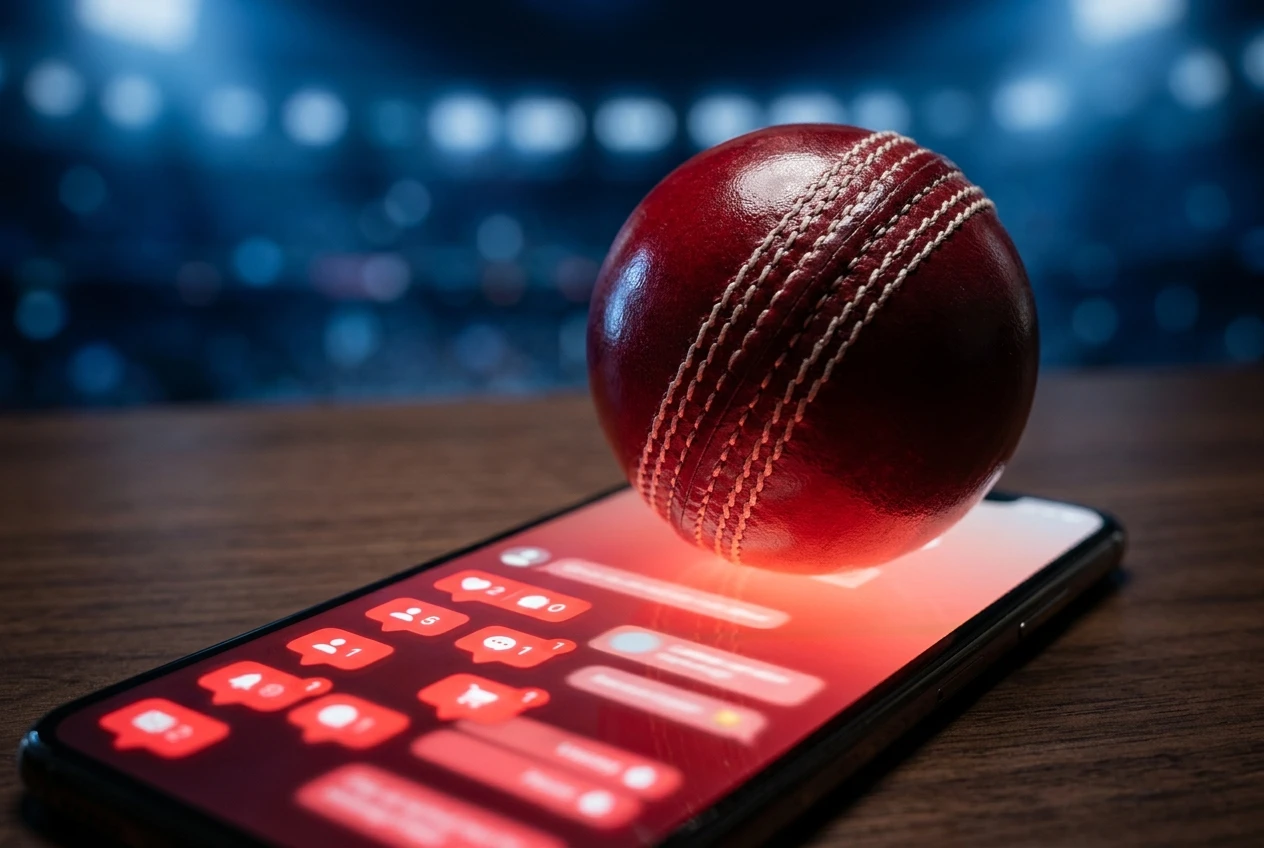
The Rate Card on Rented Hate
The PTI investigation, which ran in multiple national dailies on Tuesday, quoted an industry insider on how these campaigns are bought.
There are agencies that can charge anything between Rs 25,000 to Rs 2 lakh for spreading unmitigated hatred against a particular player. To run a campaign, customised stats could be given. Now it’s up to them to make the topic trend. Obviously, the rates will be different for hours of trending and trending for days.
That second sentence is the operative one. The product is not abuse in isolation. The product is trending placement, billed by the hour. The customised stats line matters too, because it explains why so many of the takedown threads that flood timelines after a bad performance arrive pre-loaded with selectively framed numbers that look researched.
Stripped to the basics, the rate card looks like this:
- Rs 25,000: entry tier, short-burst negative trending for hours, recycled aggregator content
- Rs 1 lakh: mid tier, custom data deck against a target, multi-day trending push
- Rs 2 lakh: ceiling tier per the PTI insider, sustained campaign across platforms
- Add-ons: customised statistics packages designed to be screenshot-friendly
For comparison, a mid-tier IPL player’s per-match retainer is several multiples of the top campaign rate. The economics of buying a takedown have never been better.
The Decision Cricket Made a Decade Ago
How did the country’s most-watched sport end up renting hate at office-supply prices? The PTI report traces it to a structural shift around 2015, when broadcast advertising started compressing and social-media following became a major variable in a player’s endorsement valuation.
The Aggregator Economy Took Root
A senior official at the Board of Control for Cricket in India (BCCI, the country’s cricket governing body) told the agency that the change had a specific architecture.
And here entered a very important component. The sports management firms that handled players’ image and commercials. The managers would comb through profiles of social media aggregators with decent following. They would be engaged to improve a player’s social media traction.
What started as a positive-traction service did not stay positive. Aggregator pages run on engagement, and engagement spikes harder on negative content than on tributes. Once the supply side of the market was built, the demand side widened to include anyone who wanted a rival player buried.
Endorsements Made the Math Work
Top-tier cricket endorsement deals in India have been linked to social-media reach since the late 2010s. A player with 30 million followers commands a meaningfully larger fee than the same player at 10 million, even when on-field returns are comparable. That gap turned aggregator traction into a line item brand managers would pay to influence. The dark side of the same infrastructure, hiring the same operators to drag a competitor, was a small commercial step from there.
Why the Loop Cannot Close Itself
The networks are not single accounts. They are fan-page clusters, often anonymously held, with shared admins moving content across handles. Taking down one node does not bring down the campaign. India’s IT Rules require platforms to act on reported posts within hours, but the rules were written for individual abuse, not for industrial-scale coordination from paid operators.
The Targets Are Almost Always Women
The throughline of the last 18 months is who absorbs the worst of it. The players themselves get jeered in stadiums and slated in column inches; their female relatives get death threats by direct message.
| Trigger event | Target | Public response |
|---|---|---|
| Hardik Pandya replacing Rohit Sharma as MI captain, IPL 2024 | Natasa Stankovic, then-wife | Pandya booed at Wankhede, family abuse migrates to her Instagram |
| Australia beats India in 2023 ODI World Cup final | Jessica Davies, Travis Head’s wife | Sustained abuse for weeks, threats against the couple’s daughter |
| Handshake snub, SRH vs RCB, IPL 2026 playoff | Jessica Davies (again) | Davies’ statement to The Advertiser, friends and family targeted |
| PBKS rain-hit draw vs KKR, IPL 2026 | Shresta Iyer, sister of Shreyas Iyer | Threat calls to her business line, public statement against trolls |
Shresta Iyer’s reply, posted to her Instagram on Sunday, was blunter than the average response. She told viewers to open her comment section and see for themselves what the campaign looked like.
I have come to talk about those fans who are jobless, frustrated people who have no business. There are so many people there who are frustrated, jobless, who have nothing to do. I pity you guys. I genuinely pity you guys.
Ashwin Saw It Coming in March
Speaking at the Revsportz Conclave in Kolkata two months ago, Ravichandran Ashwin laid out the pattern before the latest cases broke. The off-spinner, who retired from international cricket in 2024, said he had heard private dressing-room conversations reappear online as supposedly organic fan opinions, repeated under different handles.
There’s something of a disease going around right now. Many of the opinions that surface on social media through fan armies, I’ve heard them before, first-hand. Sometimes, I’ve heard these exact views at a breakfast or lunch table, only to see them later appear online under a different name. I’m not saying players themselves are planting these opinions, but it is concerning. Is there some kind of orchestration? I can’t say for certain, but there does seem to be a structured ecosystem at play.
Ashwin stopped short of naming the firms involved. The PTI report this week filled in the architecture he sketched, with a price list attached.
Where the Crackdown Stops Short
The board has moved this season, but not on this part of the problem. BCCI Secretary Devajit Saikia issued an advisory in March covering player social-media discipline, restricting reels from team hotels, monitoring of unauthorised guests in player rooms, and a flagged set of concerns around what the board called influencer access to franchises. The Anti-Corruption Unit also warned franchises about honey-trap risk and unauthorised hotel guests.
The Players’ End Is Being Tightened
Chennai Super Kings net bowler Jishan Adil was asked to delete behind-the-scenes practice videos in April. Several franchises have rolled out media-training modules for first-time IPL players covering what to post and what to dodge. The discipline is real on the player side.
The Operator End Is Not
There is no equivalent BCCI advisory pointing at the paid-aggregator end of the same supply chain. No public action against the sports-management intermediaries the board’s own senior official described to PTI. Platforms continue to act on individual reports rather than on the cluster-level coordination, partly because Indian law has no specific category for paid orchestrated hate against a sportsperson. Existing recourse runs through general defamation or IT Act provisions, which require the target to file and prosecute, which most of the female relatives currently absorbing the worst of the abuse have not done.
The Audit Trail Already Exists
Payment flows are traceable. Aggregator clusters share admins. The customised-stats decks the insider described are produced in identifiable formats. The investigative work would not be hard for an agency with subpoena power. What is missing is a complaint that names the architecture rather than the individual abusers, and a board willing to act on it.
If the BCCI’s IPL 2027 advisory cycle introduces operator-end disclosure rules and a register of paid social-media work routed through franchise-affiliated managers, this week becomes the inflection point Ashwin warned about. If not, the next handshake refused on national television will fund another set of campaigns at the prices PTI just published.
 Hyderabad Gold Dip Freezes Buying as Duty Talk Hits Wedding Season
  India Pushes Japan CEPA Review After 15 Years of One-Way Gains
  HDFC Bank’s US Class Action Turns Deposit Scheme Into Securities Reckoning
  Gold Holds Above $4600 as Treasury Buybacks Fuel Debasement Bid
  Scotland’s Prevention Push Leaves Community Groups Squeezed
  Amazon Locks Three Million Nvidia GPUs Even as Trainium Grows