
 Ishan Crawford
 BT will now run the network and cyber defenses behind Scotland’s water supply for more than five million people, replacing the patchwork of suppliers Scottish Water used before. The multi-million-pound deal, announced this week, hands the telecoms group end-to-end control of roughly 7,000 network connections and the operational technology that keeps water flowing to 2.6 million households and 150,000 business properties.
BT’s own network has failed at national scale twice in the past three years. One of those failures was a 2023 collapse of the 999 emergency call system that cost the company a record £17.5 million fine from Ofcom, the UK telecoms regulator. The company now taking over the watch for Scotland’s water infrastructure has its own file of recent outages, and that file is the part of this story getting the least attention.
BT Becomes Scottish Water’s Single Network and Security Partner
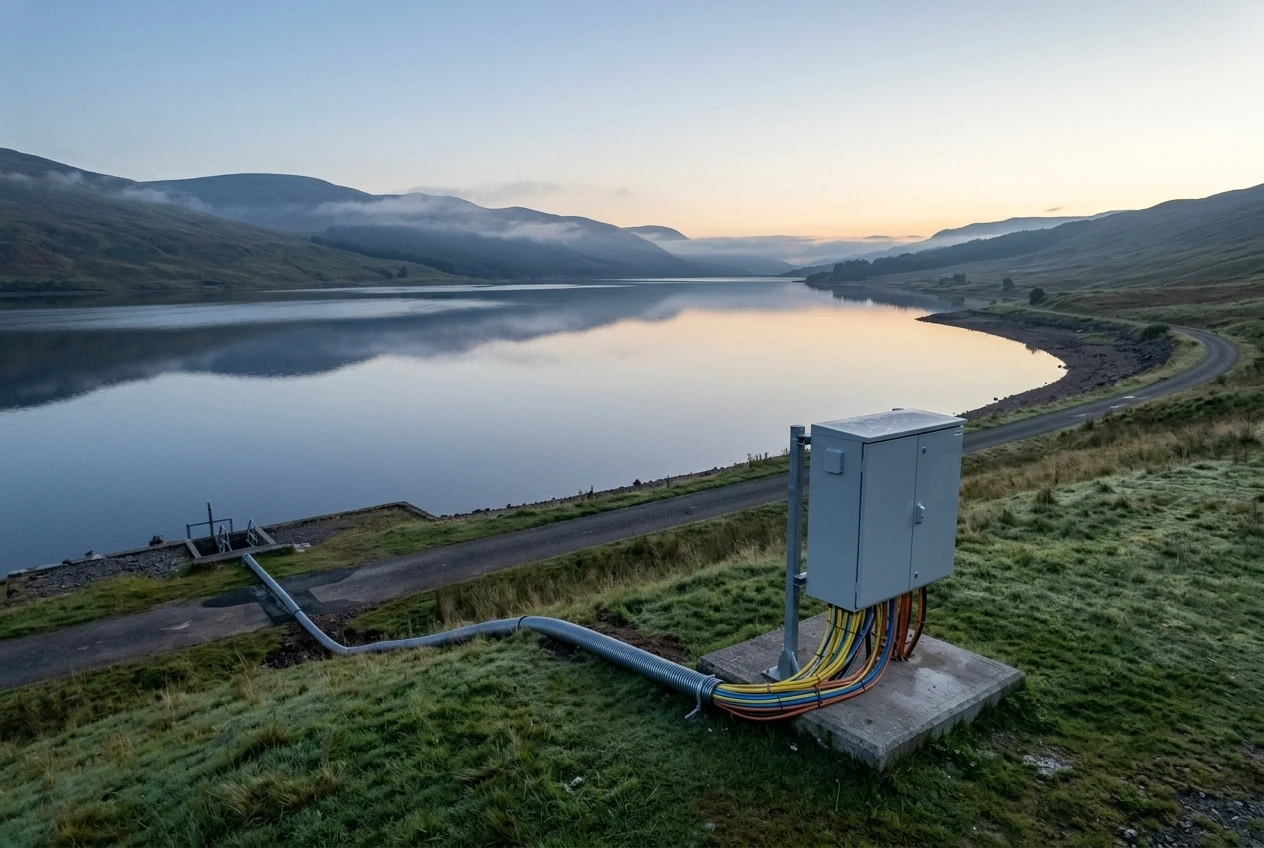
Scottish Water is a publicly owned utility that delivers drinking water and wastewater services to communities across Scotland, and under the new deal chosen to enhance critical national infrastructure for the organisation, BT takes on both the connectivity and the cyber security estate at once. That includes broadband, MPLS, satellite and internet links, plus a large operational technology network that runs pumping stations and treatment works.
The utility delivers roughly 1.51 billion litres of drinking water and treats about 1.07 billion litres of wastewater every day, according to reporting on the contract by Computer Weekly. Keeping that system visible and defended used to be split across several suppliers. Now one company holds the whole picture.
BT’s plan centers on a converged Network Operations Centre and Security Operations Centre, folding network monitoring and threat detection into one real-time desk. Ishbell MacPhail, head of BT Business in Scotland, said the combined setup would help make services “more resilient, responsive and ready for the future.”
A Parallel £100 Million Deal Went to Accenture Too
The BT contract is not the whole story. Scottish Water split a much larger digital overhaul between two partners, and the second half has drawn almost no coverage outside trade press. Accenture picked up a separate applications management contract worth up to £100 million, focused on the software that runs the utility’s day to day operations, while BT’s networks and security piece is worth up to £130 million. Together the two awards total roughly £230 million.
| Partner | Contract Focus | Value (Up To) | Term |
|---|---|---|---|
| BT | Networks and security, converged NOC/SOC, IT and OT estate | £130 million | 4 years, extendable to 8 |
| Accenture | Enterprise applications performance and stability | £100 million | 4 years, extendable to 8 |
| Combined framework | Full digital directorate overhaul | £230 million | Starts 1 September 2026 |
Chris Toop, Scottish Water’s director of digital and innovation, framed both awards as one strategy rather than two separate procurements.
This strategic partnership between Scottish Water and BT is an important step in our digital journey. By working with BT, we are strengthening the technology foundations that support every part of our business. Together, we’ll deliver more resilient, secure and efficient digital services that enable us to better serve our customers, support our colleagues and meet the challenges of the future.
Toop made near identical comments about the Accenture award, telling trade outlet Waterbriefing that the two firms would together strengthen “the technology foundations that support every part of our business.” The applications side deals with billing, customer records and operational software; the BT side deals with the wires, radios and sensors that keep the taps running.
Local Teams and Social Value Anchor the Bid
Part of what won BT the contract was its ability to staff it locally rather than run it from a distance. Scottish Water and BT both pointed to a Scotland-based delivery team as a condition of the award, not a bonus feature.
- A dedicated, locally based BT team working directly alongside Scottish Water staff
- Commitments to local employment and skills development tied to the contract
- Community engagement programmes funded as part of the deal’s social value terms
- Faster, closer-to-the-ground decision making on operational priorities, rather than routing through a distant head office
Scottish Water has framed the arrangement as feeding into its longer-term push toward a more resilient, sustainable water sector and the country’s net zero goals. That gives the contract a second audience beyond engineers: local hiring and community programmes that ministers and councils will be watching as much as uptime statistics.
The Company Taking Over Cyber Defense Has Its Own Outage File
Here is the part of the announcement that neither BT nor Scottish Water mentioned. The company now responsible for spotting and stopping threats to Scotland’s water network has, within the past three years, been fined and investigated twice over failures in its own critical systems.
On 25 June 2023, a configuration error on a BT server triggered a collapse of the 999 emergency call handling system. Ofcom’s own investigation found the fault ran for more than ten hours and left nearly 14,000 call attempts, from 12,392 different callers, unable to connect. Ofcom later fined BT £17.5 million for being ill-prepared to handle the failure, saying the company’s attempt to switch to a backup system also failed because of poor internal documentation.
Then, on 24 and 25 July 2025, a software fault knocked out mobile call services on EE, BT’s own mobile network, across the UK. Customers could not make or receive calls to other networks, including 999. Ofcom opened a fresh formal investigation into BT and rival operator Three that December, examining whether both companies had again failed to meet their legal duty to keep emergency lines open during a network failure.
Two national outages touching Britain’s emergency call system in three years is now the recent track record of the company Scottish Water has just handed sole oversight of its water network’s security and uptime.
Water Utilities Have Become a Standing Target
The timing is not neutral either. UK water suppliers have moved from an occasional target to a recurring one, and Scottish Water’s overhaul lands in the middle of that shift.
- August 2022: The Clop ransomware gang breaches South Staffordshire Water’s systems, having originally mistaken the utility for Thames Water, and later publishes screenshots of its industrial control software.
- June 2023: BT’s 999 call handling system collapses for more than ten hours, a failure Ofcom later fines the company £17.5 million over.
- October 2024: Southern Water is hit by the Black Basta ransomware gang and pays out, according to leaked internal chat logs from the group, even though the utility says only IT systems were affected.
- November 2024: Thames Water discloses an alleged cyberattack, adding a third major English water company to the list within two years.
- July 2025: A software fault takes down BT and EE mobile call services nationwide, cutting some customers off from 999 for a second time in two years.
- December 2025: Ofcom opens formal investigations into BT and Three over the summer outages.
- May 2026: The Information Commissioner’s Office fines South Staffordshire Water £963,900, finding the utility let intruders sit undetected in its network for nearly two years.
- July 2026: Scottish Water names BT and Accenture as its digital partners in a combined £230 million programme covering networks, security and applications.
The UK’s Drinking Water Inspectorate logged 15 incident reports from suppliers under NIS Regulations between January 2024 and October 2025, including five confirmed cyberattacks, a record for any two-year period, according to reporting based on freedom of information disclosures. Cybersecurity firm Semperis has said around 60% of utility operators were targeted by cyberattacks within the past year, a figure its director of security research, Yossi Rachman, has pointed to as evidence of how exposed the sector has become. None of the disclosed UK incidents disrupted an actual water supply. Ireland was less fortunate: in December 2023, a pro-Iran hacking group cut water service to about 160 homes in County Mayo for two days after breaching an industrial control component.
What Happens When One Company Holds Both Keys?
Combining a Network Operations Centre and a Security Operations Centre into one desk gives Scottish Water faster visibility and one point of accountability instead of several. It also means that if BT’s own systems falter, as they have twice in three years, the network monitoring and the security monitoring can both go dark at the same moment, instead of one backing up the other.
Regulators have already made the stakes explicit for customers with no alternative supplier to turn to. Ian Hulme, the ICO’s interim executive director for regulatory supervision, said customers of a water utility “do not have the choice over which water company serves them.” The same logic applies to a single network and security contractor: Scottish Water’s households cannot shop around if the arrangement goes wrong.
Scrutiny of who gets to hold critical Scottish infrastructure has sharpened elsewhere too. The UK government recently blocked a Chinese-backed wind factory investment at Ardersier port on national security grounds, a reminder that ownership and control of essential Scottish infrastructure is drawing more government attention than it used to, even when the provider in question is a long-established British company rather than a foreign one.
The Contracts Begin This September
Both the BT and Accenture agreements start on 1 September 2026. Each carries an initial four-year term, with an option to extend to a maximum of eight years if performance holds up.
That gives Scottish Water and BT roughly one budget cycle to prove that one converged operations desk can do what several separate suppliers used to do, without becoming the single weak point regulators have already fined BT for twice.
 ONGC licence frees Venezuela cash and operatorship talks
  Anthropic Hits $65 Billion Run Rate and Flips the AI Cash Test
  Supreme Court grounds the fare free-for-all with three-week clock
  Gold Nears $4400 as Soft Data Meets Oil Inflation Risk
  Nifty Slips as Zaggle Circuits and Dhoot Debuts Big
  Diesel Crack Tops $100 as Iran Rhetoric Lifts Crude