
 Ishan Crawford
 One black hole merger already ran the test scientists thought only future detectors could handle. Recorded on January 14, 2025 and named GW250114, the collision was the loudest binary black hole signal ever logged, with a network signal-to-noise ratio of 80. That volume let physicists confidently pick out two separate vibrational tones in its dying ring. It is exactly the kind of multi-tone reading a sweeping new review says will only become routine once next-generation detectors come online.
The review, led by researchers at the University of Birmingham, Johns Hopkins University and Lisbon’s Instituto Superior Técnico, lays out how that ringing, known as black hole spectroscopy, could test Einstein’s general relativity harder than any laboratory experiment on Earth. More than 70 physicists contributed to the assessment, published in the journal Classical and Quantum Gravity with the Institute of Physics.
A Collision Leaves a Fingerprint in Space-Time
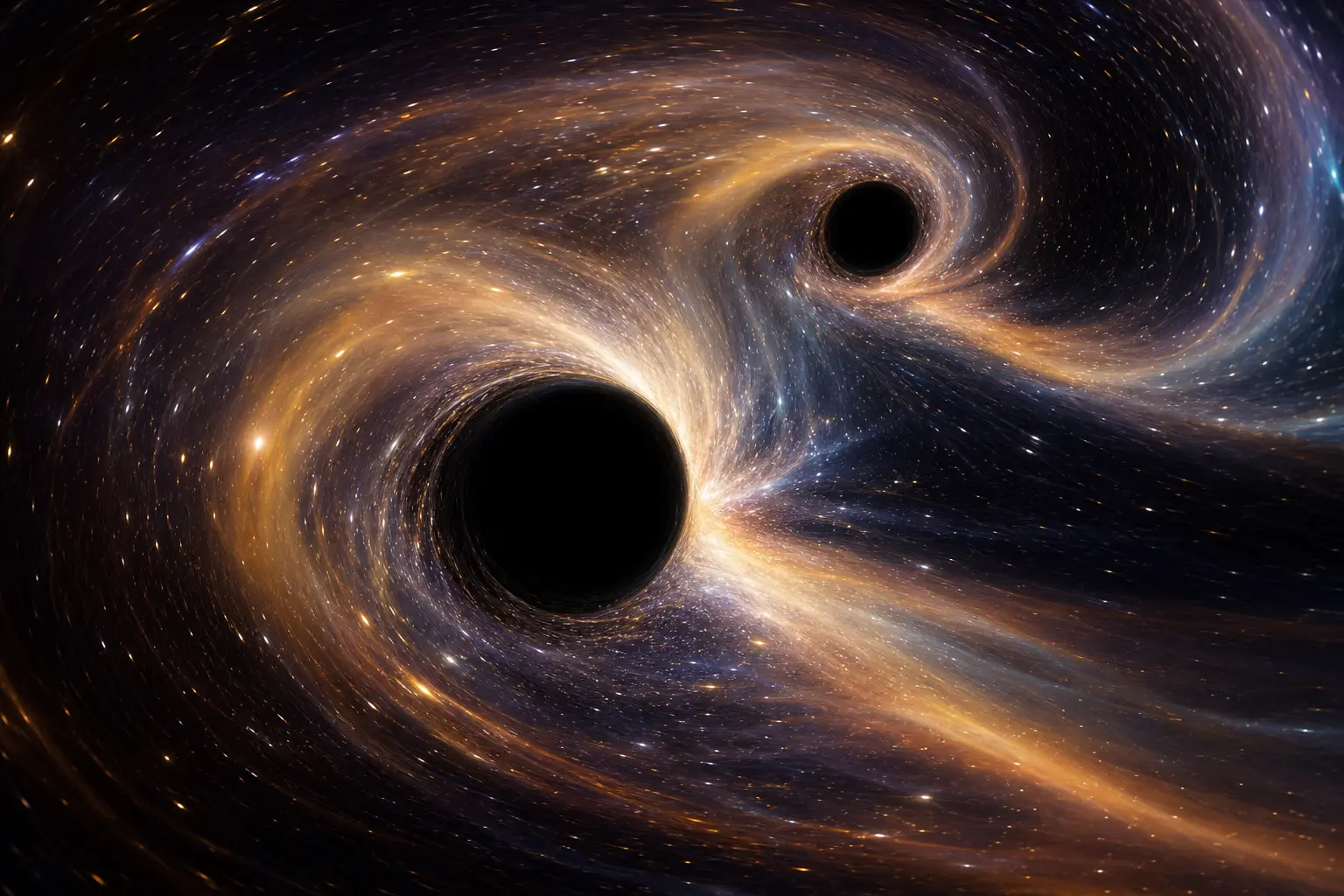
When two black holes spiral together and collide, the crash violently warps space-time. The newly formed object does not go quiet right away. It rings, shedding the distortion as gravitational waves during a phase physicists call ringdown.
Each vibration is called a quasinormal mode, with its own frequency and its own decay time, the way a struck bell produces both a pitch and a fade. Under general relativity, that pattern depends on just two numbers: the black hole’s mass and its spin. If several measured tones all point back to the same mass and spin, they support the Kerr solution, the simple description of a rotating black hole that Einstein’s equations predict. If they do not agree, something is off: an unfamiliar compact object, an unexpected surrounding environment, or physics general relativity does not capture.
Black hole collisions offer gravitational fields too intense and too fast-changing to reproduce in any lab, which is exactly why scientists want to listen so closely to what comes out of them.
What Did GW250114 Measure?
GW250114 was the merger of two black holes with near-identical masses, about 33.6 and 32.2 times the mass of the sun, detected by the two LIGO observatories with small spins and almost no orbital eccentricity. Its exceptional loudness let researchers confidently isolate two ringdown tones for the first time in a single event and check whether the merged object obeyed a 50-year-old theorem about black hole horizons.
The event’s own dedicated ringdown analysis submitted to Physical Review Letters found the post-merger data consistent with a black hole’s dominant quadrupolar mode and its first overtone, at a 4.1-sigma confidence level, a rare feat current detectors were not expected to manage often. A companion study went further, placing limits on a predicted third, higher-pitched tone with a different geometric pattern, still undetected but now bounded by data.
- Signal-to-noise ratio: 80, the loudest binary black hole merger detectors have logged
- Two masses close in size, 33.6 and 32.2 times the sun’s mass, with negligible eccentricity
- Two ringdown tones confirmed at 4.1-sigma, matching the Kerr spectrum to within 30 percent
- Hawking’s area law held even after excising the five loudest merger cycles from the data
The wider gravitational-wave catalog has kept growing around that single spectacular event. The newest LIGO-Virgo-KAGRA release, cataloging 161 additional signals from April 2024 through January 2025, brought the total number of confirmed gravitational-wave detections since 2015 to 390. The catalog’s own summary flagged GW250114 for delivering the collaboration’s first confident multi-tone ringdown measurement, the exact capability the new review treats as a marker of the field’s maturity.
More Than 70 Physicists Map a Fast-Moving Field
The review pulls together black hole perturbation theory, numerical simulations and gravitational-wave data analysis because a measured ringdown depends on both a black hole’s natural modes and the details of the collision that excited them. Its preprint, first posted last year and revised twice since, credits Emanuele Berti of Johns Hopkins, Vitor Cardoso of the Niels Bohr Institute and Instituto Superior Técnico, and Gregorio Carullo of the University of Birmingham as its co-leads.
Work on the review grew out of a 2024 gathering in Copenhagen called Ringdown Inside and Out, where specialists compared notes on the field’s fastest-moving open questions. What emerged is a picture far messier than a single ringing bell. The review catalogs several complications researchers now have to model.
- Overtones, additional vibrations riding alongside the dominant tone like harmonics on a musical instrument
- Mode coupling, where one vibration’s behavior influences another as the newly formed black hole settles
- Exceptional points, rare spots where two modes approach, merge or swap behavior in ways seen in other physical systems but only now studied in black holes
- Long-lived tails, faint afterglow following the main ringdown that a crowded environment full of matter or other objects can amplify
Every one of those effects can make a signal harder to read. Every one also carries information a simpler model would miss entirely.
The Weak Points Where General Relativity Could Break
General relativity predicts that an isolated, spinning black hole needs only two numbers, mass and angular momentum, to describe it completely. That simplicity is what makes spectroscopy possible in the first place, and it is also where the theory becomes testable.
The review names three places a mismatch could show up. One is modified gravity, the broad family of theories that depart from Einstein’s equations under extreme conditions. Another is dark matter, where new particles or fields clustered around a black hole could shift its vibration spectrum, though separating that signal from ordinary astrophysical matter remains genuinely difficult. A third is quantum physics near the event horizon, territory where general relativity, a classical theory, runs into unresolved questions about singularities and information loss.
“By listening to the ringing of newly formed black holes, we are turning gravitational waves into a tool for exploring some of the deepest questions in physics, from the nature of gravity itself to the possibility of discovering entirely new forms of matter and energy,” said Carullo, one of the review’s co-leads.
Detectors Built to Hear a Richer Spectrum
Every ringdown measured to date has agreed with general relativity, but current instruments usually cannot resolve enough separate tones to run the field’s hardest tests. That is the gap the next generation of gravitational-wave observatories is built to close.
| Observatory | Design | Expected First Data | Leap Over Today’s Detectors |
|---|---|---|---|
| Einstein Telescope | Underground triangular facility with six interferometers on 10-kilometer sides | 2035, with construction due to begin this year | Broader reach into lower frequencies current instruments miss |
| Cosmic Explorer | Two L-shaped surface facilities in the United States, arms up to 40 kilometers | Mid-to-late 2030s | An order of magnitude greater astronomical reach than LIGO |
| LISA | Space-based gravitational-wave observatory, still in development | Not yet finalized | Access to frequencies masked by Earth’s seismic noise |
The European-led Einstein Telescope, a project with a budget estimated at 1.8 billion euros (about 1.9 billion dollars), is choosing between candidate sites in Sardinia and the Meuse-Rhine border region. The proposed Cosmic Explorer network in the United States would pair with it to triangulate sources across the sky. Routine multimode measurements from either detector would let astronomers compare mass and spin estimates drawn from the same signal, and test whether some mergers challenge existing ideas about how black holes form.
“As gravitational-wave detectors become more sensitive, black hole spectroscopy promises to transform black holes from mysterious objects into precision laboratories to study challenging astrophysical processes and uncover new fundamental physics phenomena,” Carullo said.
Construction crews are due to break ground on the Einstein Telescope’s chosen site later this year, the first physical step toward a detector built to hear the tones GW250114 could only begin to reveal.
Frequently Asked Questions
What is a quasinormal mode, exactly?
A quasinormal mode is the fading vibration a black hole gives off right after a merger, described by a single complex number that combines two things at once, a frequency that sets the pitch and a damping rate that sets how fast the tone dies out. The review catalogs these frequencies across many orders, not just the dominant tone but higher ones too, labeled with indices like l equals 3 and l equals 4, each with its own signature.
What is the black hole no-hair conjecture?
It is general relativity’s claim that an isolated, rotating black hole can be fully described by just its mass and its spin, with no other distinguishing features. Physicists have tested that idea empirically since at least 2018, when Gregorio Carullo and coauthors published a direct empirical test of the no-hair conjecture using gravitational-wave data, years before GW250114 gave the field its strongest evidence yet.
What kinds of dark matter could show up in ringdown data?
The Einstein Telescope’s own science case points to a few candidates worth checking against ringdown data, including primordial black holes formed in the early universe and axion clouds that can form around a spinning black hole, alongside ordinary matter accreting nearby. Separating any of those signatures from a black hole’s natural vibration remains one of the field’s harder open problems.
Why does Hawking’s area law matter beyond black holes?
Hawking’s area law, also called the second law of black hole mechanics, states that a black hole’s horizon area cannot shrink on its own, a rule that echoes the law of entropy in thermodynamics. Once Hawking radiation is factored in, physicists swap the plain area law for a generalized version that weighs the black hole’s entropy against the entropy carried off by that radiation.
Is LIGO still finding new black holes while bigger detectors are built?
Yes. Upgrades finished in 2024, including Virgo’s return to operation after four years offline, let the LIGO-Virgo-KAGRA network catch as many as three to four confirmed gravitational-wave signals a week. The collaboration is still running observations even as construction crews prepare the sites for the next-generation detectors the new review says the field ultimately needs.
 ONGC licence frees Venezuela cash and operatorship talks
  Anthropic Hits $65 Billion Run Rate and Flips the AI Cash Test
  Supreme Court grounds the fare free-for-all with three-week clock
  Gold Nears $4400 as Soft Data Meets Oil Inflation Risk
  Nifty Slips as Zaggle Circuits and Dhoot Debuts Big
  Diesel Crack Tops $100 as Iran Rhetoric Lifts Crude