
 Ishan Crawford
 The B790 codename surfacing inside iOS 27 beta 2 looked at first read like a clean confirmation of Apple’s camera-equipped AirPods. Developer Sam Henri Gold found a JSON system file instructing the device’s Visual Intelligence feature to identify landmarks, text, and everyday objects from two cameras positioned on either side of the user’s head. The discovery came days after a leaker claimed the underlying project had been suspended.
Gold’s find also lands the same week Bloomberg’s Mark Gurman reported that Apple’s smart glasses, internally known as N50, have slipped from a planned late 2026 introduction to a target launch at the end of 2027. Two of Apple’s most-watched wearable projects are now visibly behind schedule at the same time, and one of them may not be shipping at all.
What the iOS 27 Code Actually Contains
Sam Henri Gold, a product designer and developer based in New York, shared the iOS 27 dual-camera wearable code report this week, drawing on the second developer beta of iOS 27. The find is a JSON file containing a system prompt for an internal Apple identifier called B790. The file instructs Apple’s Visual Intelligence feature on how to interpret images captured by the device, including identifying objects a user is holding or pointing at.
One example embedded in the prompt has the system answer a user pointing a camera at the Eiffel Tower and asking “What’s this?” with the monument’s location and historical details, including the year 1889. A second example, a coffee mug, tests the system on a more ordinary object. The prompt also includes recovery instructions, directing the software to ask for another image if the original is blurry, dark, or partly hidden, and instructs the system to “translate visual to descriptive text query” of less than 250 characters.
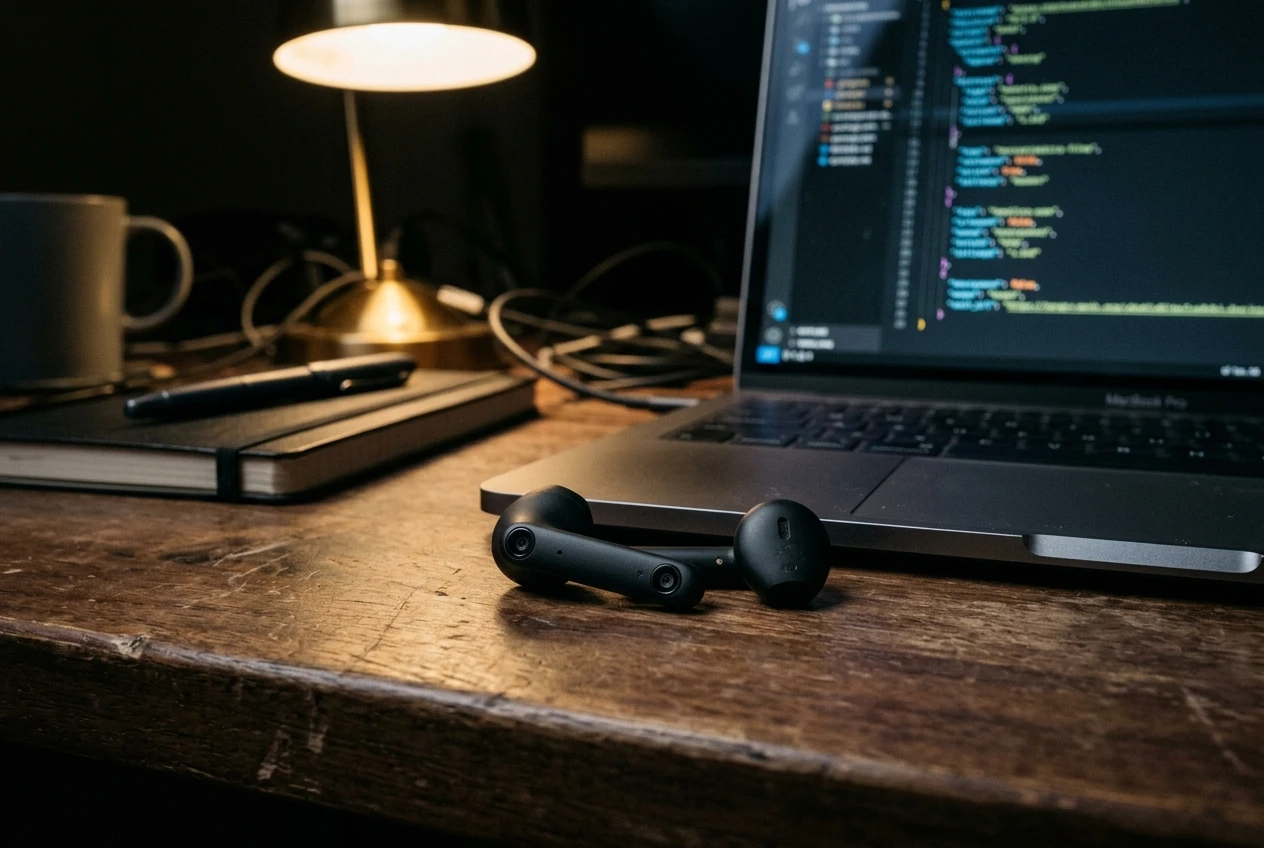
The most concrete hardware detail is in the file’s description of how the device will capture images. It processes two images from cameras positioned on either side of a user’s head, left first, then right, with both depicting the same scene from slightly different horizontal positions. In computer vision, that pattern is called stereo image processing. The setup would give the system a sense of depth and spatial context that a single front-facing camera cannot.
Why the Codename Reads as AirPods
Gold initially suggested the code pointed to Apple’s smart glasses, reasoning that a wearable with two head-mounted cameras fit the glasses form factor more naturally than earbuds. The B790 identifier, though, aligns much more closely with Apple’s earbuds naming history. The AirPods Pro 3, which Apple shipped in 2025, is internally known as B788. The two codenames sit right next to each other, a pattern Apple has used for products in the same family.
Apple’s smart glasses, by contrast, are said to carry a different internal name. Bloomberg’s Mark Gurman has reported that the glasses are known inside Apple as N50, a separate naming convention. The gap between B790 and N50 is the strongest textual evidence that the iOS 27 code describes earbuds, not eyewear, per a B790 code analysis of the leak.
The Suspension Claim That Complicates the Picture
Days before Gold’s find made the rounds, a different leaker cast doubt on whether the camera-equipped AirPods would ever ship. The prototype collector and occasional leaker known as Kosutami posted on social media that development of the product had been “suspended.” A suspension claim covered on July 3 lays out the chain of posts.
Kosutami’s post corrected an earlier statement. In June, the leaker had said the project was “concluded.” The follow-up reframed that as “suspended,” a word that leaves the door open to a future restart but implies the work has stopped for now. MacRumors, which has a longer track record with Kosutami, noted that the leaker has been right on Apple hardware details, including the iPhone 16 Pro’s metal-enclosed battery, and wrong on timing, including a call on AirPods Pro 3 in August 2024.
The claim is hard to square with the iOS 27 code, since software support for a hardware product usually means the hardware is still in active development, and Apple does not typically build Visual Intelligence infrastructure for a device that is not coming. The visual AI infrastructure the code describes would also feed Apple’s smart glasses, a product still on the roadmap.
- Around 2022: Apple begins developing AirPods with cameras (per Bloomberg)
- May 2026: Bloomberg reports the camera-equipped AirPods in advanced testing, with operations teams securing components for a launch
- June 2026: Kosutami says the AirPods project is “concluded”
- July 3, 2026: Kosutami corrects the wording to “suspended”
- This week: Sam Henri Gold finds the B790 codename in iOS 27 beta 2
Bloomberg’s Mark Gurman reported in May 2026 that the camera-equipped AirPods had reached an “advanced” testing stage and that operations teams were securing components for a launch. Apple originally wanted to start selling the camera-equipped AirPods in the first half of 2026, the report said, but held the launch back because the smarter, AI-driven version of Siri was not yet ready. That smarter Siri now exists in the current iOS 27 beta and is set to roll out more widely when iOS 27 ships in September. With the Siri dependency cleared, Apple may have decided to redesign or re-spec the product rather than rush it.
Where Apple’s Smart Glasses Fit
The B790 code is only half of Apple’s wearable story. The other half is the smart glasses project, internally known as N50, which has slipped from a planned late 2026 introduction to a target launch at the end of 2027. Bloomberg’s Mark Gurman reported the late 2027 smart glasses delay in May 2026 and laid out the reason.
The company is now working toward launching the glasses at the end of next year, I’m told.
The delay fits a pattern inside Apple. Meta’s Ray-Ban smart glasses, which integrate cameras and AI assistance into a normal-looking frame, have established that the category is commercially viable, and Apple’s pitch is to reach a much wider audience than the $3,499 Vision Pro ever did. The first Apple glasses are expected to use oval-shaped cameras and offer multiple frame styles, including prescription and sunglass options. They will not include a heads-up display at launch. Instead, they will function as a hardware platform for Apple Intelligence, capturing images and feeding them to Siri for analysis.
The same camera-plus-AI pattern appears in the B790 code, which is why the two projects are often discussed together. Apple’s plan, in other words, is to ship the camera-and-AI formula on two different form factors, earbuds first and glasses a year or so later, with the glasses project visibly behind schedule and the earbuds project, per Kosutami, paused.
| Product attribute | Camera-equipped AirPods (B790) | Apple smart glasses (N50) |
|---|---|---|
| Latest reported status | Suspended, per leaker Kosutami (July 3, 2026) | Delayed to end of 2027, per Bloomberg (May 2026) |
| Camera setup described in code | Stereo image capture from two head-side cameras | Oval cameras, multiple frame styles; no AR display at launch |
| Original launch target | First half of 2026 (per Bloomberg) | End of 2026 (per Bloomberg) |
What Two Cameras on Either Side of the Head Would Do
The dual-camera setup described in the B790 code is the part that would actually do something new. A single front-facing camera on earbuds could capture what a user is looking at, but it cannot tell how far away an object is or where it sits in space. Two cameras, one on each side of the head, give the system two slightly offset views of the same scene. From those two views, the system can derive depth and a rough 3D structure of the room, useful for navigation, for placing reminders in physical context, and for identifying objects that are partly hidden.
The B790 prompt already hints at that. It tells the system to handle “spatial relations” and “visual properties,” language that suggests the device is meant to understand where things are, not just what they are. Apple’s existing Visual Intelligence on the iPhone 15 Pro and newer can already identify plants, animals, landmarks, and text. The dual-camera wearable would extend that capability beyond the iPhone into settings where a user is unlikely to pull out a phone, while walking, while cooking, while driving.
Why the Software Is in Place Before the Hardware Ships
Apple has been working on camera-equipped AirPods for around four years, according to Bloomberg, and the visual AI models that would run on the cameras have been the bottleneck, not the hardware. iOS 27 is the first place this story surfaces, and it is the software, not the device, that has been ready first.
Apple moved Visual Intelligence into the Camera app in iOS 27, a change that makes the feature available without going through a dedicated Visual Intelligence mode. The B790 system prompt is essentially a parallel set of instructions for the same family of capabilities, tuned for a device that is hands-free and head-mounted. Apple’s pattern in past launches has been to seed the software in an OS update, then ship the hardware that depends on it a year or two later, which is why the code is in iOS 27 even though no compatible AirPods are on sale yet.
What the AirPods will be called is still unsettled. An AirPods Ultra expectations guide from MacRumors has reported that naming is still open, with AirPods Pro 4 and AirPods Ultra both in play, and the “Ultra” branding the more widely rumored choice. Pricing has not been disclosed, but cameras and the H3 chip Apple is reportedly developing for the new AirPods would push the cost above the current $249 AirPods Pro 3.
For now, the B790 code says the software is being prepared for a camera-equipped wearable. Kosutami’s “suspended” post says the hardware work has stopped. Both can be true at once: the operating system is built in advance, the product roadmap is still being redrawn.
- AirPods camera project: in development for around four years, per Bloomberg.
- Current AirPods Pro 3: priced at $249, per MacRumors.
- Smarter AI version of Siri: in the iOS 27 beta, with wider release set for September 2026, per MacRumors.
- Visual Intelligence moved to the Camera app in iOS 27, per PhoneArena.
Frequently Asked Questions
What is the B790 device in iOS 27?
The B790 identifier appears in a JSON system file inside the second developer beta of iOS 27, discovered by developer Sam Henri Gold. The file describes a dual-camera wearable that processes two slightly offset images from cameras on either side of a user’s head. The most likely match is Apple’s camera-equipped AirPods, given the B790 codename sits next to the B788 codename for the current AirPods Pro 3.
Have the camera-equipped AirPods been cancelled?
A leaker and prototype collector known as Kosutami posted on July 3, 2026, that the project had been “suspended,” correcting an earlier “concluded” statement. Bloomberg reported in May 2026 that the camera-equipped AirPods were in advanced testing, and Apple is still building software support for them in iOS 27. The two reports have not been reconciled. “Suspended” is not the same as “cancelled,” and Apple has historically restarted paused hardware projects.
When would Apple’s camera AirPods launch?
Bloomberg’s most recent guidance points to a late 2027 launch, alongside the 20th anniversary iPhone and a second-generation foldable iPhone. Apple originally targeted the first half of 2026, but held the launch back because the smarter AI version of Siri was not yet ready. The smarter Siri now exists in the current iOS 27 beta and is set to roll out more widely when iOS 27 ships in September.
What would the cameras in the AirPods do?
The cameras would feed visual information about the wearer’s surroundings to Siri, allowing the assistant to answer questions about objects in view, provide contextual reminders, and assist with turn-by-turn directions on foot. The cameras are not intended for taking photos or videos, only for AI processing. The dual-camera setup on either side of the head would give the system a stereo view, allowing it to estimate distance and spatial relationships in addition to recognizing objects.
What are Apple’s smart glasses, and when will they launch?
Apple’s smart glasses, internally known by the codename N50, are a pair of AI-powered eyewear designed to compete with Meta’s Ray-Ban smart glasses. Bloomberg’s Mark Gurman reported in May 2026 that the launch has been delayed from a planned end-of-2026 introduction to the end of 2027. The first Apple glasses are expected to feature oval-shaped cameras, multiple frame styles including prescription and sunglass options, and integration with Apple Intelligence, but no heads-up display at launch.
 SEBI CAS Forces Options Traders to Recalibrate Closing Risk
  Sensex Drops 400 Points as Oil Spike Tests Market Resilience
  Ardee Industries IPO Rides Lead Recycling Boom at Discount
  Gold Nears 4300 but Iran Risks Cap Gains Ahead of NFP
  Scotland Construction Stalls as Skills and Tariffs Blunt Infra Gains
  Lok Sabha Bill Opens UPI Charges Path for Banks Over Merchants