
 Ishan Crawford
 Apple shares hit $342.89 on Tuesday and briefly valued the company at $5.036 trillion. That made it only the second company to reach $5 trillion, after Nvidia. The stock closed at $340.08, so the mark lasted just part of the session. A day earlier Apple had already passed Nvidia to reclaim the title of world’s most valuable public company.
The same light capital spending that Wall Street once faulted is now the reason investors are buying. Rivals pouring hundreds of billions into AI data centers are the ones under pressure.
A Milestone That Lasted Hours
Apple’s market value edged above $5 trillion for the first time early Tuesday before retreating. Nvidia sat near $4.7 trillion. Alphabet was around $3.9 trillion and Microsoft near $2.9 trillion.
- $342.89 intraday high on the $5 trillion print
- $340.08 closing price Tuesday
- ~25% Apple year-to-date gain versus Nvidia’s low-single-digit rise
- $12.7 billion Apple capital expenditure in fiscal 2025
Nvidia first crossed $5 trillion in October. Apple’s climb has been steadier and less dependent on the AI infrastructure boom that lifted chipmakers and cloud hyperscalers.
Alphabet’s Forecast Reset the Trade
Last Wednesday Alphabet raised the top end of its 2026 capital expenditure outlook to $205 billion from $190 billion. Google Cloud grew 82 percent in the quarter, the fastest pace since at least 2020. The stock still dropped 7 percent the next day and pulled Amazon, Meta and Microsoft lower with it.
Investors focused on the financing. Alphabet’s long-term borrowings climbed 111 percent to $98 billion in six months. The company posted negative free cash flow last quarter for the first time, roughly $5.86 billion. Quarterly capex near $44.9 billion outran operating cash flow.
- Amazon long-term debt up 81 percent to $119 billion from December to March
- FactSet expects Microsoft free cash flow to turn negative in the fourth quarter, a first since at least 2001
- Combined Alphabet, Amazon, Microsoft and Meta spending headed above $700 billion this year, mostly on AI data centers
Twelve months ago that spending gap looked like Apple’s biggest problem. In the last week it became the bull case.
How Apple Keeps the Cash Flow Clean
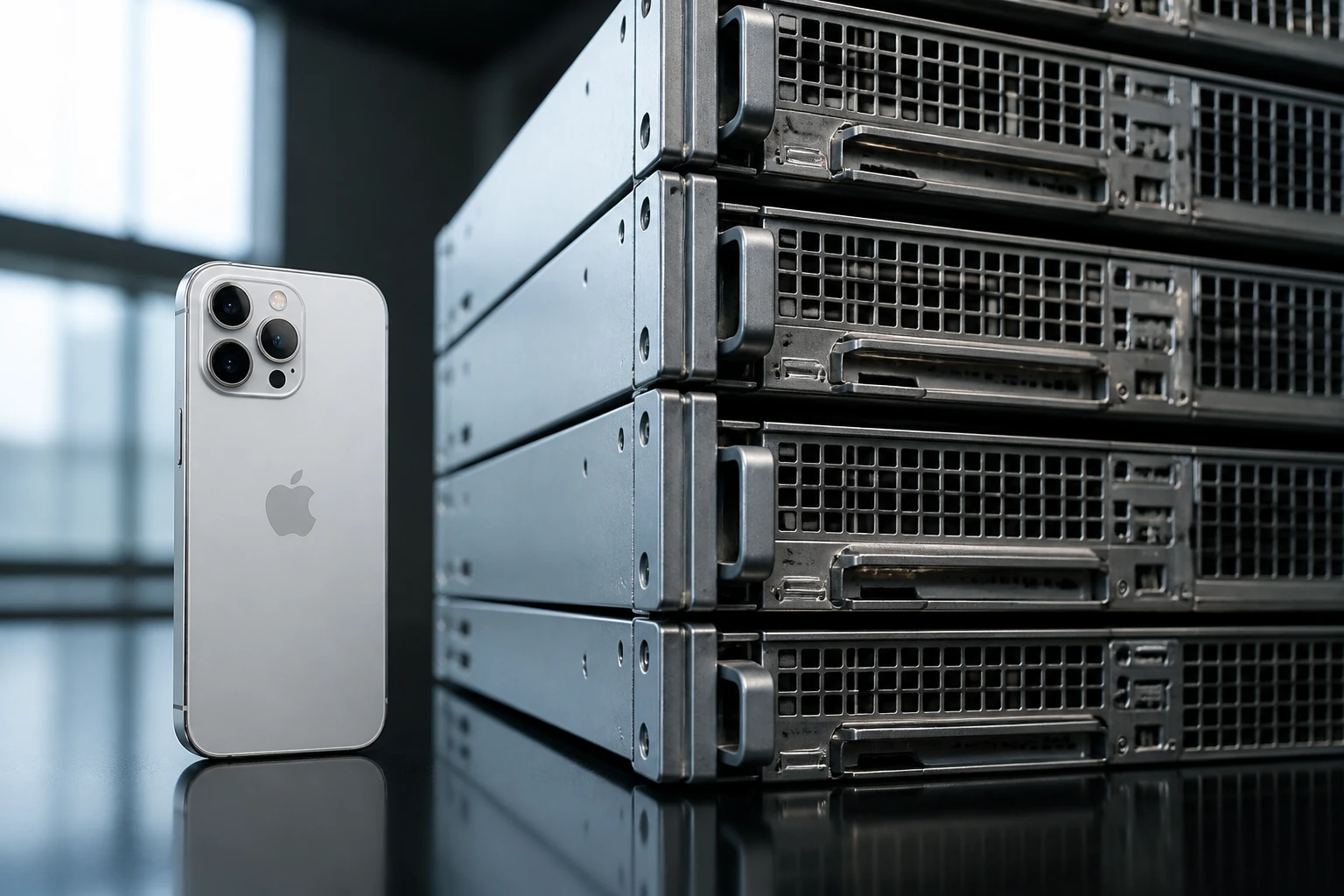
Apple buys compute capacity instead of building most of it. Apple CFO Kevan Parekh has described a hybrid model that mixes first-party and third-party capacity. When Apple does own servers it runs them on Apple silicon. Private Cloud Compute sits behind Apple Intelligence features. The Siri overhaul due this fall leans on Google AI technology under a collaboration.
Once criticized for not spending more on AI, they have been able to avoid some of those capex pitfalls.
Jay Woods, chief market strategist at Freedom Capital Markets, made that point. The March quarter illustrated the outcome: more than $28 billion in operating cash flow, capital spending under $3 billion, and almost all of it free cash.
Apple’s full-year fiscal 2025 capital spending was $12.7 billion. That is a fraction of what any single hyperscaler now plans for one year. The company still invests in on-device models and its own chips, but the heavy training and inference loads can sit with partners. Costs appear partly as operating expense, which can scale up or down without locking in multi-year depreciation on racks that lose value quickly.
Where the Heavy Spenders Stand Now
The contrast shows up clearly when the numbers sit side by side.
| Company | Recent Capex Signal | Balance-Sheet Pressure |
|---|---|---|
| Apple | $12.7B fiscal 2025; under $3B in March quarter | Strong free cash, large buybacks |
| Alphabet | 2026 outlook to $205B | Long-term debt +111% to $98B; negative FCF |
| Amazon | Elevated AI data-center build | Long-term debt +81% to $119B |
| Microsoft | Expected further guidance raise | FCF seen turning negative Q4 |
| Meta | High ongoing AI spend | Part of the $700B+ group total |
Apple generated heavy free cash and returned capital. Alphabet skipped buybacks in a recent period for the first time in a decade while Apple authorized another $100 billion. Crowd discussion on X has zeroed in on the same gap: if the AI infrastructure cycle delivers weaker returns than hoped, Apple is the large-cap name whose balance sheet is not carrying the full weight of the buildout.
What Traders and Analysts Are Watching This Week
Microsoft and Meta report after the close Wednesday. Amazon follows Thursday. All three are expected to lift spending guidance again. Cowen analyst Derrick Wood has said another increase would likely bring more selling. Apple reports Thursday evening. Analysts look for revenue growth above 15 percent, with some estimates near $108.8 billion and EPS around $1.88.
It will be Tim Cook’s final earnings call as CEO. John Ternus takes over on September 1. The upcoming earnings call therefore carries both the usual product and services questions and the succession handoff.
On X and in market notes the sharper takes treat Apple’s stance as deliberate optionality. Models are commoditizing. Open-source and lower-cost training runs have compressed the advantage of owning every GPU. Apple can switch vendors or lean harder on its roughly two-billion-plus active devices for on-device work. Peers that financed multi-year data-center buildouts face higher interest costs and the risk that utilization or pricing falls short of the revenue needed to justify the outlays.
Cook Hands Off After the Numbers
Cook has led Apple since 2011. The transition to Ternus, currently hardware engineering lead, was announced earlier and takes effect September 1. Thursday’s call is the last under Cook’s tenure.
- July 28, 2026, Apple briefly crosses $5 trillion market value
- July 29-30, 2026, Microsoft, Meta, Amazon and Apple report earnings in succession
- September 1, 2026, John Ternus becomes CEO
Apple’s fiscal 2025 fourth-quarter results already showed record September revenue and services strength. The installed base of active devices hit a new high. Those distribution advantages remain the company’s core AI argument: intelligence that runs fast and private on the devices customers already own, supplemented by rented cloud capacity when needed.
The Bet That Flipped in a Week
For most of the past year the market treated heavy AI capital expenditure as table stakes. Alphabet’s latest raise, paired with clear free-cash-flow strain, reversed the reading almost overnight. Apple’s hybrid approach suddenly looked like discipline rather than delay.
The $5 trillion print was brief. The relative performance is not. Apple is up about 25 percent this year while several of the heavy spenders have given back gains on the financing questions. Whether that ranking holds depends on the guidance that arrives this week and on how quickly AI services revenue can catch the infrastructure bills already incurred. For now the company that spent the least sits at the top of the market-cap table.
 ONGC licence frees Venezuela cash and operatorship talks
  Anthropic Hits $65 Billion Run Rate and Flips the AI Cash Test
  Supreme Court grounds the fare free-for-all with three-week clock
  Gold Nears $4400 as Soft Data Meets Oil Inflation Risk
  Nifty Slips as Zaggle Circuits and Dhoot Debuts Big
  Diesel Crack Tops $100 as Iran Rhetoric Lifts Crude