
 Ishan Crawford
 A Transport Scotland working group met for the first time on 4 August 2026 to launch a feasibility study into a direct Caledonian Sleeper service from Scotland to mainland Europe. The high-level review will examine technical and commercial realities of running overnight trains through the Channel Tunnel, with findings due to ministers later this year.
The move fulfils a Scottish Government manifesto pledge. It also reopens a file last closed when the Nightstar project collapsed nearly three decades ago under rising costs and the rise of budget airlines.
Working Group Puts Manifesto Promise on Track
Transport Scotland, Scottish Rail Holdings and Caledonian Sleeper form the group. They will oversee a high-level feasibility study exploring technical and commercial opportunities plus the challenges of extending sleeper services to the continent.
Cabinet Secretary for Economy, Tourism and Transport Stephen Flynn framed the start carefully.
We committed to exploring the potential for a direct Caledonian Sleeper service to mainland Europe and I am pleased that this work is now underway. The establishment of this working group marks an important first step in delivering that commitment and will help ensure the feasibility study is informed by the expertise of our rail partners. This is an early-stage exercise and the study will focus on understanding the practical, technical and commercial considerations involved. The findings will provide an evidence base to inform any future decisions.
Flynn’s statement, released with the announcement, stresses that no service decision has been taken. Caledonian Sleeper has operated in-house under Scottish Rail Holdings since June 2023 after the Serco contract ended.
That public chain of command matters for the study’s scope. The same bodies that run today’s Euston services will judge whether those services can stretch beyond London. Expertise sits with the operator already responsible for overnight paths, crew rosters and the CAF Mk5 fleet, rather than with a fresh joint venture built only for the Tunnel.
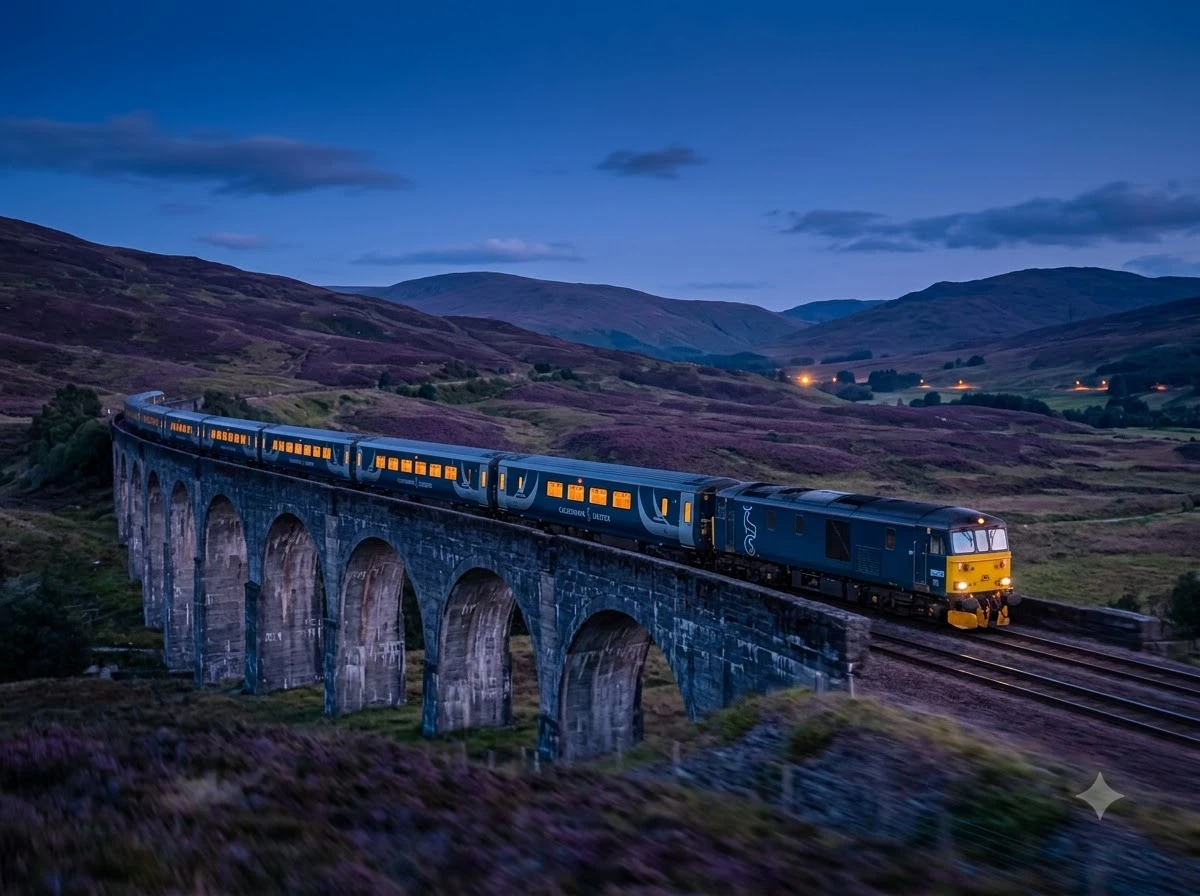
Nightstar’s Ghost Still Rides the Rails
The idea of Scottish cities linked overnight to Paris, Brussels and beyond is not new. In the mid-1990s European Night Services, majority-owned by the Eurostar operator, planned Nightstar trains to run alongside daytime Eurostar services through the Channel Tunnel.
- 1992: Original service pattern published, including Glasgow Central to Paris and Brussels plus London, Plymouth and Swansea links.
- 1992-1996: Order placed for 139 purpose-built coaches (72 sleepers, 47 seated, 20 service vehicles) based on Mark 4 designs, plus Class 92 electrics, pairs of Class 37 diesels and generator vans for non-electrified legs.
- August 1996: Testing begins on the East Coast Main Line.
- 1997: Project put on hold as costs rise and low-cost airlines expand; only about 45 cars fully complete, dozens more part-built.
- 9 July 1999: Nightstar formally cancelled. Completed and incomplete stock later sold to Via Rail Canada for its Renaissance fleet. Class 92s and 37/6s dispersed to other operators.
Security separation of international and domestic passengers, expensive station facilities and the commercial threat from EasyJet and Ryanair sealed the fate. One contemporary assessment noted that even the locomotives struggled to power a full train under British loading gauge and power limits.
| Aspect | Nightstar (1990s) | Current Study (2026) |
|---|---|---|
| Operator base | European Passenger Services / LCR joint venture | Transport Scotland / Scottish Rail Holdings / Caledonian Sleeper (public) |
| Rolling stock | 139 new coaches ordered, ~45 completed | Existing CAF Mk5 fleet of 75 coaches; any Europe extension would need Tunnel-capable additions or mods |
| Key routes planned | Glasgow-Paris/Brussels, London-Amsterdam/Cologne etc. | Scotland cities to major continental hubs with border infrastructure (Paris Gare du Nord, Brussels-Midi likely) |
| Main failure drivers | Costs, budget airlines, privatisation fragmentation, loco/power issues | Study to test commercial case against same Tunnel security and border rules |
| Market context | Rising low-cost air competition | Night-train demand recovery plus climate pressure on short-haul flights |
The stock that was built never carried a revenue passenger under the Nightstar brand. The new study starts from a different ownership model and a changed passenger mood, yet the physical and regulatory obstacles of the Tunnel remain largely the same.
What collapsed then was not a single flaw but a stack of them. Rising build costs met falling air fares just as the industry fragmented under privatisation. Any fresh case must show why that stack does not reform under today’s border and pathing rules.
Climate Demand Gives the Old Idea Fresh Air
Night trains across Europe have seen a post-pandemic revival. Operators report strong occupancy on surviving and restarted routes. Advocacy groups argue the fleet of roughly 1,500 night cars is aging and far too small; one set of proposals calls to triple night-train passengers and reach 300 lines by 2035. Shifting journeys from air can cut energy use by around 80 percent and CO2 by 95 percent on comparable routes, according to the same analyses.
- Passenger recovery: Rail volumes across Europe hit multi-year highs after 2022, with night services often sold out on popular corridors.
- New entrants and expansions: Private and state operators have added or planned hotel-style sleepers, though several ambitious start-ups have already folded.
- Policy tailwinds: Climate targets and airport capacity limits favour surface alternatives for trips under roughly 1,000 km.
- Still fragile: Aging rolling stock, path conflicts with freight and high-speed day services, and thin commercial margins continue to threaten the revival.
Caledonian Sleeper already runs five routes northbound and southbound six nights a week. The Highlander serves Aberdeen, Inverness and Fort William; the Lowlander serves Edinburgh and Glasgow. All currently terminate at London Euston. Passengers bound for the continent must transfer to St Pancras for Eurostar. A through sleeper would remove that change and the associated time and carbon penalty.
The climate arithmetic is simple on paper. An overnight rail leg replaces a short-haul flight and a hotel night in one ticket. Whether enough travellers will pay the premium once Tunnel charges and security overheads are added is the commercial question the study must test.
Tunnel Rules and Border Walls Still Stand
Railway Gazette and earlier Channel Tunnel operators have catalogued the same practical barriers that defeated Nightstar and later blocked Deutsche Bahn’s ICE ambitions and other non-London international plans.
- UK immigration and security require fully secure “airside” facilities and juxtaposed border controls before boarding. Domestic passengers cannot share the British leg of an international train under current rules.
- Stations and depots need dedicated secure areas for passport and security screening. Paris Gare du Nord and Brussels-Midi already have the infrastructure; most other continental stations do not.
- Rolling stock must meet Tunnel safety standards (including the ability to split and evacuate independently) and British loading gauge.
- Commercial viability must cover higher crewing, pathing charges, and lower frequency than air or day high-speed options.
- Post-Brexit and post-pandemic cost pressures have already shrunk Eurostar’s own network ambitions.
A French start-up, Midnight Trains, floated a Paris-Edinburgh hotel-sleeper concept in 2023. It ceased trading in June 2024 after the pan-European vision proved too ambitious. The Scottish study therefore begins with a clearer map of what has already failed.
Those failures share a pattern. Ambition outran the narrow list of stations that can already process international passengers under juxtaposed controls. Any viable Scottish extension is likely to start and finish only where that infrastructure already exists.
Coolcations and Carbon Guilt on Both Sides of the Water
For Scottish travellers the prize is a single overnight journey to Lille, Paris, Brussels, Amsterdam or further connections without the London transfer. Journey time and carbon guilt both fall. For continental visitors the reverse flow opens “coolcation” itineraries: Edinburgh’s castle and festivals, island-hopping, whisky and golf, plus Glasgow’s cultural scene. Tourism boards on both sides have quiet skin in the game.
Airports and short-haul airlines would feel any meaningful modal shift. Rail advocates on X and elsewhere treat a Scotland-Europe sleeper as both climate policy and experiential travel. At the same time, early replies to Transport Scotland’s announcement zeroed in on nearer problems: Mk5 coach comfort and ride quality, and the reliability of ordinary Scottish services. One widely seen reply put it bluntly that money would be better spent making the existing fleet quieter and smoother before chasing the continent.
The same public ownership that now runs the sleeper also carries political pressure to deliver visible domestic improvements first. That tension will sit inside any commercial case the study produces. Separate Scotland-France direct ferry plans also advancing show ministers are testing multiple surface links at once.
A Through Sleeper Removes the London Transfer
Today’s journey forces a break of gauge in the capital. Passengers leave the Caledonian Sleeper at Euston, cross to St Pancras with luggage, clear Eurostar security and board again. The through concept collapses that sequence into one departure and one arrival.
The gain is not only convenience. Each transfer adds waiting time, missed connections and a second security queue. Removing them shrinks door-to-door hours and the carbon cost of the London leg. The study must still prove that the saving survives Tunnel pathing charges and the extra crewing an international overnight requires.
- Current chain: Scottish origin to Euston, street or Underground transfer, Eurostar check-in, continental arrival.
- Through chain: Scottish origin, onboard border process where rules allow, direct arrival at a Tunnel-ready hub.
- Open variables: which hubs already hold secure facilities, and whether Mk5 stock can be adapted or must be joined by new vehicles.
Those variables decide whether the product is a true overnight hotel train or a more modest London-connect hybrid. The working group’s brief leaves room for either reading.
Public Ownership Reframes the Risk Ledger
Nightstar was a joint-venture play built around new stock, private capital and a daytime Eurostar partner. The 2026 study starts inside a publicly owned operator that already holds paths, depots and a 75-coach Mk5 fleet. Capital risk and political risk therefore trade places.
Ministers can order evidence without ordering trains. That lowers the cost of asking the question. It does not lower the cost of answering it with a yes. Tunnel-capable stock, secure platform space and viable yields remain large tickets. Public ownership simply means those tickets land on a government balance sheet rather than a collapsed special-purpose vehicle.
The ferry plans advancing in parallel underline the point. Surface links are being tested as a set, not as a single bet on rails. If the sleeper case looks thin, ministers still have another mode in motion. If both cases look workable, Scotland gains two low-carbon doors to the continent instead of one.
What the Study Must Answer
The working group’s brief is deliberately limited to practical, technical and commercial considerations. It will not design a full timetable or order trains. Later this year ministers will receive an evidence base, nothing more. Key questions already visible from past failures include:
- Which terminal stations on the continent already possess the border and security infrastructure required?
- Can existing or modified Mk5 stock meet Tunnel rules, or is a new fleet (and its capital cost) unavoidable?
- How would paths be secured through the congested West Coast and Channel Tunnel corridors without destroying the overnight schedule?
- What fare yield and load factor would cover the higher operating costs once air competition and hotel-sleeper rivals are factored in?
- Is there a staged option (for example a London-connect overnight with simplified transfer) that reduces risk while still capturing part of the market?
None of those answers existed in usable form when Nightstar was cancelled. The difference now is that the operator is publicly owned, the climate case is stronger, and night-train demand has already returned on other European corridors. The barriers themselves have not melted.
The report’s value will lie in ranking those barriers by cost and time. A finding that stock and stations can be adapted is a different decision from a finding that only a full new fleet will do. Ministers need that distinction drawn in figures, not in aspiration.
Same Walls, Different Weather
Thirty years after the first coaches were ordered, Scotland is again asking whether a sleeper can cross the Channel without changing trains. The working group’s report later in 2026 will decide if the commercial and technical numbers finally add up, or whether Nightstar’s unfinished business remains unfinished. The trains that were built for the 1990s dream still run in Canada. The ones that might realise the 2020s version have yet to be specified.
 SEBI CAS Forces Options Traders to Recalibrate Closing Risk
  Sensex Drops 400 Points as Oil Spike Tests Market Resilience
  Ardee Industries IPO Rides Lead Recycling Boom at Discount
  Gold Nears 4300 but Iran Risks Cap Gains Ahead of NFP
  Scotland Construction Stalls as Skills and Tariffs Blunt Infra Gains
  Lok Sabha Bill Opens UPI Charges Path for Banks Over Merchants