
 Ishan Crawford
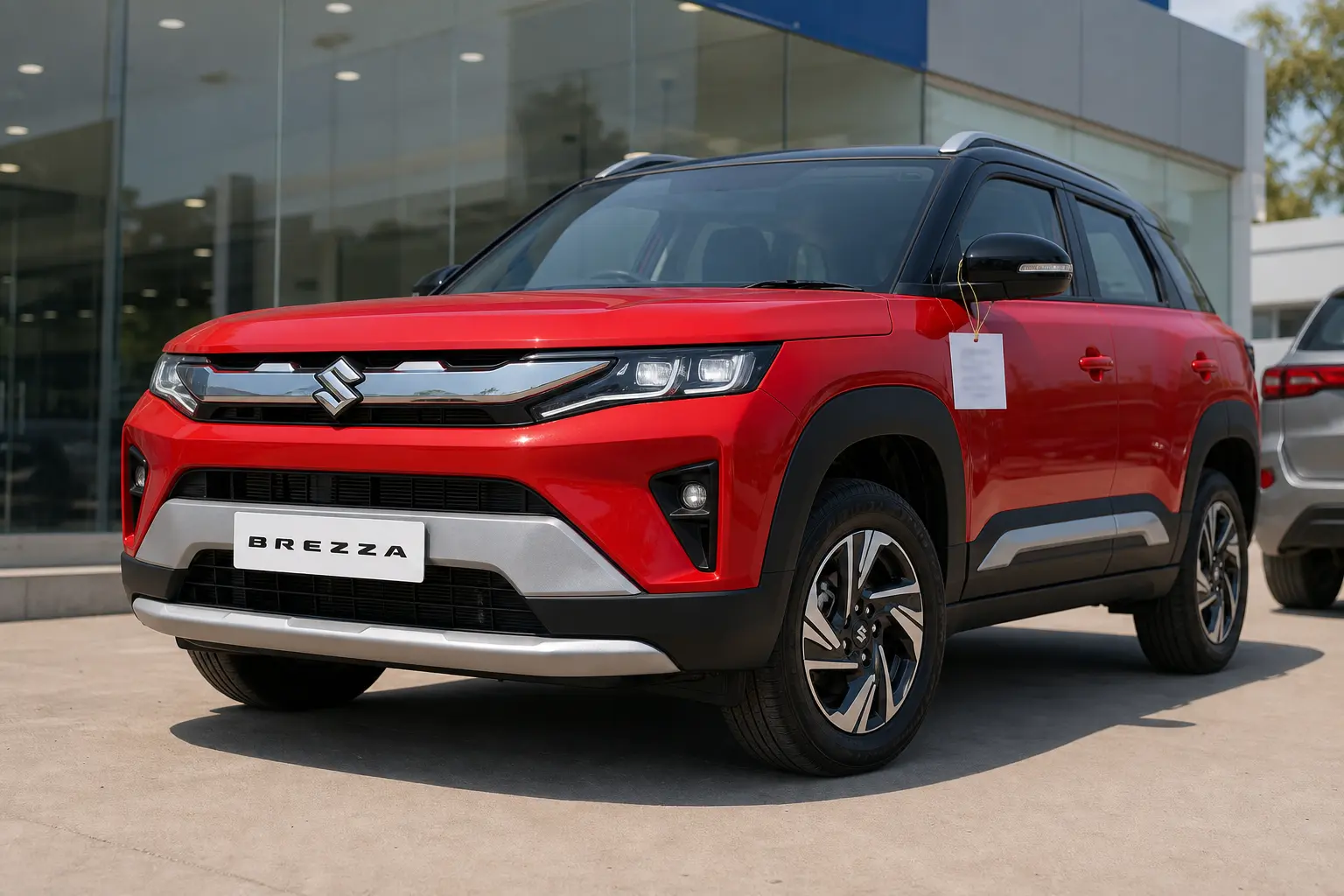
 Maruti Suzuki’s facelifted Brezza starts at Rs 7.40 lakh ex-showroom (about $8,400), nearly a lakh below the SUV it replaces. That drop did not come from cheaper steel or a trimmed options list. It came from a new 1.0-litre turbo-petrol engine built small enough to land inside India’s lower tax bracket for compact cars.
The second-generation Brezza, on sale since 2022, got its first major update last Friday, July 24. Styling changes are minor. The tax math underneath them is not, and it explains why the Brezza’s cheapest, newest engine now costs less than its oldest one.
Four Variants, Three Engines, One Price List
Maruti sells the updated Brezza in four trims, LXI, VXI, ZXI and ZXI Plus, spread across three powertrains: a 1.5-litre naturally aspirated petrol, the same engine running on compressed natural gas (CNG), and the new 1.0-litre turbo-petrol. Automatic transmission is limited to the 1.5-litre petrol.
| Variant | Petrol MT | Petrol AT | Petrol + CNG MT | Turbo-Petrol MT |
|---|---|---|---|---|
| LXI | Rs 8.30 lakh | Not offered | Rs 9.30 lakh | Rs 7.40 lakh |
| VXI | Rs 9.26 lakh | Rs 10.61 lakh | Rs 9.99 lakh | Rs 8.55 lakh |
| ZXI | Rs 10.50 lakh | Rs 11.85 lakh | Rs 11.50 lakh | Rs 9.85 lakh |
| ZXI Plus | Not offered | Rs 13.55 lakh | Not offered | Rs 11.16 lakh |
All figures are ex-showroom, pan-India, for single-tone paint. A dual-tone finish with a black roof adds roughly Rs 14,000 to Rs 20,000 depending on trim. The range tops out at Rs 13.70 lakh for a dual-tone ZXI Plus automatic.
Why the Newer Engine Costs Less
India overhauled its Goods and Services Tax (GST) structure on September 22, 2025. The reform, which the government’s own broadcaster credited with lifting the wider automobile sector, scrapped the old system of a 28% base rate plus a compensation cess of 1% to 22%, which pushed effective car taxes as high as 50%.
In its place sit two flat slabs. Small cars now clear customs at 18%. Everything else sits at 40%.
- GST 2.0 small-car test – a petrol engine no larger than 1,200cc or a diesel no larger than 1,500cc, in a body no longer than 4,000mm, qualifies for the flat 18% rate. Fail either test and the vehicle moves to the 40% slab, regardless of length.
The outgoing Brezza’s 1.5-litre engine runs past that cc line, so it never qualified. Even after the government cut the small-car levy to a flat 18% last September, the old Brezza’s cheapest variant stayed at Rs 8.26 lakh, taxed at 40% along with every other trim. The new 1.0-litre turbo fixes that by simply not exceeding 1,200cc. The rule tracks displacement, not induction type. Tata gets the same result on the Nexon with a 1.2-litre turbo engine that stays just under the same line.
The 1.5-Litre Engine Still Pays the Old Tax Rate
Maruti did not drop the 1.5-litre naturally aspirated engine. It just left it in the 40% bracket. That produces an odd pairing: the older, less powerful engine now costs more than the newer, stronger one at every trim.
The 1.5-litre unit makes 103 PS and 139 Nm, with a mild-hybrid system, and pairs with either a 6-speed manual or 6-speed automatic. The new 1.0-litre turbo, also mild-hybrid, makes 110 PS and 170 Nm but comes only as a manual. Comparing manual-to-manual, the turbo undercuts the naturally aspirated engine by Rs 90,000 on the LXI, Rs 71,000 on the VXI and roughly Rs 65,000 on the ZXI.
More power, more torque, lower price. The trade-off shows up in fuel efficiency, where the 1.5-litre still leads: 21.09 kmpl (ARAI-claimed, LXI and VXI manual) against 20.47 kmpl for the turbo. The CNG version, still built on the 1.5-litre block and priced above both petrol options at every trim, gets no such tax relief and instead leans on running costs, claiming 26.90 km/kg.
Beyond the Engine Bay
The facelift’s visible changes are modest next to the tax story, but they are real. Maruti reworked the front fascia with a slimmer chrome grille, sculpted bumpers and triangular fog lamp surrounds, added new 16-inch alloy wheels, and revised the rear bumper. Inside, the dashboard keeps its upright layout with a floating touchscreen, now larger, alongside gloss black steering wheel inserts and winged rear headrests.
- 10.1-inch touchscreen infotainment with wireless Android Auto and Apple CarPlay, plus a wireless phone charger
- 64-colour ambient lighting and a climate control panel borrowed from Maruti’s Victoris
- PM 2.5 air filter with an AQI display and a single-pane sunroof
- Level 1 driver assistance: rear cross traffic alert, blind spot warning and safe exit warning
- Front parking sensors, a tyre pressure monitoring system and a 360-degree camera, joining 6 airbags, electronic stability control and hill hold assist
The SUV carries a 5-star Bharat New Car Assessment Programme rating, and the CNG variant now uses an underbody-mounted cylinder setup, freeing up boot space that older CNG conversions typically ate into.
Does the Brezza Still Beat Nexon and Venue on Price?
Not quite. The turbo Brezza’s Rs 7.40 lakh entry price undercuts its own past, but the Tata Nexon starts at roughly Rs 7.32 lakh and the Hyundai Venue at roughly Rs 7.26 lakh, both already inside the 18% slab on their base petrol engines. Maruti closed most of the gap. It did not close all of it.
| Model | Entry Price (ex-showroom) | Base Engine | GST Slab |
|---|---|---|---|
| Maruti Brezza (turbo LXI) | Rs 7.40 lakh | 1.0-litre turbo-petrol | 18% |
| Tata Nexon (Smart) | Rs 7.32 lakh | 1.2-litre turbo-petrol | 18% |
| Hyundai Venue (E) | Rs 7.26 lakh | 1.2-litre petrol | 18% |
All three now sit in the same tax slab, which means the fight has shifted back to equipment and discounting rather than displacement. Maruti still lists Mahindra XUV 3XO, Skoda Kylaq, Kia Syros, Kia Sonet, Nissan Magnite, Renault Kiger, Toyota Taisor and its own Fronx among the Brezza’s declared rivals, and most of that field already carries a sub-1,200cc option.
The Same Tax Math Awaits Every Rival
The Brezza facelift is really a template. Any sub-4m SUV still selling only a bigger naturally aspirated engine is quoting 40% GST on its entry trim while cross-shoppers with a small-capacity option quote 18%. That gap, running into lakhs of rupees on paper before discounts, is difficult for a showroom sales pitch to talk around.
Expect the rest of the segment to keep narrowing its engine lineups toward the 1,200cc line rather than away from it, whether through smaller turbo units or downsized naturally aspirated ones. The Brezza spent roughly ten months on the wrong side of that line after the September 2025 reform before this fix arrived. Rivals still without a compliant engine are working against the same clock.
Frequently Asked Questions
Does the Turbo-Petrol Brezza Come With an Automatic Gearbox?
No. The 1.0-litre turbo-petrol pairs only with a 6-speed manual gearbox. The 6-speed torque-converter automatic is available solely on the 1.5-litre naturally aspirated petrol engine, on VXI, ZXI and ZXI Plus.
Is CNG Offered on the Top-Spec ZXI Plus Trim?
No. Maruti caps the factory-fitted CNG option at the ZXI trim. Buyers wanting the range-topping ZXI Plus can only choose the petrol automatic or the turbo-petrol manual.
Which Brezza Engine Gets the Best Mileage?
The CNG variant leads at 26.90 km/kg, ARAI-claimed. Among petrol options, the naturally aspirated LXI and VXI manual top the range at 21.09 kmpl, ahead of the turbo-petrol’s 20.47 kmpl.
How Much Cheaper Is the Turbo Engine Than the Naturally Aspirated One?
Comparing manual gearboxes trim for trim, the turbo-petrol undercuts the 1.5-litre petrol by Rs 90,000 on the LXI, Rs 71,000 on the VXI and roughly Rs 65,000 on the ZXI.
Does the 2026 Brezza Come With a Diesel Engine?
No. Maruti Suzuki has not sold a diesel passenger car in India since 2020, and the Brezza facelift continues that pattern with only petrol, CNG and turbo-petrol options.
 ONGC licence frees Venezuela cash and operatorship talks
  Anthropic Hits $65 Billion Run Rate and Flips the AI Cash Test
  Supreme Court grounds the fare free-for-all with three-week clock
  Gold Nears $4400 as Soft Data Meets Oil Inflation Risk
  Nifty Slips as Zaggle Circuits and Dhoot Debuts Big
  Diesel Crack Tops $100 as Iran Rhetoric Lifts Crude