
 Ishan Crawford
 Reliance Industries, India’s most valuable company, posted a 22% drop in net profit to ₹20,946 crore for the June quarter, even as revenue jumped 25% to ₹3.11 lakh crore and operating EBITDA climbed 11% to ₹47,517 crore. The headline decline traces to one accounting quirk: a one-time gain from selling its Asian Paints stake a year earlier had inflated the base for comparison.
The number that will actually move markets in the coming months sits inside a different set of pages. Jio Platforms, Reliance’s telecom and digital arm, filed its draft IPO prospectus with regulators a month before this earnings report, and this quarter’s results are the closest live preview investors get before bankers lock in a price for what could become India’s largest stock market debut.
Why Did Profit Fall When Revenue Jumped 25%?
Reliance’s net profit fell because other income, a catch-all line covering investment gains and one-off items, dropped 57% to ₹6,550 crore from ₹15,119 crore a year earlier. Strip out that swing and the underlying business actually grew.
The gap traces to a single transaction. In June last year, Reliance exited its entire stake in paint maker Asian Paints, a holding it had built since 2008, in a series of block deals through its affiliate Siddhant Commercials. That divestment alone delivered a one-time ₹8,924 crore gain booked in last year’s June quarter, which pushed that period’s net profit to a then-record ₹26,994 crore and made this year’s comparison look far worse than the operating numbers justify.
Mukesh Ambani, Reliance’s chairman and managing director, framed the quarter differently in his statement.
Reliance has made a steady start to FY27, with all businesses delivering strong operating performance. Our diverse business portfolio has once again demonstrated its resilience in a quarter which witnessed continuing geopolitical tensions and volatile commodity markets.
Ambani, in the same statement, also pointed to Moody’s raising Reliance’s foreign currency debt rating to Baa1 during the quarter, a signal of balance sheet strength that sits awkwardly beside a 22% profit headline. The EBITDA margin still shrank, falling 200 basis points to 15.24% from 17.25%, evidence that even after adjusting for the one-off, cost pressure was real.
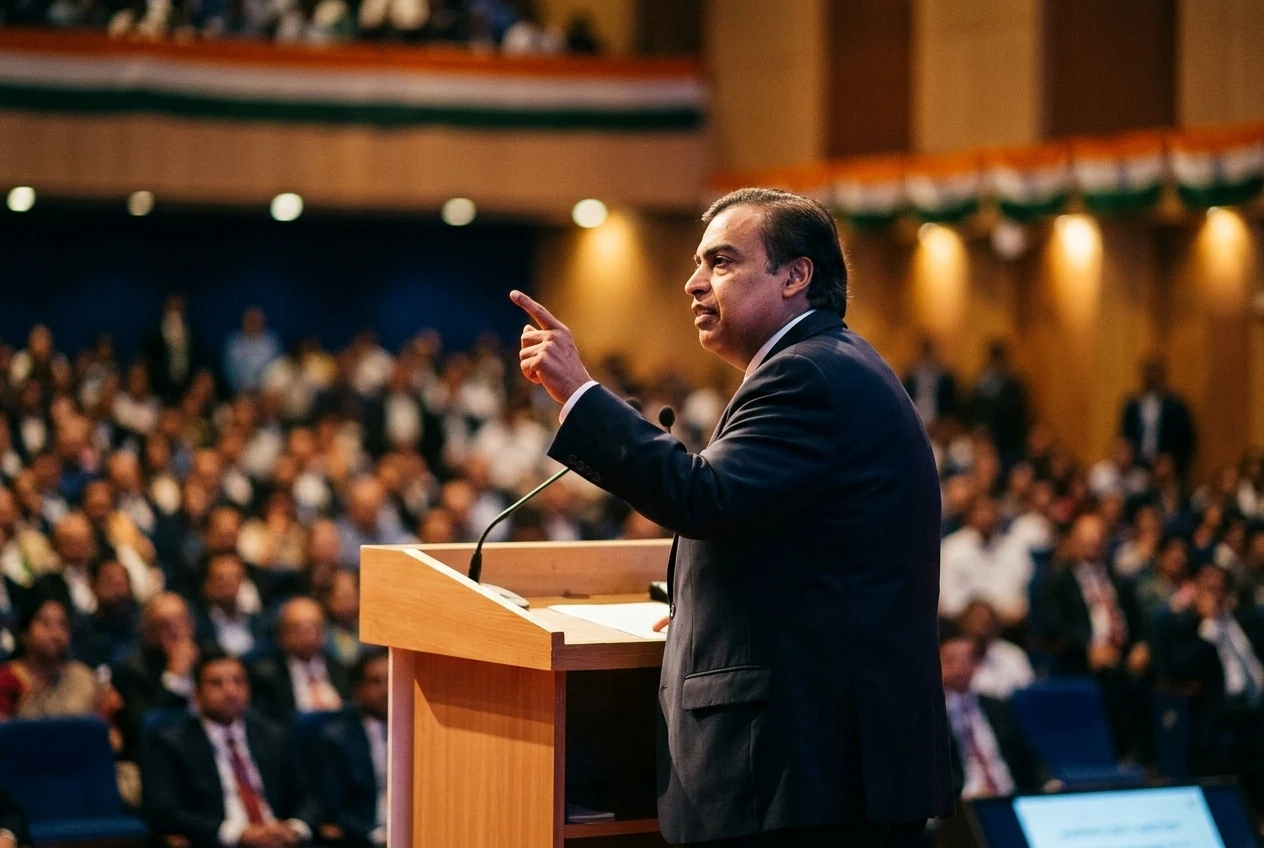
Jio Platforms Just Filed Its Last Report Card Before Going Public
Jio Platforms reported a net profit of ₹7,764 crore, up 9% from ₹7,110 crore a year ago. Its operating revenue climbed 11.8% to ₹39,173 crore, subscribers grew 7.1% to 533.3 million, and average revenue per user rose to ₹215.6 from ₹208.8.
Those numbers now carry extra weight. Jio Platforms filed its draft red herring prospectus with India’s markets regulator on June 19, proposing a fresh issue of up to 27 crore shares with no existing investor selling down, and proposed selling 270 million new shares to raise roughly ₹37,700 crore, close to $4 billion. Bankers have floated valuations for the company ranging from around $130 billion to as high as $180 billion.
The company also replaced its CEO with Pankaj Pawar in March, swapping out Kiran Thomas ahead of the listing. Akash Ambani, Reliance Industries digital arm’s managing director, used his own statement to describe the moment as more than a routine quarter.
As we embark on our next phase of journey to be a publicly listed company in India, we will continue to maintain our deep tech focus and democratise access to digital connectivity and digital services in India and globally.
Akash Ambani, Managing Director of Jio Platforms, made that statement alongside the Q1 results. His siblings Isha and Anant Ambani sit on the Jio Platforms board as the IPO process moves forward, alongside their father as chairman.
The IPO Timeline Still Has Blank Spaces
Reliance has confirmed the shape of the offering. It has not confirmed when shares actually start trading.
- What we know: Jio Platforms filed its draft prospectus on June 19, the same day Ambani announced it at Reliance’s annual shareholder meeting, structured as a full fresh issue rather than a sale of existing shares.
- What we know: Up to ₹27,500 crore of the proceeds are earmarked to repay debt at Reliance Jio Infocomm, the telecom operating unit, with the rest going toward general corporate purposes.
- What we know: Pankaj Pawar runs day-to-day operations as chief executive, while Akash Ambani holds the managing director title investors will see on the prospectus cover.
- What’s unconfirmed: Neither the price band nor a firm listing date has been set; both wait on the regulator’s review and a later book-building process.
- What’s unconfirmed: The final valuation remains a moving target between bank estimates, with a gap of tens of billions of dollars still separating the low and high ends.
- What’s unconfirmed: Regulators sought clarifications on the draft prospectus on June 25, a routine review step, but its timeline will decide whether the listing lands this quarter or slips later into the year.
Jio’s prospectus filing also revealed ambitions well beyond a phone bill. The company has pitched an agentic AI platform predicting network faults called JioBrain, alongside plans to license the technology to telecom operators abroad, a detail that widens the pitch to public investors well past connectivity.
Retail’s Delivery-Speed War Is Costing Margin
Reliance Retail’s net profit fell 14% to ₹2,806 crore from ₹3,271 crore, even as revenue from operations rose 8.2% to ₹79,745 crore. EBITDA margin contracted 80 basis points to 7.9%, and the company pointed to one specific cause: the cost of building out hyperlocal delivery.
Isha Ambani, Reliance Retail’s executive director, described the quarter as steady rather than strained.
“Reliance Retail delivered resilient performance in Q1 FY27, with growth across the key consumptions baskets,” she said in the earnings release, adding that the company’s “expanding customer base, widest store network, and growing omni-channel capabilities position us well to continue fulfilling every need, every dream, for every Indian, every day.”
The retail arm opened 252 stores in the quarter, taking its total to 20,169 across 78.4 million square feet, while its registered customer base grew 10.6% to 396 million. But the competitive backdrop is getting rougher, and Reliance is not alone in feeling it: Tata-owned fashion retailer Trent posted its own 12% share slide on a revenue miss the same week.
- Ajio Rush, the retailer’s four-hour apparel delivery service, posted 136% quarter-on-quarter order growth.
- JioMart now offers two-hour delivery across roughly 5,500 pin codes nationwide.
- Digital commerce contributed 27.3% of apparel and footwear revenue, up 490 basis points year on year.
- Rivals Blinkit, Instamart and Zepto still promise ten-minute delivery, versus JioMart’s thirty-minute hyperlocal model.
Reliance itself was direct about the trade-off in its investor presentation, describing the build-out of hyperlocal infrastructure as a near-term drag on margin in exchange for scale later. That is a bet on future share, paid for with today’s profit.
A Four-Year High in Refining Margins
The oil-to-chemicals division, Reliance’s original business, delivered the one part of this report with no asterisk attached. Segment revenue rose 30% to ₹2,01,803 crore and EBITDA rose 17.2% to ₹17,010 crore, a four-year high, driven mainly by a 54.1% jump in crude oil prices and stronger transportation fuel cracks.
It was not a clean win. Reliance said in its statement that high crude premiums, along with higher freight and insurance costs, curtailed how much of that margin it could actually capture. The reintroduction of the Special Additional Excise Duty, a windfall levy on diesel, petrol and jet fuel, also cut into domestic margins, and the company diverted propane and butane toward LPG output to hold down retail fuel prices for consumers, absorbing the cost itself. Readers who want the segment’s fuller mechanics, including how crude sourcing and product placement shifted through the quarter, can find a deeper breakdown of the refining swing already published on this site.
The Market Is Already Pricing the Jio Listing
| Business Segment | Key Q1 FY27 Figure | Year-on-Year Change | Profit Metric |
|---|---|---|---|
| Reliance Industries (consolidated) | Revenue of ₹3.11 lakh crore | Up 25% | Net profit ₹20,946 crore, down 22% |
| Oil to Chemicals | Segment revenue ₹2,01,803 crore | Up 30% | EBITDA ₹17,010 crore, up 17.2% |
| Jio Platforms | 533.3 million subscribers | Up 7.1% | Net profit ₹7,764 crore, up 9% |
| Reliance Retail | 20,169 stores across 78.4 million sq ft | 252 stores added | Net profit ₹2,806 crore, down 14% |
Reliance shares closed 2.36% higher at ₹1,327 the day the results landed, a move that priced in ahead of the print rather than reacting to it. Equirus Securities had already upgraded the stock to “Long” from “Add” with a September 2027 target of ₹1,586, arguing that downside risk looked largely priced in while catalysts, including the Jio listing and new energy contributions, were still ahead.
Jio Financial Services, a separate company Reliance spun off in 2023 and unrelated to the Jio Platforms IPO, posted a profit that doubled the same day, and its shares rallied separately on that news. The two Jio names are easy to confuse and increasingly worth telling apart, since one is already trading and the other is still months from its first tick on an exchange.
Frequently Asked Questions
When will the Jio Platforms IPO actually list?
Jio Platforms filed its draft prospectus on June 19, 2026, but neither a price band nor a firm listing date has been set. SEBI sought clarifications on the filing on June 25, a routine part of its review, and Reliance has said only that it intends to complete the listing within the current financial year.
How big is the Jio Platforms IPO expected to be?
Jio Platforms plans to raise about ₹37,700 crore, close to $4 billion, by selling 27 crore freshly issued shares, roughly 2.9% of its post-listing equity. At the top of banker estimates, it would surpass Hyundai Motor India’s ₹27,870 crore 2024 offering to become India’s largest-ever IPO.
Is Jio Financial Services connected to the Jio Platforms IPO?
No. Jio Financial Services is a separate company that Reliance demerged and listed in 2023, with its own board and its own results released the same day as RIL’s. Jio Platforms, the telecom and digital arm heading toward its own listing, is roughly 66% owned by Reliance alongside global investors like Meta and Google from a 2020 fundraising round.
What is driving Reliance Consumer Products’ growth this quarter?
Reliance Consumer Products, the FMCG arm demerged from Reliance Retail Ventures effective April 1, more than doubled its gross revenue to ₹8,600 crore for the quarter. Its Campa beverages brand generated ₹2,900 crore in sales alone, already topping half of its entire FY26 total in one quarter, while the Independence daily essentials brand added ₹3,200 crore.
How many of Jio’s subscribers are on 5G?
Jio counted 285 million True5G subscribers as of the June quarter, according to reporting on the results, out of a total subscriber base of 533.3 million. That means more than half of Jio’s customers have already migrated to its newest network, ahead of the company’s push to bring 5G to its entire base by 2030.
Disclaimer: This article is for informational purposes only and does not constitute investment advice; stock prices, valuations and analyst estimates cited here change frequently, and readers should consult a qualified financial adviser before making investment decisions.
 ONGC licence frees Venezuela cash and operatorship talks
  Anthropic Hits $65 Billion Run Rate and Flips the AI Cash Test
  Supreme Court grounds the fare free-for-all with three-week clock
  Gold Nears $4400 as Soft Data Meets Oil Inflation Risk
  Nifty Slips as Zaggle Circuits and Dhoot Debuts Big
  Diesel Crack Tops $100 as Iran Rhetoric Lifts Crude