
 Ishan Crawford
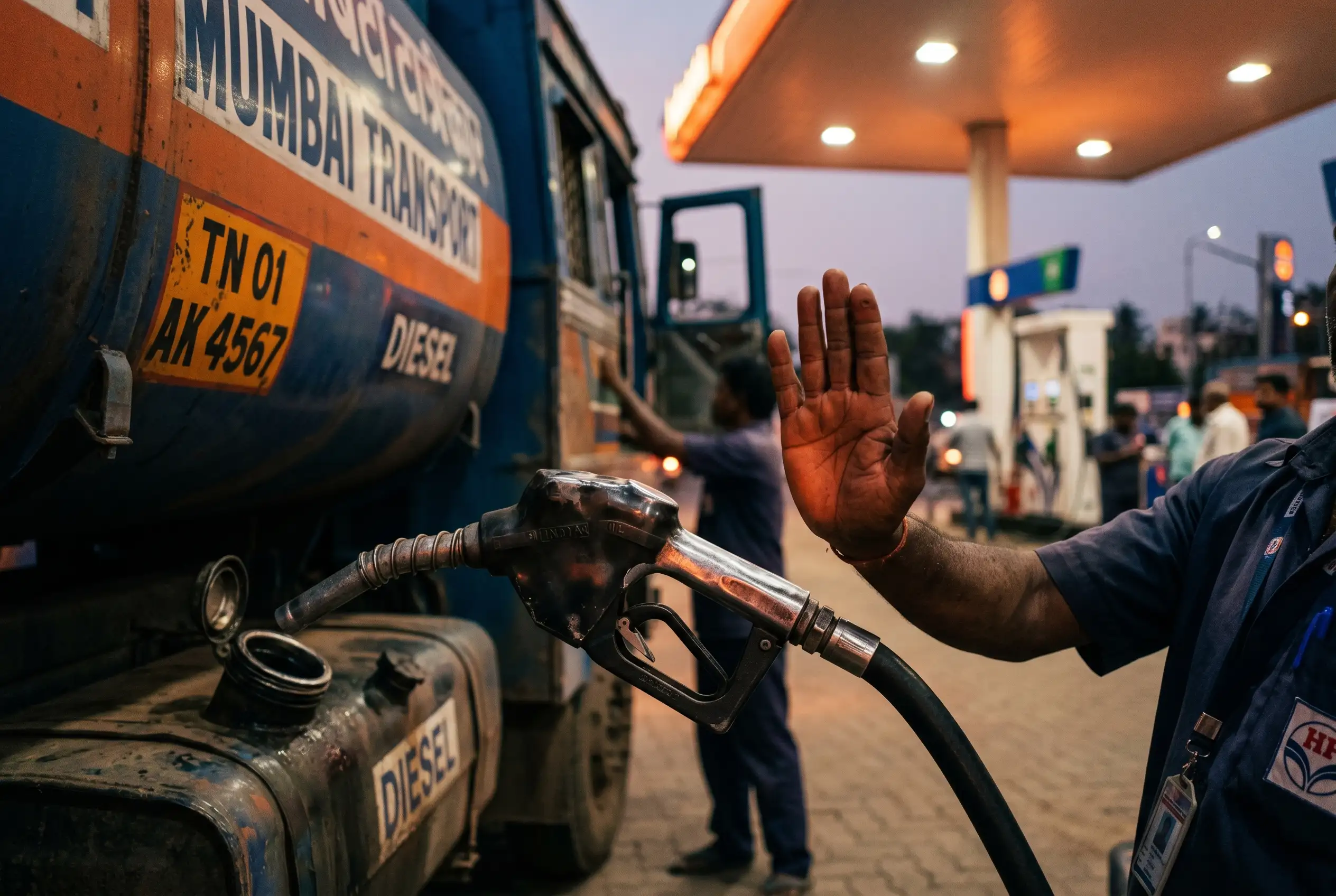
 India has barred industrial, commercial and institutional users from buying petrol and diesel at retail fuel pumps under a 90-day order issued by the Ministry of Petroleum and Natural Gas on June 11, 2026. The Motor Spirit and High Speed Diesel (Temporary Regulation of Supply through Retail Outlets) Order, 2026 also caps retail diesel sales at 200 litres per customer or vehicle per day and bars resale of the fuel. It cites ‘abnormal’ sales growth at retail outlets in some regions, driven by industrial users migrating from the bulk channel. Violations are punishable under the Essential Commodities Act.
The order closes an arbitrage that had industrial diesel buyers saving about ₹40 a litre by filling up at retail pumps in Delhi. That gap was bleeding state oil marketing companies of ₹600-700 crore a day on under-recoveries, according to the petroleum ministry. The price architecture that created the gap is still in place, and the four price hikes since mid-May have narrowed the per-litre deficit without closing it.
The Four Clauses in the New Order
The order, formally the Motor Spirit and High Speed Diesel (Temporary Regulation of Supply through Retail Outlets) Order, 2026, was issued by the Ministry of Petroleum and Natural Gas on June 11, 2026. It empowers public-sector oil marketing companies and other authorised fuel retailers to enforce the new restrictions. State governments and Union Territories have been told to act against hoarding, black marketing, unauthorised procurement and diversion of fuel supplies. The framework runs for an initial period of up to 90 days at a time, with the option to extend through a fresh government order.
Diesel sales at retail outlets are restricted to vehicle fuel tanks or containers approved by the Petroleum and Explosives Safety Organisation, with a cap of 200 litres per customer or vehicle per day. Diesel bought at retail cannot be resold, according to the order text.
Industrial, commercial and institutional users must now source petrol and diesel from their own consumer pumps, not retail outlets. ‘The Government may by a special order exempt any consumer, class of consumers, area, transaction, or category of transactions from all or any of the provisions of this Order,’ the notification reads. Any violation is punishable under the Essential Commodities Act, 1955.
| Restriction | What it covers |
|---|---|
| Industrial, commercial, institutional users barred from retail outlets | Petrol and diesel, effective immediately, for up to 90 days |
| Diesel purchase cap | 200 litres per customer or vehicle per day, into vehicle tank or PESO-approved container only |
| Resale bar | Diesel bought at retail cannot be resold |
| Penalty | Action under the Essential Commodities Act, 1955, by state and UT administrations |
Where the Retail Pump Stops Looking Cheap
The order’s reach goes back to a single number on a Delhi price board. Diesel at state-run petrol pumps costs ₹95.20 a litre in the capital, while bulk diesel sold to industrial users is priced at ₹134.50 a litre in the same city. Industrial diesel is about ₹40 per litre more expensive than the one sold at retail outlets, the government has noted. That gap is the arbitrage the order now closes. It opened up because state-run oil marketing companies held retail prices steady while bulk channel prices moved with international crude.
The migration showed up in monthly sales. In May, the three state-owned firms, Indian Oil Corporation (IOC), Bharat Petroleum (BPCL) and Hindustan Petroleum (HPCL), saw a 4.8 per cent jump in petrol sales and a 6.4 per cent surge in diesel. Private fuel retailers saw the reverse: high-speed diesel offtake across their retail and bulk channels fell by approximately 38 per cent in May, the petroleum ministry said, with the volume shifting to PSU pumps. Bulk customer volumes at the state-run OMCs dropped by about 29 per cent in the same month.
| Fuel and channel | Delhi price per litre | Pricing method |
|---|---|---|
| Petrol, retail pump | ₹102.12 | Administered cushion |
| Diesel, retail pump | ₹95.20 | Administered cushion |
| Diesel, bulk industrial | ₹134.50 | International-linked, fortnightly reset |
Industrial consumers who divert their purchases from the industrial channel to the retail pump capture this cushion at the cost of the ordinary citizen.
The Union petroleum ministry put that line in a statement to industry associations this week, as the order was being prepared.
The Daily Loss Bleed at State OMCs
Under-recovery is the gap between what an OMC pays for fuel and what it charges at the pump, after the cushion. As of June 8, state-run OMCs were absorbing ₹30 on every litre of diesel sold and ₹6 per litre on petrol, Praveen Khanooja, Additional Secretary at the Union Ministry of Petroleum and Natural Gas, said at the bi-weekly inter-ministerial briefing on the West Asia situation. The figures cover only the two transport fuels; domestic LPG is also sold below import cost and feeds into the same daily loss number.
Across petrol, diesel and LPG, Indian OMCs are absorbing daily losses in the range of ₹600-700 crore, Khanooja told reporters on June 8. The combined exposure of Indian Oil, Bharat Petroleum and Hindustan Petroleum to that gap is the largest single cost in the order’s backstory. It explains why a localised shortage at a retail pump in a particular district is treated as a strategic problem, not a logistical one. The order is the policy lever the ministry reached for to keep the cushion intact for ordinary buyers.
Since May 15, the same three firms have raised petrol and diesel prices four times, adding up to a cumulative ₹7.5 per litre in Delhi. The last of those hikes lifted petrol by ₹2.61 to ₹102.12 a litre and diesel by ₹2.71 to ₹95.20 a litre in the capital.
Under the existing two-tier price architecture, retail prices are administratively cushioned by the marketing companies’ upstream and downstream margins, while bulk diesel and aviation turbine fuel reprice fortnightly against international actuals. When global crude is calm, the two channels track each other closely. When crude lifts, the bulk channel rises in step and the retail channel does not. The West Asia crisis that began in late February pushed international crude above $100 a barrel and widened the spread. The current order intervenes on the demand side, by closing the retail channel to industrial buyers; it does not change the price architecture that created the spread.
- Under-recovery on diesel: ₹30 per litre (Ministry of Petroleum and Natural Gas, June 8, 2026)
- Under-recovery on petrol: ₹6 per litre (June 8, 2026)
- Daily OMC losses, petrol + diesel + LPG: ₹600-700 crore (June 8, 2026)
- Cumulative price hike in May: ₹7.5 per litre across four tranches
- Delhi retail diesel price: ₹95.20 per litre
Why the Retail Cushion Started to Crack
The cushion that retail fuel buyers in India have enjoyed for decades is the by-product of a price structure that puts the buffer on the OMC, not the budget. When the West Asia crisis began in late February 2026, that buffer went from comfortable to costly. State-run OMCs held pump prices unchanged into mid-May, absorbing a gap that grew as international crude moved past $100 a barrel.
The pressure point is the Strait of Hormuz, through which a large share of India’s imported crude transits. As of June 8, Brent crude futures were trading at $94.83 per barrel, having pared from an intra-day high of $98.07 amid renewed West Asia tensions, according to the bi-weekly briefing. By June 12, Brent had fallen to $86.42 a barrel on reports that the United States and Iran were moving toward a draft agreement that could lift oil sanctions and reopen the strait. Brent crude price as of June 12 shows the drop extending a string of volatile sessions. The Hormuz price shock in oil markets tracks the supply picture that drove the order.
Defence Minister Rajnath Singh, who heads the informal Group of Ministers on West Asia, said this week that the fuel supply situation in the country is normal currently and asked citizens to avoid panic purchases of petrol, diesel and LPG. The IGoM’s sixth meeting reviewed the evolving situation in the conflict and assessed India’s preparedness. India’s fertilizer availability for the kharif season remains comfortable despite West Asia disruptions, with stocks at more than 51 per cent of projected seasonal demand.
How the Enforcement Net Is Being Built
Public-sector oil marketing companies and authorised fuel retailers are now responsible for keeping industrial, commercial and institutional users off the retail forecourt. State governments and Union Territory administrations have been told to act against hoarding, black marketing, unauthorised procurement and diversion of fuel supplies. District-level monitoring committees, surprise inspections at retail outlets and dealer audits are the operational levers. The 2022 diesel run-up used a similar toolkit, with most cases settled through stock surrender and dealer warnings rather than full prosecution.
The petroleum ministry has flagged four specific malpractices for enforcement action under the Essential Commodities Act. The bigger blast radius is the resale bar, which turns the 200-litre daily cap from a per-transaction limit into a per-buyer limit. Any fuel bought at retail must stay with the buyer, and the buyer’s identity has to be traceable.
- Bulk procurement routed through retail pump networks rather than the industrial channel.
- Unauthorised stocking above quantity caps fixed by state-level control orders.
- Black marketing of petroleum products outside licensed dealer routes.
- Diversion of cargoes meant for the public distribution system into private resale.
The Price Architecture Behind the Order
The order intervenes on the demand side, by closing the retail channel to industrial buyers. It does not change the price architecture that created the spread in the first place. Retail prices are still administered through the OMC cushion; bulk prices still move with international crude. Industrial fuel diversion bleeding state OMCs has been the explicit concern in every petroleum ministry statement since the May hikes. The four May price hikes trimmed the under-recovery; they did not close it.
Official under-recovery figures cited on June 8 show the daily OMC loss across petrol, diesel and LPG in the ₹600-700 crore range. The June 8 briefing quotes from the petroleum ministry give the per-litre numbers. On April 23, the same ministry had cited under-recoveries of about ₹20 per litre for petrol and ₹100 per litre for diesel. The May 15-26 price hikes trimmed those figures to ₹6 on petrol and ₹30 on diesel by early June.
The order also reads as a signal about the rest of the fuel stack. India’s 30-day strategic LPG reserve order in June set the same template: protect the consumer price through supply-side intervention rather than a fresh price hike. The 90-day horizon of the new fuel order is the time the government has bought itself to decide how long the cushion holds.
Frequently Asked Questions
What does the June 11, 2026 order actually do?
It bars industrial, commercial and institutional users from buying petrol and diesel at retail fuel outlets and directs them to source fuel from their own consumer pumps. Retail diesel is also capped at 200 litres per customer or vehicle per day, and any diesel bought at retail cannot be resold. The framework runs for an initial period of up to 90 days.
What is the 200-litre daily cap on diesel?
The order limits retail diesel sales to 200 litres per customer or vehicle per day. The fuel must be dispensed only into a vehicle fuel tank or a container approved by the Petroleum and Explosives Safety Organisation (PESO). The cap applies regardless of whether the buyer is an individual or a business.
Can industrial users still get diesel from retail outlets under any conditions?
The order allows the government, by special order, to exempt any consumer, class of consumers, area, transaction, or category of transactions from the new restrictions. As written, industrial users are expected to source from their own bulk or consumer pumps.
How long does the order stay in force, and can it be extended?
The restrictions are in force for an initial period of up to 90 days from June 11, 2026. The government may extend the framework through a fresh order.
What is the penalty for violating the order?
Any violation is punishable under the Essential Commodities Act, 1955, and the related petroleum control orders. State governments and Union Territory administrations are responsible for action against hoarding, black marketing, unauthorised procurement, and diversion of fuel supplies.
 moto g77 POWER Launches in India at Rs 23,999 With 7,000mAh Battery
  Beats Power Pink Woven Cables: Specs, Price, and Color Match Play
  Redmi Note 17 Series Confirmed for July 14 China Launch
  Meta’s Glasses Update Guards the Camera, Not the Bystander
  India’s Retail GCC Hub Now Outscales Five Peers Combined
  Dundee to Host First Scotland StreetCar Festival Alongside Eco Rally