
 Ishan Crawford
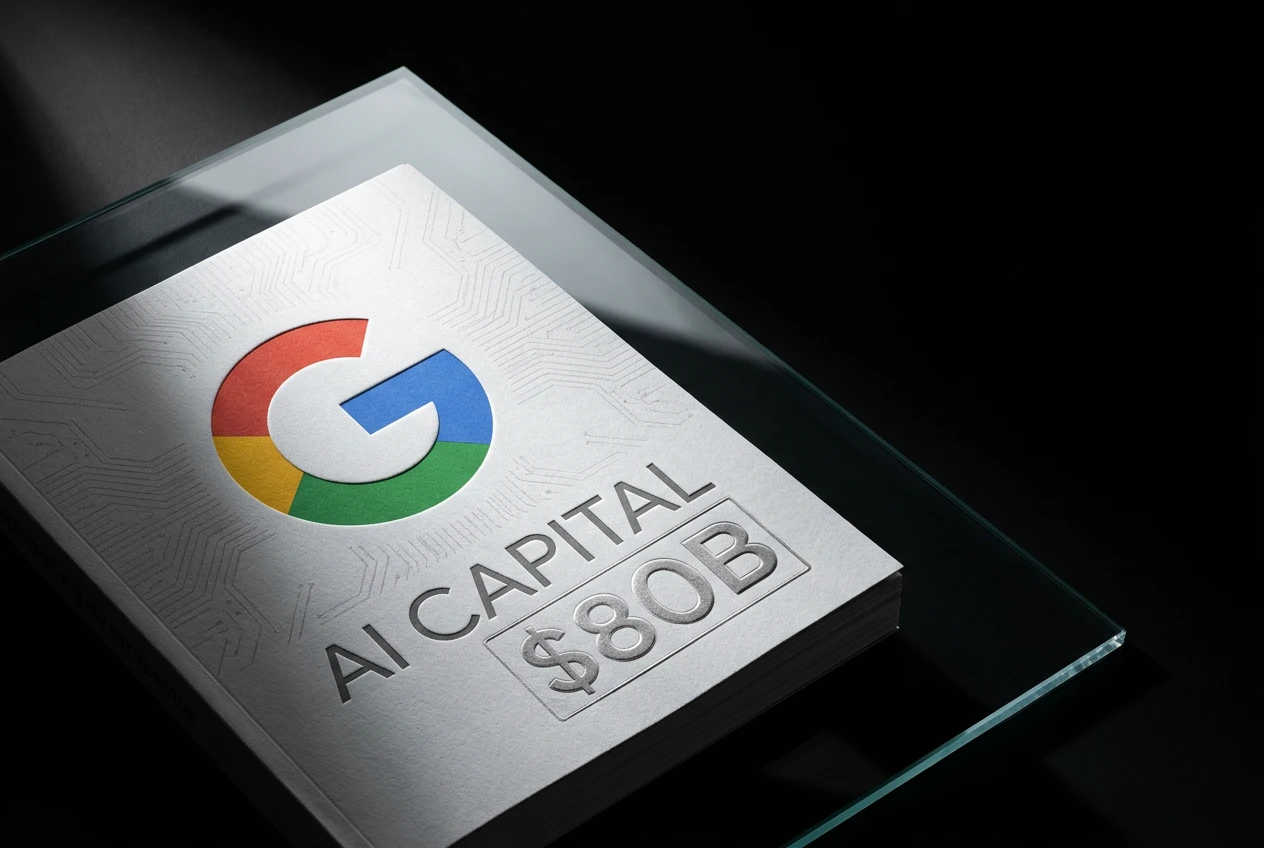
 Google’s $80 billion AI raise is a stock sale by parent company Alphabet to fund data centers, chips and global compute capacity for artificial intelligence (AI). The plan, announced June 1, combines public offerings, a stock sale program and a Berkshire Hathaway private placement as capital expenditures head toward $180 billion to $190 billion.
The structure puts public investors directly into the funding chain for a buildout that has already brought debt issuance, a buyback pause in the March quarter and long-dated commitments around data centers and power.
A Share Sale Built for Compute
In the SEC free writing prospectus, the company said the offerings total $80 billion in expected aggregate amount. Securities and Exchange Commission (SEC, the US securities regulator) filings describe three pieces, with a mix of common stock, preferred-linked depositary shares and a gradual stock sale channel.
- $30 billion in concurrent underwritten offerings, split evenly between depositary shares representing mandatory convertible preferred stock and Class A plus Class C common stock.
- $40 billion in an at-the-market offering (ATM, stock sold over time through sales agents), expected to begin in the third quarter.
- $10 billion in a private placement to Berkshire Hathaway, the Omaha-based holding company, with $5 billion of Class A stock at $351.81 a share and $5 billion of Class C stock at $348.20 a share.
The public offering piece is half common stock and half depositary shares tied to mandatory convertible preferred stock. The preferred shares are due to convert after about three years, with the share count depending on terms set at pricing. Goldman Sachs, J.P. Morgan Securities and Morgan Stanley are joint book-running managers for the underwritten offerings and managers for the ATM leg.
The Funding Stack Behind the Headline
The sale follows a debt phase. In the June 1 filing, the company said it had raised more than $85 billion of debt over the prior year across six major currencies and markets, taking total debt above $100 billion. Its March quarter Form 10-Q listed $79.1 billion of senior unsecured notes at carrying value, plus $11.7 billion of credit facilities.
That balance sheet still carried $126.8 billion in cash, cash equivalents and short-term marketable securities at March 31. The same filing showed $45.8 billion of operating cash flow in the quarter and $35.7 billion of capital expenditures (capex, money spent on long-lived assets such as data centers and servers), primarily for technical infrastructure.
Buybacks were absent in the March quarter. The board’s $70 billion repurchase authorization still had $69.5 billion available at quarter end, but the issuer used financing cash instead: net cash from financing activities was $25.1 billion in the quarter after senior notes were sold.
Cloud Demand Gives the Raise Its Case
The operating numbers give management its sales evidence. Revenue rose 22 percent to $109.9 billion in the March quarter, Google Services revenue rose 16 percent to $89.6 billion and Google Cloud revenue rose 63 percent to $20.0 billion. Cloud operating income was $6.6 billion, up from $2.2 billion a year earlier.
$462 billion is the cloud backlog disclosed in the quarter transcript. Google Cloud backlog nearly doubled sequentially, and just over half is expected to become revenue over the next 24 months. Part of that backlog now includes Tensor Processing Unit (TPU, Google’s custom AI accelerator) hardware agreements for customers using their own data centers.
Consumer demand is also part of management’s pitch. Google reached 350 million paid subscriptions in the quarter, driven by YouTube and Google One, and called it the strongest quarter for consumer AI plans. That puts subscription pricing beside the data center budget; CN Media’s Google Gemini price cuts analysis traced how the company used Google I/O to lower Gemini costs for customers.
A Different AI Financing Race
Google’s plan sits beside the other hyperscalers’ spending schedules. The capital call is showing up across cash flow statements, earnings calls and outlook sections.
| Company | Recent AI Spending Signal | Cash or Funding Detail |
|---|---|---|
| Google parent | Capex guided at $180 billion to $190 billion for the year, with the next year expected to rise significantly. | Equity offerings of $80 billion sit on top of debt raised during the prior year. |
| Microsoft | In Microsoft’s April earnings call, Chief Financial Officer Amy Hood said calendar-year capex should be about $190 billion. | The figure includes about $25 billion from higher component pricing, while the AI business passed a $37 billion annual revenue run rate. |
| Meta | In Meta’s first quarter outlook, capex guidance rose to $125 billion to $145 billion. | The company cited higher component pricing and additional data center costs for future capacity. |
| Amazon | Amazon’s first quarter release said free cash flow fell to $1.2 billion for the trailing 12 months. | The decline was driven mainly by a $59.3 billion increase in purchases of property and equipment, net of proceeds and incentives, primarily tied to AI. |
In that group, the Google parent is adding common stock, preferred-linked securities and an ATM channel to debt and operating cash flow. Microsoft is still capacity constrained. Meta raised its capex range. Amazon’s cash flow statement already carries a heavier property and equipment line.
Data Centers Add Liabilities Before They Open
The assets being financed are slow to arrive. The March quarter filing listed $75.6 billion of future lease payments for data center leases that had not yet commenced, with start dates between 2026 and 2031. It also listed $332.4 billion of material purchase commitments and other contractual obligations, including technical infrastructure, inventory, energy take-or-pay contracts and content licenses.
- At March 31, maximum potential future payments under financial guarantees were $9.0 billion.
- Credit derivatives carried maximum potential future payments of $28.4 billion.
- A separate agreement allowed up to $33.3 billion of future backstops to support data center and energy supply buildout, with a $15.3 billion backstop signed in April.
Power sits in the same chain. The International Energy Agency’s AI energy report said global data center electricity demand grew 17 percent in 2025 and that capital expenditures by five large technology companies topped $400 billion in 2025, with another 75 percent increase set for 2026.
For Google, the power bill shows up in accounting language. Chief Financial Officer Anat Ashkenazi told investors in April that higher technical infrastructure spending would pressure profit and loss through depreciation and data center operation costs such as energy.
Berkshire Takes the Private Placement
Berkshire Hathaway’s private placement is split between $5 billion of Class A stock at $351.81 a share and $5 billion of Class C stock at $348.20 a share. The filing said the investment adds to a position Berkshire has built since the third quarter of 2025.
The structure gives the issuer one named cornerstone buyer while the public offering and ATM program handle the larger capital need. The ATM program is aimed mainly at restricted stock units (RSUs, employee equity awards) and related tax withholding. The company will deliver shares net of taxes to employees, use corporate cash to pay the tax amount, then issue shares through the ATM program for equivalent proceeds.
The depositary shares carry a second clock. Each series represents a fractional interest in mandatory convertible preferred stock with a $1,000 liquidation preference per preferred share. Unless converted earlier, the preferred shares are scheduled to turn into Class A or Class C common stock on or about May 15, 2029. Capped call transactions are expected to reduce potential dilution upon conversion, subject to a cap.
Shareholders Meet the New Capex Cycle
For existing holders, the June 1 announcement changes the capital return story immediately. The company raised its quarterly dividend by 5 percent to 22 cents in April, but the March quarter had no repurchases. A large authorization stayed on paper while the balance sheet absorbed debt issuance, Wiz, Intersect and data center commitments.
The financing is also a governance test for management. Investors have usually treated Google’s advertising business as the cash engine funding everything else. The new documents show a company adding equity issuance to debt, operating cash flow and project backstops as AI demand moves from software usage to physical capacity.
CN Media’s coverage of Anthropic’s IPO filing and valuation showed private AI companies lining up for public money. Google’s filing brings the same funding pressure to one of the few companies with a $100 billion revenue quarter and a cash pile above $125 billion.
The ATM program is scheduled for the third quarter; by then, Google’s $80 billion AI raise will be visible through the share count.
Disclaimer: This article is for informational purposes only and does not provide investment advice. Securities offerings, equity dilution and technology-sector stocks involve financial risk. Readers should consult a qualified financial professional before making decisions. Figures are accurate as of publication on June 3, 2026.
 One UI 9’s Privacy Display Fix Reaches Just One Galaxy Phone
  Samsung Drops Its Own Exynos Chip for the Galaxy Watch9 and Ultra 2
  Marathon’s Vault Breaker Arrives as Bungie’s Bigger Bet Keeps Faltering
  Sony’s PlayStation Disc Cutoff Erases the Last Proof of Ownership
  Tesla’s Summer Update Hands Grok the Keys, and Musk’s Empire More Reach
  Apple’s $634 Million Masimo Payment Is Final After Appeal Denial