
 Ishan Crawford
 India’s Cabinet has approved a Rs 10,000 crore (about $1.2 billion) aviation fuel price stabilisation fund, an interest-free advance to state oil companies that holds jet fuel at Rs 75.6 a litre for domestic airlines after a West Asia oil shock drove the market price far above that level. Information and Broadcasting Minister Ashwini Vaishnaw announced the decision in New Delhi on Wednesday.
Read past the relief headline and the structure is a loan. The corpus tops up the oil companies for the gap between that capped price and the global market, and when prices ease the money is clawed back and paid into the treasury. How much it ends up costing taxpayers depends on one thing: whether West Asia crude calms down inside three years.
What the Cabinet Cleared on Wednesday
The Union Cabinet, chaired by Prime Minister Narendra Modi, signed off on one-time budgetary support of up to Rs 10,000 crore, routed as an interest-free advance to the oil marketing companies (OMCs, the three state fuel retailers Indian Oil, Bharat Petroleum and Hindustan Petroleum). Those firms sell aviation turbine fuel (ATF, the kerosene-based fuel that powers commercial jets), and the fund exists to keep what they charge airlines from tracking a runaway import bill.
Vaishnaw blamed the conflict in the Middle East for the spike. By the government’s account, ATF jumped about 2.5 times, from Rs 60.5 a litre in March to Rs 142 a litre in May. Fuel already runs near 40 percent of an Indian carrier’s operating cost, the heaviest single line in the business, and the share fuel takes of global airline costs has climbed industry-wide as crude rose.
- Rs 10,000 crore in interest-free advances to state oil firms, the headline number.
- Rs 75.6 a litre is the capped ATF price for domestic operations.
- 36 months is how long the support runs, with an annual review.
- 77 lakh jobs the government links to aviation and airports.
How the Money Moves From Treasury to OMCs
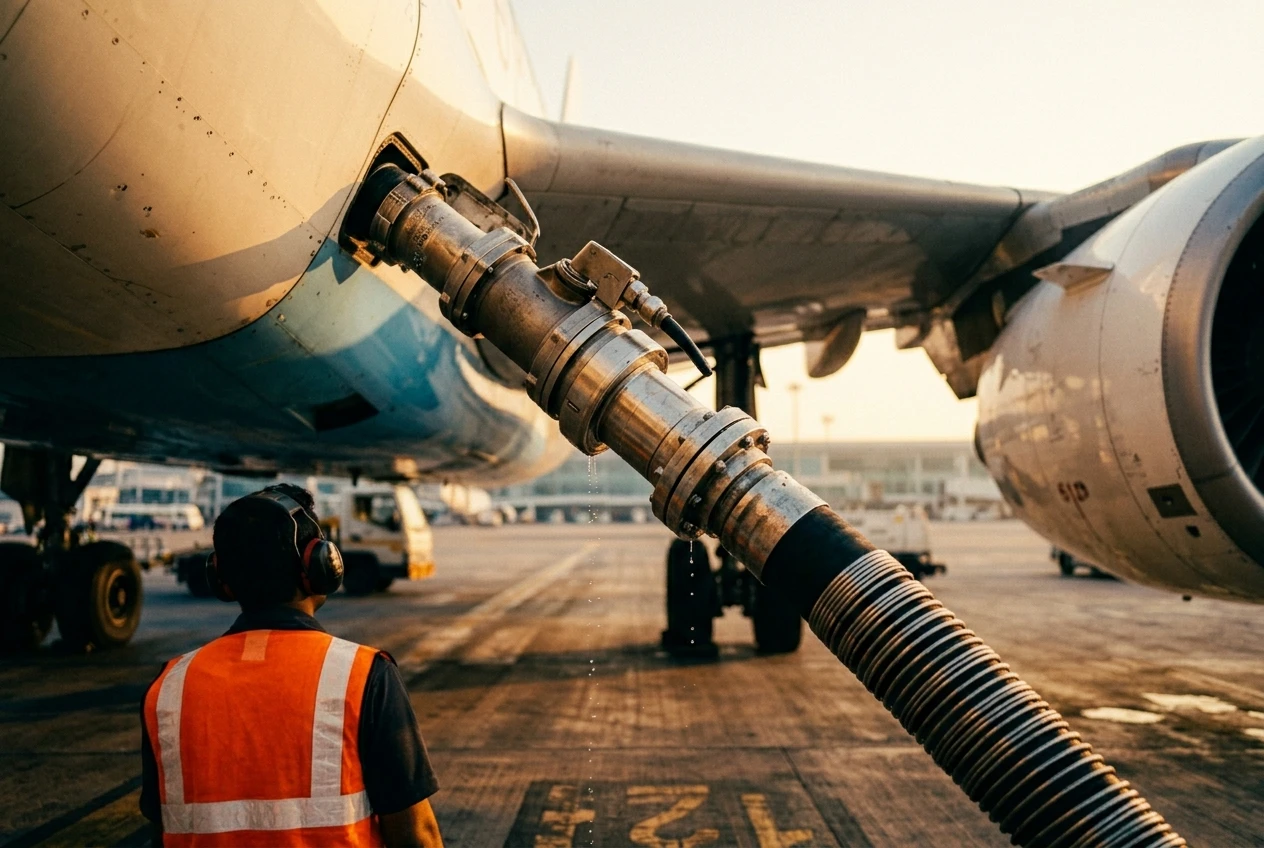
The mechanics matter here, because the advance does not go to airlines and it is not a discount printed on a ticket. It flows to the oil companies through the petroleum ministry’s budget grants, and it only kicks in when the imported fuel costs more than a fixed reference price.
| Price marker | Per litre | What it signals |
|---|---|---|
| ATF, March 2026 | Rs 60.5 | Pre-shock baseline |
| ATF import parity, May 2026 | Rs 142 | West Asia price peak |
| Capped rate for airlines | Rs 75.6 | What domestic carriers actually pay |
The Benchmark Trigger
The government has set a benchmark price for ATF. Whenever the Import Parity Price (IPP, what it costs to land the fuel in India at global rates) sits above that benchmark, the OMCs draw on the corpus to cover the shortfall and charge airlines the lower, stabilised rate. Carriers that want in sign supply agreements and buy their ATF only from these companies for up to three years.
The Clawback Loop
The flow reverses when oil falls. Once the import parity price drops back below the benchmark, the difference is recovered from the OMCs and returned to the Consolidated Fund of India (CFI, the government’s main account). The arrangement keeps running until every rupee of the advance is recovered and settled. At May’s import parity price, the gap the fund has to bridge is roughly Rs 66 a litre on every litre an airline burns.
Why Fuel Broke the Airlines’ Math
For airlines, fuel is the one cost they cannot hedge away in a week. When ATF more than doubles, every long-haul sector that ran on a thin margin tips into the red, and the first reflex is to fly less. Air India had already moved to trim about a fifth of its domestic schedule across the June-to-August window, citing cost and capacity pressure. The doubling itself tracked the wider jet fuel market that IndexMundi logs as a monthly global benchmark.
The international map got harder for a separate reason. With Pakistan’s airspace shut to Indian carriers, flights to Europe, North America and Central Asia route the long way around, burning more fuel per trip at exactly the moment fuel turned expensive. That extra burn is what the government points to when it talks about protecting connectivity to those regions, and it sits on top of the crude run-up that the World Bank’s commodity tracker has been recording since the conflict began.
The squeeze runs down the whole energy chain. The same West Asia disruption that lifted jet fuel has pushed up cooking gas, with state retailers raising commercial LPG cylinder prices for a fourth time since the war started. ATF is simply the line item that hits aviation hardest.
Everything Hinges on the Recovery Clause
This is where the second-order story sits. The advance is interest-free and, on paper, fully recoverable, so the government can present it as costing the exchequer nothing over the life of the scheme. That accounting holds only if the import parity price falls back below the benchmark before the clock runs out.
Run the other case. If West Asia stays disrupted and ATF holds near current levels through the 36-month window, there is no moment when prices moderate, no differential to claw back from the OMCs, and the advance never returns to the Consolidated Fund. At that point the interest-free loan starts to look like a plain fiscal cost, and the annual review becomes the only off-ramp.
Vaishnaw put the intended benefits plainly.
The fund will help stabilise ATF prices for scheduled Indian carriers and will prevent disruption of airline operations. It will also shield air passengers from fare spikes driven by the global price surge.
That shield is the part passengers will feel first. Whether it costs anything to maintain is a question the price of crude will answer over the next three years.
An Echo of the Oil-Bond Years
India has run a version of this before. Through the second half of the 2000s, when global crude spiked and the government held retail fuel below cost, it compensated the OMCs with oil bonds, special securities handed over in place of cash. Those IOUs ran past Rs 1 lakh crore and sat on the books for years, with repayment and interest landing on later budgets.
The new fund flips the direction of that favour. Where the bond era left the state owing the oil companies for a decade, this scheme is built so the oil companies owe the state back once prices fall. The design answers an old criticism that deferred fuel support quietly turned permanent. The catch is the same one as in the 2000s: it works cleanly only if prices come down on schedule.
Who Carries the Float for Three Years
Until any clawback happens, the working capital sits with the OMCs. They front the difference between the market price and the capped rate, financed by an interest-free advance, while their own balance sheets carry the timing risk. That comes on top of other strain; the same companies are already absorbing losses from industrial buyers diverting subsidised retail fuel in the current crunch.
For passengers, the immediate effect is a fare that does not jump with every barrel of Brent. The government lists the wider stakes it says the support protects:
- Stable ATF pricing for scheduled Indian carriers, to keep flights operating through the volatility.
- Protection for the roughly 77 lakh jobs tied to aviation, airports and the services around them.
- Continued air links to Europe, North America and Central Asia, kept viable while the Pakistan reroute adds cost.
For now, the cap is in place and the recovery clock has started. Whether the advance flows back to the treasury or ends up spent is a verdict the oil price will deliver, and the first annual review is when the government finds out which way it is going.
 ONGC licence frees Venezuela cash and operatorship talks
  Anthropic Hits $65 Billion Run Rate and Flips the AI Cash Test
  Supreme Court grounds the fare free-for-all with three-week clock
  Gold Nears $4400 as Soft Data Meets Oil Inflation Risk
  Nifty Slips as Zaggle Circuits and Dhoot Debuts Big
  Diesel Crack Tops $100 as Iran Rhetoric Lifts Crude