
 Ishan Crawford
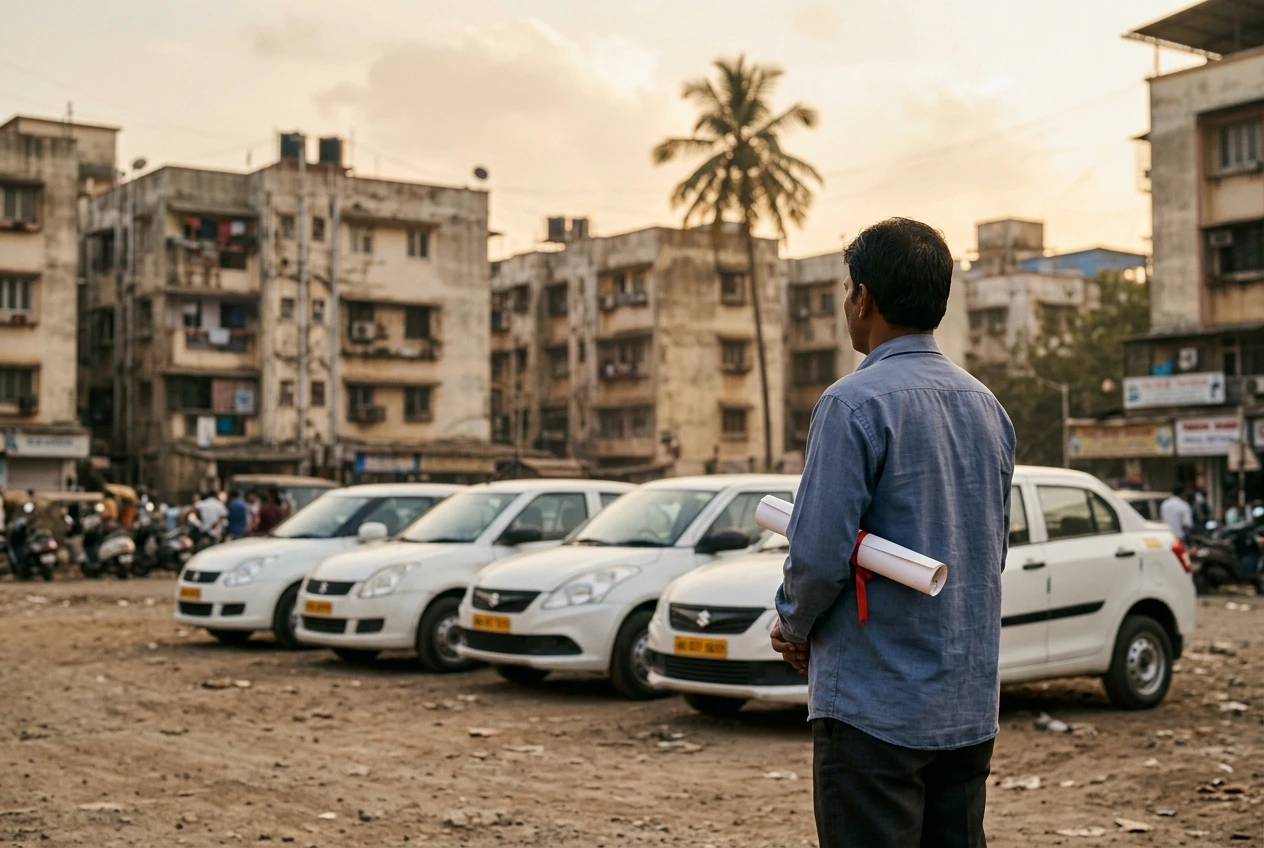
 A Mumbai cab driver with an engineering degree has gone viral for skipping the salaried route, choosing to build a four-car taxi business that now brings in about ₹2 lakh a month (roughly $2,400). The hook is his backstory: after finishing engineering, the jobs on offer paid just ₹20,000 to ₹30,000 a month, so he bought one car instead and kept buying. The clip has been passed around X this week as a Monday-morning pep talk.
It plays as motivation. Underneath the cheerful framing, though, the numbers describe something less flattering about what an Indian engineering degree now buys, and why a growing share of graduates are walking away from the field they trained for.
The Clip That Turned a Salary Slip Into a Pep Talk
The driver told his story to Caleb Friesen, a Bengaluru-based Canadian content creator who films short conversations with ordinary Indians about money and work. The driver said he began with a single vehicle and built from there, the same way, he argued, that large companies grow. He name-checked Reliance, pointing out that even giants start small before they expand.
Asked whether going into business was risky, he did not flinch. Risk, he said, is the price of not spending your life on someone else’s payroll.
You have to take a risk in your life. Otherwise, you work for someone else. After 60, no one will give you a job.
That line, delivered by an unnamed driver in a parked car, did more numerical work than most career advice. It also set up the comparison that makes the clip sting rather than simply inspire: the gap between what his degree was supposed to earn him and what he earns now.
The Math That Made an Engineer Quit the Field
The driver was blunt about why he never took an engineering job. “I have completed my engineering and was getting ₹20,000 to ₹30,000. This is not good,” he said, adding that he felt he had spent far too much on his education to accept offers that small.
Put on an annual basis, those offers of ₹20,000 to ₹30,000 a month work out to roughly ₹2.4 lakh to ₹3.6 lakh per annum. That sits right at the bottom of the current market. Fresher salary surveys for 2026 put core branches such as mechanical, electrical and civil engineering at about ₹4 lakh to ₹6 lakh a year, while graduates from lower-tier private colleges often start at ₹3 lakh to ₹6 lakh. His business income of about ₹2 lakh a month comes to roughly ₹24 lakh a year, gross.
The contrast is stark enough to put in a single frame.
| Measure | The salaried engineering job | The four-car fleet |
|---|---|---|
| Monthly pay | ₹20,000 to ₹30,000 | About ₹2 lakh gross |
| Yearly equivalent | ₹2.4 lakh to ₹3.6 lakh | About ₹24 lakh gross |
| Who you work for | An employer | Himself, plus three hired drivers |
| Career ceiling | Slow increments, job security risk after 60 | Add more cars, scale the model |
Even after costs, the spread holds. The job he turned down would have left him earning a fraction of what the business pays today. For a man who calculated the return on his tuition, the decision read less like a leap of faith and more like arithmetic.
Why 1.5 Million Degrees Chase Too Few Jobs
One driver’s story would be a curiosity if it were rare. It is not. India graduates a vast number of engineers every year, and a large slice of them never work as engineers at all.
The Degree Glut
India produces an estimated 1.5 million engineering graduates a year, churned out by around 3,500 engineering colleges. The bulk of that volume comes from private institutions; by one widely cited breakdown, roughly 85% of graduates emerge from private colleges, many of them unaccredited. That supply has expanded far faster than the number of genuine engineering roles, which is how a qualified graduate ends up looking at offers near minimum-wage territory.
The Employability Gap
Quality is the other half of the problem. Industry assessments by the Confederation of Indian Industry (CII, India’s main industry association) with the skills-testing firm Wheebox found about 64% of engineering graduates were rated employable in 2024, up from 57% the year before, with a figure of 71.5% projected for 2025. By one circulated estimate, only around 10% of the annual cohort land actual engineering jobs, the rest absorbed into IT support, sales, gig work or, like this driver, self-employment. The published India engineering graduate employability data and broader employability rates across Indian degree streams both track the same gap between the number of degrees and the number of jobs that pay like degrees.
That mismatch is the quiet story inside the viral one. When the safe path pays ₹25,000 and the risky path pays several times that, the math nudges capable people out of the profession, as the CII and Wheebox global employability findings imply across the wider graduate pool.
How the Four-Car Fleet Pays
The business itself is simple, which is part of why it works. The driver owns four cars, drives one of them himself, and hands the other three to hired drivers on a revenue-sharing arrangement.
- Each hired driver works a vehicle and collects the daily fares.
- After accounting for fuel and running expenses, the driver pays the owner a fixed share of the day’s earnings.
- The owner pockets that share across three cars, plus his own driving income, for about ₹2 lakh a month gross. Because some vehicles are still under loan, his take-home lands closer to ₹1.7 lakh after EMIs (equated monthly instalments, the fixed loan repayments on the cars).
It is a small fleet operator’s model dressed as a cab-driver story. The leverage comes from owning the assets and renting out the labour, the same structure that lets a single garage owner outgrow a single salaried mechanic.
The Part the Feel-Good Edit Leaves Out
The clip skips the failure rate. For most people behind a wheel in India, the gig economy has been moving the wrong way.
Estimates of owner-driver earnings on platforms such as Uber and Ola now cluster around ₹25,000 to ₹55,000 a month for those with no heavy loan, and far less, sometimes ₹8,000 to ₹30,000, for drivers carrying an EMI or a rental. Many were promised ₹1 lakh or more when they signed up years ago and now struggle to clear ₹500 on a full day after the platform’s cut, which runs from roughly 15% to 30% of each fare. An academic study of cab aggregator driver economics from the Tata Institute of Social Sciences documented exactly that squeeze on drivers’ real incomes.
So the model that made this man ₹2 lakh a month depends on conditions that can turn. It needs cheap, available drivers willing to share their earnings, affordable car loans, and fares that still cover fuel after the platform takes its slice. Tighten any of those and the spread between gross income and EMIs narrows fast.
His success is real. It is also a survivor’s story, the one that goes viral while the drivers who could not clear their loans never get filmed.
What the Comments Section Got Right
The video drew the reaction you would expect, and a few sharper observations than usual. One viewer wrote that the driver had casually delivered the best advice in the clip: “Build your own label.” Another noted that Indian cab drivers “sometimes understand hustle, finance and human psychology better than half the LinkedIn ‘growth gurus.'”
The clip resonates because it inverts the deal a degree was supposed to offer. The promise was that years of study and tuition fees bought a safe, well-paid career. For a large share of India’s graduates, that promise has thinned to a ₹25,000 starting offer, and a parked sedan started to look like the better investment.
If engineering salaries climb back toward what the degree costs, stories like this stay one-off hustle clips. If they keep lagging while a million-plus graduates arrive every year, the next viral video will sound exactly the same, and that, not the ₹2 lakh figure, is the part worth watching.
 One UI 9’s Privacy Display Fix Reaches Just One Galaxy Phone
  Samsung Drops Its Own Exynos Chip for the Galaxy Watch9 and Ultra 2
  Marathon’s Vault Breaker Arrives as Bungie’s Bigger Bet Keeps Faltering
  Sony’s PlayStation Disc Cutoff Erases the Last Proof of Ownership
  Tesla’s Summer Update Hands Grok the Keys, and Musk’s Empire More Reach
  Apple’s $634 Million Masimo Payment Is Final After Appeal Denial