
 Ishan Crawford
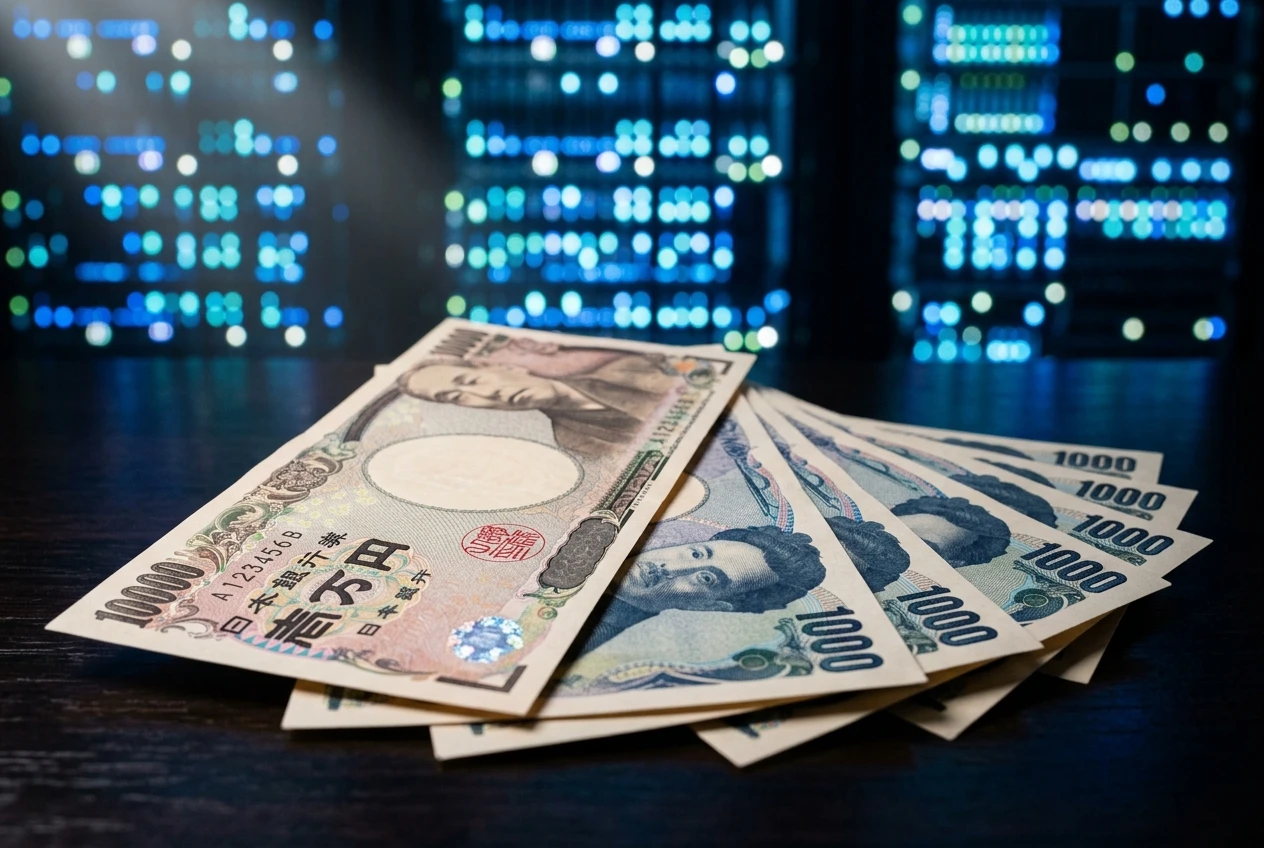
 Japan’s Ministry of Finance (MoF, the government arm that orders currency intervention) sold ¥11.7 trillion ($73.6 billion) to support the yen between late April and late May 2026, the largest single-month yen-buying operation on record, after USD/JPY broke above 160 during the Golden Week holidays. The pair has already drifted back toward 159, and traders are lining up to test that line again this week.
That number reads as proof of Tokyo’s resolve. What it cannot fix is the reason the money keeps leaving: a region-wide artificial intelligence (AI) stock boom is pulling capital out of the yen and into risk assets, and selling dollars does nothing to that flow.
Tokyo Spent a Record Sum and Bought a Few Days
The intervention worked, briefly. When authorities stepped in after the yen slid past 160.72, USD/JPY snapped down to around 155 inside a single session. Within three weeks the pair had retraced most of that move and was trading near 159 again.
The official tally landed Friday. According to the Ministry of Finance’s foreign-exchange intervention disclosures, the campaign ran from April 28 to May 27 and marked the first time Tokyo had entered the market since 2024.
- ¥11.7 trillion ($73.6 billion) in yen-buying between April 28 and May 27
- First intervention since 2024, ending a roughly two-year pause
- USD/JPY snapped to about 155 from 160.72, then crept back toward 159
- The biggest single-month defense of the currency Japan has ever run
For that outlay, Tokyo bought time, not a trend change. The speed of the round trip is the tell. Spending a record sum to move the pair for a handful of sessions is a poor trade when the underlying pressure never lets up, and that pressure has not let up. The same buyers who got faded in early May are back, probing the level that triggered the whole episode.
Why the Rate-Gap Explanation Comes Up Short
The standard story blames the yield gap. Hold Japanese rates near zero while US rates sit high, the logic runs, and money naturally flows to the higher-paying currency. There is real truth in it. The Bank of Japan’s April policy statement left the benchmark at 0.75%, a level set in a split 6-3 vote, with three board members already pushing for a hike.
The Bank of Japan (BoJ, the country’s central bank) has signaled more tightening ahead, but the math is unforgiving. Analysts’ base case is one hike in 2026 and another in 2027, taking the terminal rate to roughly 1.25%. Even that path narrows the gap with US yields only at the margin, and it assumes the BoJ keeps moving while a Middle East conflict clouds its inflation read.
So a rate-led recovery in the yen would need either aggressive hikes the board has shown no appetite for, or a sharp fall in US yields. Neither is on the table while American growth and inflation expectations hold up. The same dynamic surfaced elsewhere this week, with safe-haven demand cracking as yields stayed firm even with regional tension in the headlines.
Rates explain part of the weakness. They do not explain why the yen keeps sliding on days when US yields are flat. That gap is where the second driver lives.
The AI Trade Is Where the Yen Is Leaking
Capital is rotating into Asian equities at a pace that dwarfs the rate story, and almost all of it is chasing AI and semiconductors. That hunger for risk is the quiet engine under the yen’s slide. Investors increasingly fund those positions in the cheap, liquid yen, then deploy the cash into stocks across the region, and the currency leaks lower with every fresh allocation.
| Market | Latest milestone | AI engine |
|---|---|---|
| Nikkei 225 (Japan) | Topped 67,000 for the first time, June 1 | SoftBank up 10.3% in a session |
| KOSPI (South Korea) | Record 8,845, up more than 80% this year | Samsung and SK Hynix near 42% of the index |
| Taiex (Taiwan) | Repeated all-time highs | TSMC alone above 40% of the benchmark |
The concentration is striking, and it is no longer a Japan story. It is a regional one, with the yen serving as the funding currency of choice.
SoftBank Passes Toyota at the Top
On June 1 the Nikkei 225 topped 67,000 for the first time, closing the morning near 67,038 after a high above 67,231. SoftBank Group, the Tokyo-based technology investment company, did most of the lifting, jumping 10.3% and contributing the bulk of the index’s advance.
The move pushed SoftBank’s market value to around ¥47.2 trillion, past Toyota’s ¥45.7 trillion, making the investment group Japan’s most valuable listed company for the first time in over two decades. The trigger was SoftBank’s 75 billion euro French data-center commitment, a plan to build 5 gigawatts (GW) of AI computing capacity in France, with a first phase of 45 billion euros.
Korea and Taiwan Set the Pace
The bigger record is being set next door. South Korea’s KOSPI hit an all-time high of 8,845 on June 1 and is up more than 80% this year, with Samsung Electronics and SK Hynix together making up over 42% of the index. Taiwan’s Taiex has logged record after record, with chipmaker TSMC accounting for above 40% of the benchmark on its own.
That pull is visible in the money draining from slower markets. Foreign investors have been yanking cash out of India to chase the Korea and Taiwan AI rally, a rotation that runs straight through the yen as its funding leg. When the trade is this crowded, the currency on the other side of it has few natural buyers.
What Intervention Can Buy, and What It Can’t
Intervention is most effective when a currency move looks detached from fundamentals. A speculative overshoot can be slapped back, and the threat alone often does the work. A flow driven by genuine investment demand is a different animal, and Tokyo knows it.
- Each return to 160 teaches traders something. The more often the market revisits the level and survives, the more willing it is to push again.
- Reserves are finite. A record monthly spend cannot be repeated indefinitely without drawing political scrutiny and reserve-management limits.
- The flow is structural. As long as global money wants AI exposure, the yen stays the cheapest way to fund it.
That leaves Tokyo defending a line the market keeps probing precisely because the move behind it is not froth. Officials may soon have to decide whether the level is worth defending at all if the next push is powered by US strength rather than yen-specific selling. Spend into a fundamentals-driven trend and the reserves burn for nothing.
Friday’s Jobs Report Is the Next Trigger
The immediate catalyst is American, not Japanese. Friday brings the US non-farm payrolls (NFP, the monthly headline jobs count that moves the dollar). A strong print would hand traders a clean reason to buy dollars, since faster growth and stickier inflation argue for higher-for-longer US rates.
That is the scenario Tokyo least wants. Intervention against a fundamentals-driven move is far harder to justify and far easier for the market to fade. A weak number would do the opposite, easing pressure on the yen without a single yen of official selling.
The cross-currents are already showing across the region’s currencies, where Asian peers have been sliding against a firm dollar even as local equity indices print records. A hot payrolls report would sharpen that split and march USD/JPY back toward the danger zone, handing the MoF a fresh decision it would rather not make.
The Levels Traders Are Watching
The technical picture says the latest leg up is tiring. The climb from 155.01 is losing momentum, with bearish divergence showing on the 4-hour MACD (moving average convergence divergence, a standard momentum gauge). The map from here is straightforward.
| Level | Role in the current setup |
|---|---|
| 158.74 | Near-term support; a clean break argues the bounce from 155.01 is done and points back toward 155 |
| 160.71 | Resistance and the politically charged intervention zone capping the upside |
| 165 | The next likely line of defense if the upper barrier is cleared cleanly and with force |
While 158.74 holds, another run higher cannot be ruled out, but the 160.71 zone should cap it. Lose 158.74 and the rebound from 155.01 looks complete, with the correction aiming at 155 again. Clear the barrier with conviction, and the next number traders say out loud is 165.
Frequently Asked Questions
How much did Japan spend defending the yen?
Japan’s Ministry of Finance spent ¥11.7 trillion ($73.6 billion) between April 28 and May 27, 2026, its largest single-month currency intervention on record and its first market action since 2024.
Why does the AI stock boom weaken the yen?
Global investors chasing AI and semiconductor shares across Asia increasingly borrow in the low-yielding, liquid yen to fund those positions, then convert into other currencies, which steadily pushes the yen lower regardless of interest-rate moves.
Will Japan intervene again if USD/JPY hits 160?
Most likely, because that level is politically sensitive, but its effectiveness depends on the trigger. Intervention works best against speculative overshoots and is far weaker when a move is driven by genuine US economic strength.
What is the next catalyst for USD/JPY?
Friday’s US non-farm payrolls report is the immediate trigger, with a strong number likely to spur dollar buying. Beyond that, the Bank of Japan’s rate path matters, though its base case of a roughly 1.25% terminal rate barely narrows the gap with US yields.
Disclaimer: This article is for informational purposes only and is not financial or investment advice. Currency trading carries substantial risk, and figures, levels, and forecasts are accurate as of publication and may change quickly. Consult a qualified financial professional before making any trading or investment decision.
 GTA Online Summer Heist Event Doubles Classic Finales Cash
  Samsung Galaxy F70 Pro Tease Locks Flipkart While M47 Holds Amazon
  Meta AI Glasses Turn Delhi Protests Into Walking Cameras
  India’s Net Neutrality Review Follows Airtel Slicing Gap
  Galaxy Z Fold 8 Preorders Race Past S26 Benchmarks
  Maruti Hansalpur Plant D Lifts Capacity Toward Four Million