

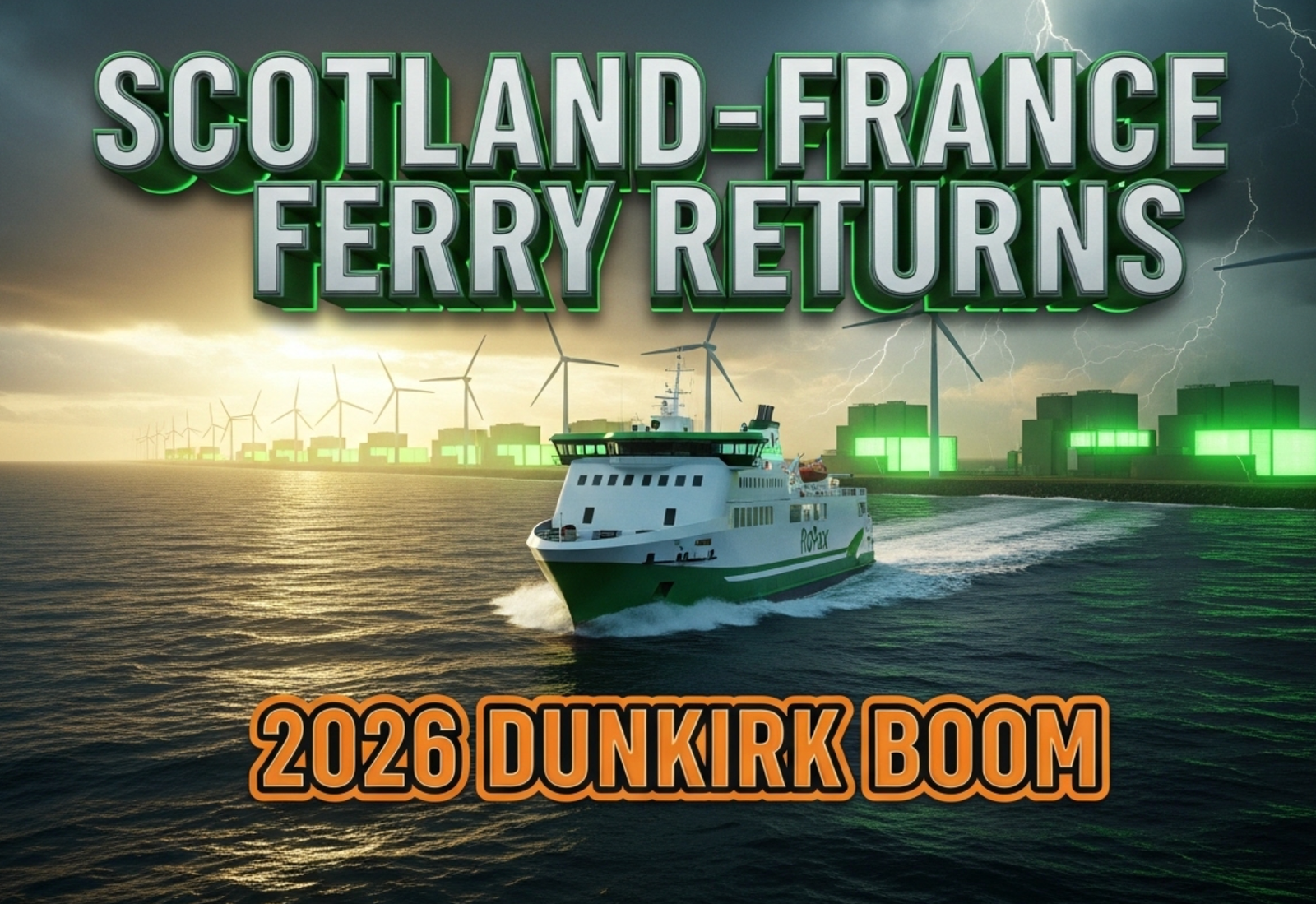
A direct ferry linking Scotland and northern France could return as early as late 2026, eight years after the last freight ships left Rosyth and sixteen years after passengers last sailed straight to the continent.
The surprise revival is tied to Dunkirk’s colossal €40bn (£35bn) port transformation that is already attracting battery giants, hydrogen projects and low-carbon steel production. Local leaders say the scheme could become Europe’s blueprint for bringing heavy industry back to life without wrecking the planet.
Port officials and shipping sources confirm talks are “very advanced” for a new Rosyth-Dunkirk service combining roll-on roll-off freight with passenger cars and foot traffic.
The move would give Scottish exporters a Brexit-beating lifeline that avoids the Dover-Calais bottleneck and cuts road miles by hundreds compared to current routes.
Why Dunkirk Suddenly Looks Unstoppable
Dunkirk port has quietly turned itself into France’s hottest industrial story.
Verkor opened its €2bn electric-car battery gigafactory in December 2025 and is already in talks with Renault Alpine about hydrogen sport-car development on site.
ArcelorMittal is spending €1.3bn switching its huge Dunkirk steelworks from coal blast furnaces to electric arc furnaces, backed by €850m of French government money.
Technip Energies breaks ground next year on another battery and sustainable aviation fuel plant on land that was a toxic refinery wasteland for decades.
A brand-new €25m rail terminal opens in 2027, designed to pull thousands of lorries off the roads each week.
Together these projects have already locked in more than €4bn of real investment, with the full €40bn vision running to 2040.
“This is not just another port upgrade,” says Patrice Vergriete, Dunkirk’s mayor and former French transport minister. “We are showing how a region that lost everything in the 1980s can come roaring back by betting everything on clean energy.”
The Ferry That Refuses to Die
The last direct passenger link from Scotland to the continent, DFDS’s Rosyth-Zeebrugge route, closed in 2018. Freight followed in late 2018 when DFDS pulled out completely.
Since then Scottish businesses have complained bitterly about extra costs and delays sending goods through English ports.
Multiple studies commissioned by the Scottish government concluded a direct continental link would save exporters up to £40m a year and slash carbon emissions.
Now Dunkirk’s explosive growth is changing the maths.
Port president Stéphane Raison told industry insiders in Lille last month that “several operators” have submitted serious proposals for Rosyth-Dunkirk, with one shortlisted bidder expected to be named before summer 2026.
The new service would use modern eco-friendly vessels capable of running on LNG or future green fuels produced right next door at the port.
Journey time is estimated at 18-20 hours, competitive with driving plus Channel crossing, and far less stressful.
Jobs, Pride and a Second World War Echo
People in Dunkirk still talk about “the spirit of 1940” when 338,000 Allied troops were rescued from the beaches under German fire.
Mayor Vergriete deliberately invokes that memory when he describes today’s fight to save and create jobs.
In the 1970s the area employed 35,000 in shipyards, steel and refineries. By the 1990s that had crashed below 5,000.
Today the port directly supports 12,000 jobs and officials say the new green industries will push total employment past 20,000 within ten years.
“We lost everything once,” says Marie-Pierre de Bailliencourt from Institut Montaigne, which published a glowing report on Dunkirk in December 2025. “Now we are proving deindustrialisation is not the end of the story.”
For Scotland the ferry would mean more than cheaper exports. It would be a statement that direct European links are still possible, even after Brexit.
Farmers could ship lamb straight to French tables. Whisky makers could avoid English motorway chaos. Holidaymakers could drive off the boat and be in the Alps or Atlantic coast in hours.
One Fife business owner told us: “Getting our goods to Europe without going through England again would feel like getting our country back.”
Port sources say the first sailings could happen before the end of 2026 if final agreements are signed this spring.
Dunkirk is ready. The ships are waiting. After years of talking, the direct Scotland-France link suddenly feels closer than at any time since 2010.
Scotland and northern France, divided by water but united by stubborn hope, might just be about to shake hands again across the North Sea.
What do you think, should Holyrood help fund the new ferry or leave it entirely to private operators? Drop your view below and use #ScotlandFranceFerry if you’re shouting about it on social media.


