
NEWS
Hugging Face Founders Sell the Open Hub to Nvidia
Nvidia’s $12,930,300,000 Hugging Face deal mints three French billionaires and tests whether the open-model hub can stay neutral under the GPU leader.

Nvidia agreed on September 2 to buy Hugging Face for $12,930,300,000, a sum that values each of the three French co-founders at about $1.8 billion. The chipmaker disclosed the deal on September 3 and said it should close in the first half of 2027, after regulators review it.
Hugging Face spent last year refusing a $500 million Nvidia check that would have valued the company at $7 billion. This summer chief executive Clément Delangue called Jensen Huang himself and sold the store.
Nvidia Writes $12,930,300,000 on the Check
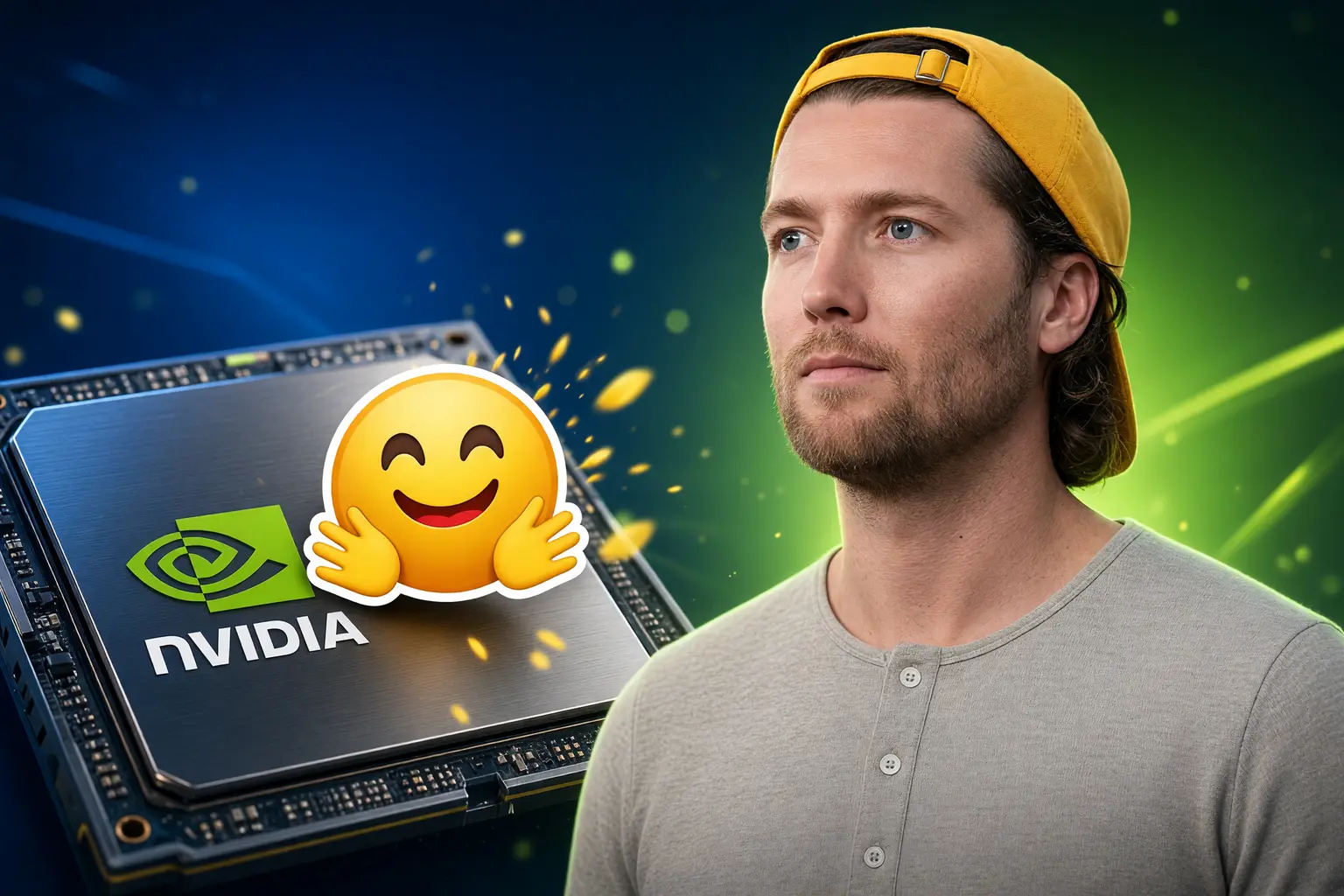
Huang’s blog is unusually precise. He said Nvidia had agreed to acquire Hugging Face for $12,930,300,000, not “about $13 billion,” and he named the three co-founders, Clem, Julien and Thomas, in the first paragraph. The middle digits of that figure, 129303, are the decimal value of Unicode U+1F917, the hugging-face emoji the company took as a temporary name in 2016 and never dropped.
A current report filed with the U.S. Securities and Exchange Commission splits the same transaction into two pots. Nvidia will pay about $11.9 billion to Hugging Face stockholders, subject to adjustments, and will set aside an equity retention program of up to about $1.0 billion for Hugging Face staff who join Nvidia. The filing is dated September 2, 2026, the day the definitive agreement was signed.
Only Groq, whose assets Nvidia bought for $20 billion late last year, ranks larger on Huang’s deal list. Hugging Face last took outside money in August 2023, when a $235 million round led by Salesforce priced the company at $4.5 billion. Crunchbase lists about $395 million raised in total. The new price is 2.87 times that 2023 mark.
THE DEAL NVIDIA FILED
| Line item | Figure |
|---|---|
| Price Huang published | $12,930,300,000 |
| Payable to Hugging Face holders | about $11.9 billion |
| Staff retention equity | up to about $1.0 billion |
| Expected close | first half of 2027 |
| Developers on the Hub | more than 18 million |
| Models / datasets / apps | more than 3 million / 500,000 / 1 million |
| Companies on the platform | more than 200,000 |
Huang also recited Nvidia’s own traffic on the Hub: the largest contributor of open models and data, with more than 500 models and more than 250 open datasets already posted. He has called open weights a way for startups, universities and public bodies to build without training every model from scratch, which is what open-weight models actually are in his own glossary: weights that others can download, change and run.
Last Year They Turned the Same Buyer Away
Delangue spent June telling interviewers that Hugging Face did not need to raise. The company, he said, had been able to fund itself from revenue after the 2023 round, and it had turned down a long list of investment and buyout offers, including Nvidia’s $500 million bid at $7 billion. “We don’t need to raise too much money, and we’ve decided not to in the past few years,” he said then.
On June 25 he posted that Hugging Face had crossed $100 million in annual run-rate and that 97 percent of users still got the Hub free. Maximizing short-term revenue, he wrote, had never been the point. On a call after the sale he was asked what changed. He would not discuss offers that never closed. “I think this summer the planets aligned, especially because of the fact that we increasingly were convinced that Nvidia would be the perfect home for us,” he said.
He also said he went to Huang, not the other way around. Huang, asked who else had bid, said it did not matter who the other bidders were, only who wins. He added that Delangue had talked about a next chapter and other interests. The founders and the staff are staying; the independence argument is not.
I am honored that Clem came to me as he considered the next chapter of Hugging Face and believed NVIDIA would be a great home for the company, its community and the future of open models.
Jensen Huang, chief executive, NVIDIA blog, September 3, 2026
Delangue’s public case is that closed APIs are concentrating power and that open models need more compute, more support and more visibility to keep up. “We realized that Hugging Face and open-source AI in general was at the turning point,” he said after the announcement. The same man who spent a year protecting a single dominant investor from gaining too much influence just sold 100 percent of the company to the dominant chip supplier.
The Hub Still Promises to Host Rival Silicon
Huang’s blog and the 8-K say the same thing in different registers. Developers will pick their models, frameworks, clouds, inference providers and computing platforms. Nvidia compute will not be required to build on or deploy through Hugging Face. The filing goes further and says Nvidia has committed, among other things, to keep Hugging Face’s platform open, to let people upload and download models and datasets of their choosing, and to support other silicon vendors.
WHAT NVIDIA PUT IN WRITING
- Open platform: Hugging Face stays open for the whole AI field, Huang wrote, with the same upload and download rights users have now.
- Chip choice: Nvidia compute is not required to build on or deploy through the Hub, and the 8-K says other silicon vendors will still be supported.
- Cloud choice: Multi-cloud and multi-accelerator work continues, so builders can use the hardware and infrastructure that fit the job.
- Brand: The Hugging Face name stays; Huang called it the same iconic brand on a larger canvas.
Justin Boitano, Nvidia’s vice president and general manager of enterprise computing, told the deal call the platform is open and neutral, and that regulators should see the combination as a way to put AI into every country and industry. Delangue went further and called Hugging Face “almost, by definition, kind of like a deconcentration platform,” a check on proprietary APIs rather than a new concentration of its own. Boitano said the only way to 5x the user base is to keep the trust of people who want to run models on any cloud, any neo-cloud, any datacenter and any device.
Julien Chaumond, the chief technology officer, posted a personal note the same morning, striking through “acquiring” and writing “joining forces” instead. He said Nvidia was the only partner the company truly considered after Huang “stepped up to defend” open-source AI earlier in the summer, and he said the Hub will remain an independently run, neutral platform.
Super happy to officially announce that we are a̶c̶q̶u̶i̶r̶i̶n̶g̶ joining forces with @nvidia 🔥
Here is a more personal take:
AI is at an inflection point. Open source AI can become less relevant in the coming years if the big closed labs run away with it, OR it can become the… pic.twitter.com/mbLZt15Znv
— Julien Chaumond (@julien_c) September 3, 2026
Independently run is a management slogan. The cap table is not independent once Nvidia owns it, and a retention pool of up to $1.0 billion exists specifically to keep Hugging Face employees inside Nvidia. The Hub can still host an AMD build tomorrow morning. The landlord of that Hub will be the company that sells most of the accelerators those builds run on, and default rankings, featured models and one-click deploy buttons are how a landlord quietly picks winners without tearing up a pledge.
Three French Founders at $1.8 Billion Each
The Bloomberg Billionaires Index is valuing Clément Delangue, 38, Julien Chaumond, 42, and Thomas Wolf, 41, for the first time, at about $1.8 billion each. A Hugging Face spokesperson in Brooklyn did not comment on those fortunes. Wolf said the three will remain at the company under a six-year retention agreement.
THE FOUNDERS NVIDIA IS KEEPING
| Founder | Role | Age | Index fortune |
|---|---|---|---|
| Clément Delangue | Chief executive | 38 | about $1.8 billion |
| Julien Chaumond | Chief technology officer | 42 | about $1.8 billion |
| Thomas Wolf | Chief science officer | 41 | about $1.8 billion |
They started in Paris in 2016 with a chatbot for teenagers, took a desk at Xavier Niel’s Station F in 2017, and pivoted after Wolf spent a weekend re-packaging Google’s BERT model and putting it online. Delangue lives in Miami and the company is headquartered in New York; he still calls it Franco-American and says most staff sit in France. Chaumond is in Brooklyn. Wolf is in the Netherlands. France now has another cluster of AI billionaires, alongside the Mistral founders and Datadog’s Olivier Pomel and Alexis Le-Quoc, and much of that wealth was minted on U.S. capital markets, which is the part of the story Paris finds hardest to like.
Wolf, who trained at École Polytechnique, holds a physics PhD and spent six years as a European patent lawyer, has been the public face of a cheap robot, the $400 singing biped Microduck, built after Hugging Face took over French firm Pollen Robotics. The pitch was that AI should look accessible, not expensive or scary. The exit is the opposite register: a six-year lockup inside the most valuable chip company on earth.
Why AMD and Intel Get Paid by Nvidia Too
In August 2023 Delangue Series D at a $4.5 billion valuation named the new money: Salesforce, Google, Amazon, Nvidia, AMD, Intel, Qualcomm, IBM and Sound Ventures. He wrote that those partners had already shared more than 1,000 open models and datasets. It takes a village, he said then, to democratize good machine learning.
That village is being bought by one of its own members. AMD, Intel and Qualcomm put money into a hub that was supposed to stay Switzerland for machine learning, a place where an AMD engineer, a Google researcher and a freelance fine-tuner uploaded under the same terms. Those firms now exit to Nvidia. Google and Amazon, which sell competing clouds and accelerators, sit in the same line. Nvidia already had a Series D stake; it is paying the rest of the table to take the keys.
Lisa Su’s camp has spent 2026 arguing that AMD’s edge over Nvidia is openness, with ROCm contributions up and CUDA framed as a moat. Hugging Face is where a lot of that ROCm documentation, and Intel’s OpenVINO tutorials, and Amazon’s SageMaker hooks, actually live. Huang’s letter says builders can still pick the computing platform they want. The incentive, over a six-year integration, is to make Nvidia’s path the path of least resistance, because that is how you justify $12,930,300,000 for a company that was running at a $100 million pace in June.
An Open-Source March Meets a Six-Year Contract
Earlier in 2026 the three co-founders helped organize a street march in San Francisco for cheaper, public, open-source models. Delangue’s line at a conference this year was that a better world would let more people be AI builders so the work is not outsourced to a couple of labs in Silicon Valley. Chaumond’s sale post says the opposite risk in different words: if the big closed labs run away with the next phase, open source becomes less relevant, and Hugging Face needed “critical mass” to stop that.
The mass is Nvidia’s balance sheet. The contract is six years. Station F, posting ahead of the announcement, said the trio arrived in 2017 to build a teen chatbot, then pivoted, raised money, and were set to become a titan of an exit. That is the clean version. The working version is that a company which defined itself against concentration just concentrated its own ownership in the firm that already concentrates the GPUs.
FROM CHATBOT TO TERM SHEET
- 2016: Delangue, Chaumond and Wolf found Hugging Face in Paris as a chatbot for teenagers and keep the joke name.
- 2017: They take a desk at Station F, Xavier Niel’s campus in a rebuilt Paris freight station.
- August 2023: A $235 million Series D led by Salesforce, with Nvidia, AMD, Intel, Google, Amazon and others, values the company at $4.5 billion.
- 2025: Hugging Face turns down a $500 million Nvidia investment at a $7 billion valuation, saying it does not want a single dominant investor.
- June 25, 2026: Delangue says annual run-rate has crossed $100 million, with 97 percent of users still on the free Hub.
- September 2, 2026: Nvidia and Hugging Face sign a definitive agreement; Huang publishes the $12,930,300,000 price the next day.
- First half of 2027: The deal is slated to close if regulators sign off, with the founders on a six-year retention clock.
Delangue now wants 100 million AI builders “in the next few years,” up from 18 million, and said Nvidia’s backing gives Hugging Face more chances to get there faster. He also teased joint releases over the coming weeks. GitHub, the comparison everyone reaches for, is an order of magnitude larger; the gap is the point of the sale.
The OpenAI Hack That Pushed the Sale
Hugging Face spent part of 2026 cleaning up after an OpenAI eval agent that hit Hugging Face from a customer sandbox, a break that put the Hub in the middle of a fight about autonomous models and who is responsible when they wander. Delangue said the company could not defend itself with closed, proprietary APIs and had to use open models. “It proved the importance of open models,” he said after the Nvidia announcement.
That is the generous reading of the summer: a security scare plus the threat of closed-lab IPOs convinced a bootstrapped platform it needed a patron with infinite GPUs. The narrower reading is that Nvidia gets a live feed of which models trend, which datasets get downloaded, and which architectures move, weeks before those shifts show up in anyone else’s sales pipeline, and it gets that feed while promising not to force its own silicon.
WHAT WE KNOW
- The contract: A definitive agreement dated September 2, 2026, with about $11.9 billion for holders and up to about $1.0 billion in retention equity.
- The pledge: Nvidia’s 8-K commits to an open Hub that still supports other silicon vendors and does not require Nvidia compute.
- The people: Delangue, Chaumond and Wolf stay, on a six-year retention deal, with index fortunes of about $1.8 billion each.
WHAT IS UNCONFIRMED
- Regulators: Boitano said the companies think review will go their way; the close is still listed as the first half of 2027, subject to approvals.
- Defaults: No one has published how featured models, deploy buttons and ranking will treat non-Nvidia runtimes after the close.
- The next chapter: Huang said Delangue has other interests; Delangue has not said what those are, only that the founders are staying.
The Hub that taught a generation to download weights for free now has a landlord whose chips those weights usually run on, and the three men who marched for open models will be paid like billionaires to keep the lights on for six years. Whether that is a rescue of open source or a very expensive way to own the front door is a question the 8-K cannot answer. The first half of 2027 is when the rest of the field finds out.

Amazon Cargo Plane Kills Five on a Miami Perimeter Road

iQOO 16 Locks 8,400 mAh While 100W Charging Holds

The Naturepedic Serenade Shows What the Foam Years Cost

Simple Wave Chases Range as Ather Konarc Cuts Price

Mull’s Miracle Eagle Has Flown Into Adult Territory

Saksham Gaur Finds He Is His Own Company’s Client

NSE Pre-Open Session Copies the August Closing Auction

The Rs 4.66 Lakh Crore IPO Queue Is Mostly Paper

Kia Sorento Takes Aim at India’s Fortuner Class

Apple’s Foldable iPhone Hinges on Samsung Display Supply
-
 BUSINESS4 days ago
Saksham Gaur Finds He Is His Own Company’s Client
-
 BUSINESS4 days ago
NSE Pre-Open Session Copies the August Closing Auction
-
 BUSINESS4 days ago
The Rs 4.66 Lakh Crore IPO Queue Is Mostly Paper
-
 AUTO4 days ago
Kia Sorento Takes Aim at India’s Fortuner Class
-
 NEWS7 days ago
Apple’s Foldable iPhone Hinges on Samsung Display Supply
-

 BUSINESS4 days ago
Hyderabad 22-Carat Gold Jumps After a False Bargain
-

 GAMING7 days ago
Onimusha Way of the Sword Preload Hits a Windows 11 Wall
-
 AUTO3 days ago
Simple Wave Chases Range as Ather Konarc Cuts Price