

As Russian missiles pound Ukraine’s power plants for the third brutal winter, thousands of families who found safety in Scotland now face a heartbreaking question. Many have built new lives here, yet their hearts still ache for home.
Their towns lie in ruins. Their visas have been extended. And peace feels further away than ever.
War Enters Its Third Cruel Winter
Russia’s latest bombing campaign has plunged millions of Ukrainians into darkness and cold.
In Kharkiv, Sumy and Odesa, entire districts sit without heat as temperatures drop to -15C. Hospitals run on generators. Children study by candlelight.
President Zelenskyy says Russia deliberately targets civilians to break the country’s spirit before any negotiations.
The timing is no accident. Just as Donald Trump’s team pushes for talks, Moscow appears determined to negotiate from maximum strength.
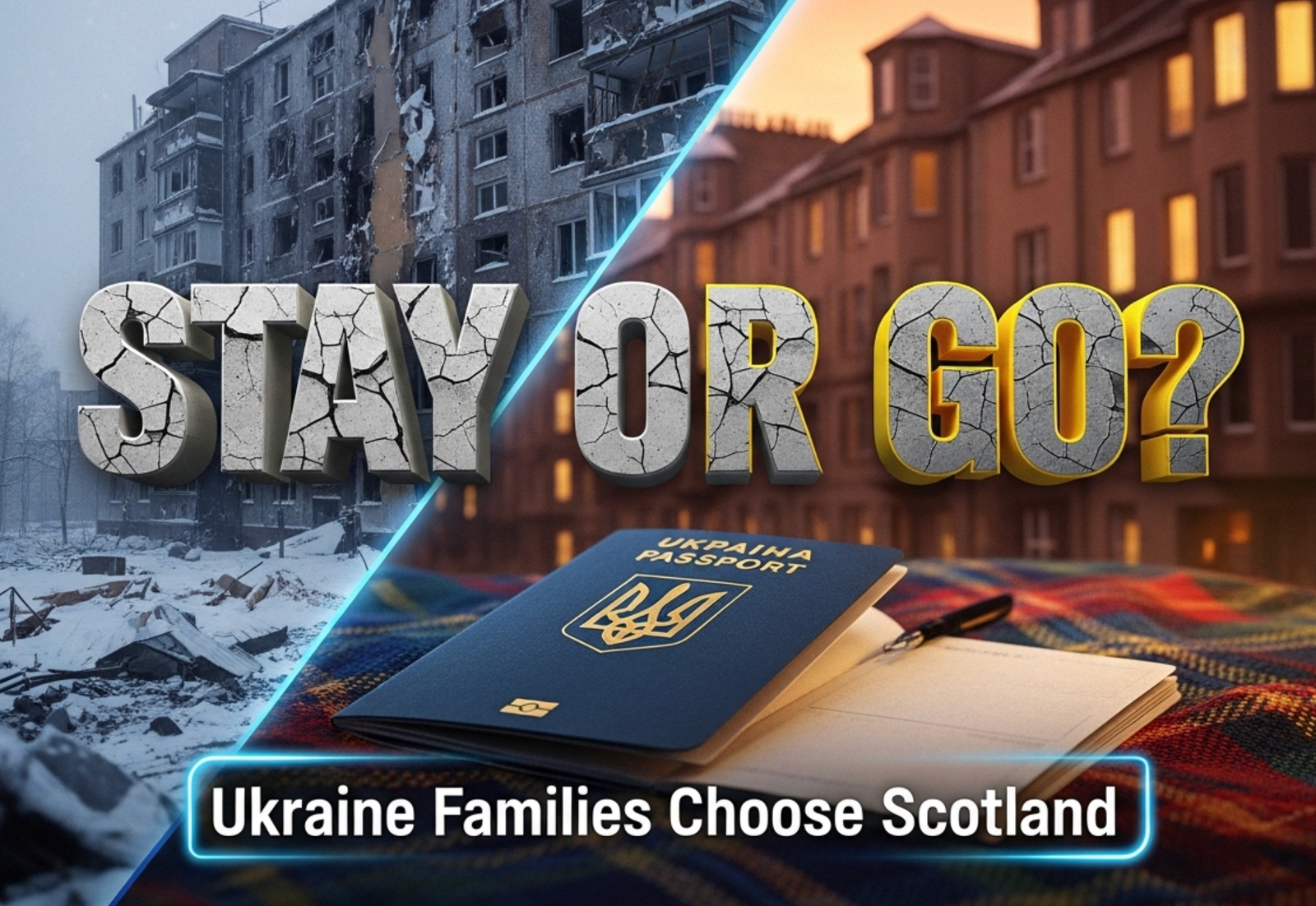
Scotland Became Home When Home Disappeared
More than 29,000 Ukrainians have arrived in Scotland since March 2022.
Svitlana Savinova’s story is typical and devastating.
Her home in Izyum was destroyed in the first weeks of the full-scale invasion. The pretty green town she loved, population 40,000, is now half-empty and turned into a military fortress.
“We hid in the cellar while bombs fell around us,” she remembers. “When we came out, everything was gone.”
Like thousands of mothers, she fled with her daughter Maria, then 12.
Two years later, Maria plays drums in Elgin’s junior pipe band and speaks English with a soft Highland lilt. Svitlana has qualified as an engineer through Moray College.
“Scotland saved us,” Svitlana says simply. “This is home now.”
The Numbers Tell Their Own Story
Recent research by the Scottish Refugee Council reveals the depth of integration:
- 78% of Ukrainian adults in Scotland are now employed or studying
- 94% of school-age children are enrolled in Scottish schools
- 63% say they want to stay long-term or permanently
- Only 12% plan to return as soon as the war ends
These aren’t cold statistics. They are lives rebuilt from absolute devastation.
Visa Extensions Bring Breathing Space
In September 2024, the UK government extended permission to stay for Ukrainians until September 2027.
For families like the Sivkos in Elgin, this means their three children, Marfa, Luka and baby Foma, can continue growing up without the terror of air raid sirens.
Host families across Scotland have become chosen family. Children call their Scottish grandparents “Granny” and “Grandpa”.
Yet the extension comes with a quiet cruelty, it is still temporary.
The Home Office repeats that the schemes were always designed for people to return when safe. But what does “safe” mean when your entire city has been flattened?
The Impossible Choice
Talk to any Ukrainian family in Scotland and you’ll hear the same conflict.
They miss Ukraine with an ache that never fades. They miss babusya’s varenyky, the sound of their own language in the streets, the particular light of Kyiv in spring.
But they also know what awaits them.
Rebuilding will take decades. Russia’s occupation left landmines in gardens, trauma in children, and an economy in tatters. Many men remain fighting or have died.
For mothers with young children, the calculation is brutal but simple: safety versus homeland.
“I dream in Ukrainian,” one mother in Glasgow told me, tears falling. “But I cannot send my son back to a war zone. Scotland gave him childhood. Ukraine took it away.”
A New Scottish Diaspora
Something profound is happening.
A new generation of Scots is growing up speaking Ukrainian at home and Gaelic at school. Pipe bands now have drummers with names like Danylo and Sofiya.
In Aberdeen, Ukrainian supplementary schools teach language and culture every Saturday. In Edinburgh, Orthodox churches hold services in both Ukrainian and English.
These children are becoming what their parents never expected: Scottish-Ukrainians.
When peace finally comes, and it will come, some families will board flights back to rebuild their motherland.
Many more will stay, carrying Ukraine in their hearts while building futures in Scotland’s hills and cities.
They are living proof that refuge can become home, that survival can become thriving, that from the worst evil can come the deepest gratitude.
For now, they light candles for Ukraine in Scottish windows and teach their children two national anthems.
Both feel like home.
What do you think? Should Scotland offer permanent residency to Ukrainian families who want to stay? Share your thoughts below.