

President Donald Trump has renewed his push to acquire Greenland, citing national security needs in the Arctic. This bold move, announced in early January 2026, raises questions about his expansionist views and whether places like Scotland could face similar claims from the United States.
Trump’s Latest Push for Greenland Control
Trump made his intentions clear in a recent interview, stating the United States needs Greenland for defense against growing threats in the Arctic. He pointed to rising tensions with countries like Russia and China, which have increased their presence in the region.
Global warming has opened new shipping routes and resource opportunities there, making the island a key spot for trade and military strategy. White House officials have discussed various options, from buying the territory to stronger actions if talks fail.
Experts note that Greenland belongs to Denmark, a close U.S. ally in NATO. Yet Trump’s team questions Denmark’s hold, arguing the U.S. role in global security gives it a stronger claim.
This comes amid broader talks on securing the Western Hemisphere, a focus in Trump’s foreign policy. His advisors have linked this to preventing outside powers from gaining footholds near North America.
Why Greenland Matters to U.S. Strategy
The Arctic is heating up as a hotspot for international rivalry. Melting ice reveals vast mineral deposits and energy sources, drawing interest from multiple nations.
Trump’s national security plan from late 2025 stresses control over areas in the Western Hemisphere to block rivals. Greenland fits this view because of its location, even though Denmark governs it.
Here are some key reasons behind the U.S. interest:
- Military bases: The U.S. already has one in Greenland and wants more to monitor Arctic activities.
- Resource access: The island holds rare earth metals vital for tech and defense.
- Climate edge: Control could help manage new sea lanes opened by warming.
Analysts say this push revives old ideas like the Monroe Doctrine, now twisted to justify taking territories seen as weak spots. Trump’s team calls non-Western powers “hemispheric competitors” that threaten stability.
Public reactions vary, with some Americans supporting the move for jobs and security, while others worry about damaging ties with Europe.
Recent events, such as joint military drills with Canada in the north, show how Trump aims to strengthen borders against perceived threats.
Scotland Enters the Expansion Debate
Talk of Greenland has sparked fears that Scotland could be next on Trump’s list. His logic of hemispheric control puts parts of the United Kingdom in play, based on geographic lines.
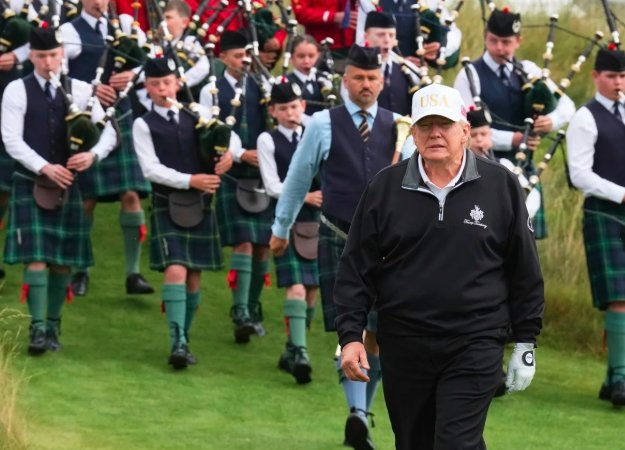
Trump owns golf courses in Scotland and has deep family ties there, from his mother’s roots. He has invested millions in places like Aberdeenshire, promising growth but often clashing with locals over land use.
If the same rules apply, Scotland’s position in the Western Hemisphere could make it a target for U.S. influence. Commentators point out that Trump’s past deals in Scotland involved bold promises and environmental disputes.
A table below outlines Trump’s known ties to Scotland:
| Year | Event | Impact |
|---|---|---|
| 2006 | Bought Menie Estate for golf course | Sparked local protests over dunes destruction |
| 2014 | Opened Trump International Golf Links | Boosted tourism but faced wind farm opposition |
| 2024 | Expanded holdings in Ayrshire | Promised jobs amid economic talks with UK leaders |
This history fuels concerns that Trump might push for more control, perhaps through economic pressure or alliances.
European leaders have voiced unease, seeing this as a sign of shifting U.S. policy toward old allies.
Global Reactions and Pushback
Denmark has firmly rejected any sale or takeover, with its prime minister calling for more U.S. military help instead. European allies, including the UK, have rallied behind Denmark, stressing NATO unity.
In the U.S., some lawmakers back Trump’s stance for security reasons, while critics warn of starting conflicts within the alliance. Public polls from early 2026 show mixed views, with 45 percent of Americans favoring stronger Arctic control.
International groups like the United Nations have urged calm talks, highlighting risks to global peace. Trump’s team insists no force is planned, but options remain open.
This echoes his earlier threats toward Canada, where he joked about making it the 51st state to secure northern borders.
What Could Happen Next
Experts predict negotiations with Denmark could drag on, possibly leading to a deal for more U.S. bases without full control. However, if talks stall, tensions might rise, affecting trade and alliances.
For Scotland, any real claim seems unlikely but highlights Trump’s bold style. It could strain U.S.-UK relations, especially with ongoing trade deals.
Logical reasoning suggests Trump uses these claims to negotiate better terms, like resource shares or military pacts. Recent events, such as China’s Arctic investments, add urgency to his plans.
In the end, this story shows how climate change and power shifts are reshaping world maps.
What do you think about Trump’s territorial ideas? Share your views in the comments and spread this article to join the discussion.