
 Ishan Crawford
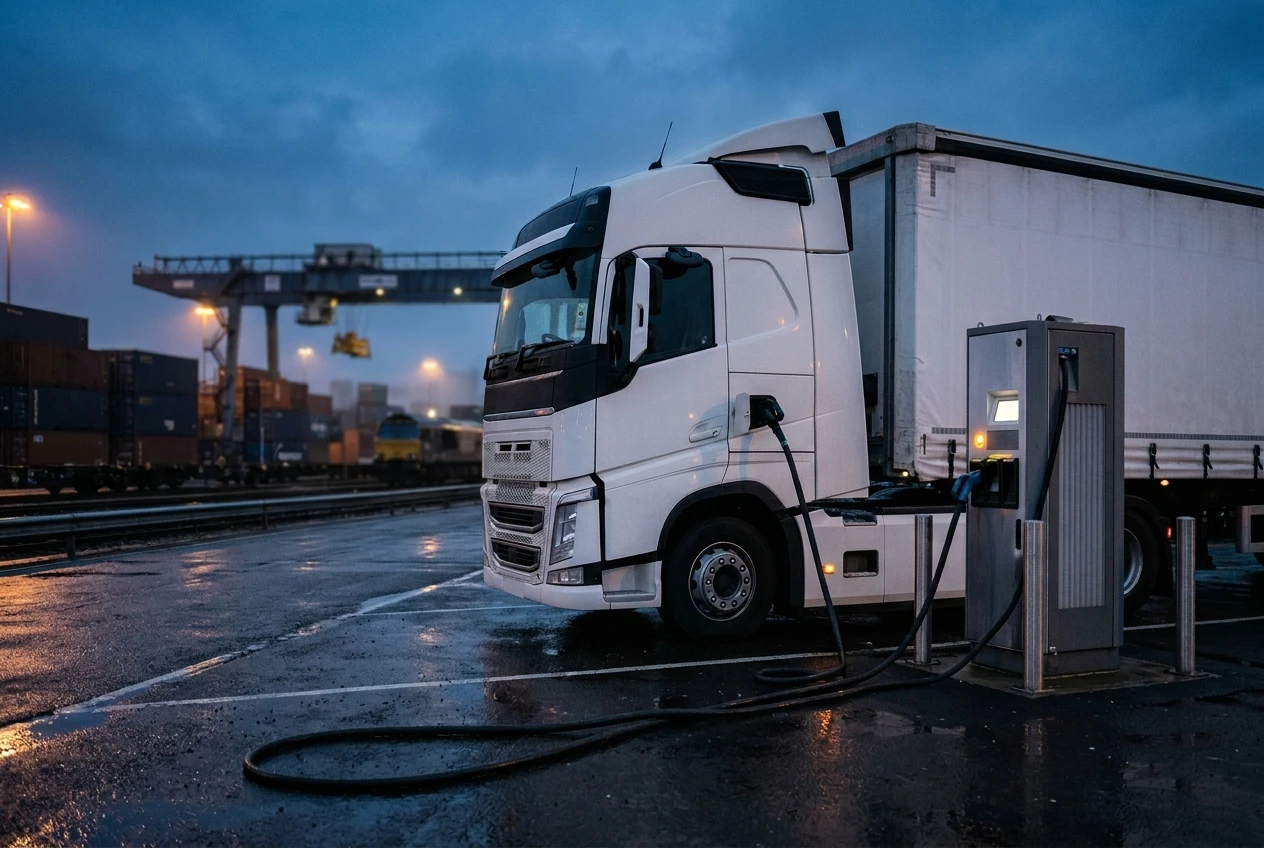
 Scotland’s first megawatt charging hub for electric trucks is live in Coatbridge, North Lanarkshire, where UK electrification firm Amphos has built megawatt-scale charging for logistics operator Russell Group’s battery-powered 42-tonne lorries. For now the site charges on the older CCS standard in about 40 minutes, fast for a heavy truck but not yet fast enough to vanish into a working shift.
The number that matters arrives in July. That is when Amphos plans to upgrade the connectors to the Megawatt Charging System, which should cut a full charge to roughly 20 minutes and drop it inside the legally mandated break a driver already has to take.
What Switched On in Coatbridge
Amphos acted as the Independent Connections Provider (ICP, the contractor that designs and builds a site’s grid connection) and handled the design and installation of the charging gear. The hub sits at Russell Group’s rail freight terminal in Coatbridge, a few miles east of Glasgow.
The hardware is heavy. Russell has installed two 720 kW double-port chargers and one 1.2 MW double-port unit, all supplied by Vestel Mobility, capable of up to 3.75 megawatts of high-voltage direct-current power combined. Several trucks can plug in and charge at once, which is the part that keeps a fleet rolling rather than queuing for a single post.
This is the second megawatt-scale charging hub for electric heavy goods vehicles (HGVs) in the UK and the first in Scotland. Part of the bill was covered by Innovate UK, the government’s innovation agency. The wider country has been spending hard on the lighter end of charging too, with the Scottish government’s funding to expand the public EV charging network running in parallel with depot projects like this one.
Why 40 Minutes Still Misses the Driver’s Break
Heavy-truck charging only works if it disappears into a schedule the driver already keeps. Under British drivers’ hours rules, a driver can be at the wheel for up to 4.5 hours before taking a mandatory 45-minute break. The entire design logic of megawatt charging is to fit a full top-up inside that window.
Today’s 40-minute charge on the Combined Charging System (CCS, the connector most cars and current electric trucks use) cuts it fine once you add the minutes to park, plug in and unplug. The planned switch to the Megawatt Charging System (MCS, a high-power connector built specifically for heavy vehicles) is expected to bring that down to about 20 minutes.
Megawatt charging allows us to bring a heavy goods vehicle in, charge it during a driver’s break, and send it straight back out fully charged.
That is Stephen Madden, head of engineering at Russell Group. Mark Oxtoby, chief executive of Amphos, said the jump from 1 MW to 3.75 MW “brings fully electric, high-utilisation HGV fleets within reach for fleet operators up and down the country.”
| Spec | Now | After July upgrade |
|---|---|---|
| Connector standard | CCS | MCS |
| Typical full charge | ~40 minutes | ~20 minutes |
| Fit with the 45-minute break | Tight, runs over with handling time | Sits inside the break |
The distinction sounds small. In daily operation it decides whether an electric truck can do two long legs in a shift or sits idle waiting for electrons.
Three MAN Tractors Hauling Tesco Loads
The charging is only half the project. Russell Group has added three fully electric MAN eTGX 4×2 tractor units, each able to pull a full 42-tonne load and rated for more than 430 kilometres on a single charge. They will run logistics for Tesco across Scotland.
MAN’s long-haul battery model is built around stackable battery packs; the manufacturer’s own specifications for the eTGX semitrailer tractor range stretch to roughly 570 km with six packs, so Russell’s quoted 430 km reflects real loaded duty rather than a brochure best case. On megawatt charging up to 750 kW, MAN reckons a 20 to 80 percent top-up takes around 27 minutes.
The trucks are Russell’s contribution to a larger national trial. The firm is running three battery-electric MAN units alongside three hydrogen fuel-cell Scania trucks under the same demonstrator, a deliberate hedge across the two zero-emission technologies still competing for the heaviest, longest routes.
Why the Chargers Sit Beside a Rail Terminal
The hub’s location is doing quiet work. It sits at Russell’s rail freight terminal, not a roadside depot, and that is the point. The electric trucks deliver to Tesco stores, then run back to the terminal carrying store deliveries that move onward by rail.
Those return loads feed an existing electric-locomotive freight service between Daventry in the English Midlands and Coatbridge. The road legs are now battery-electric, the trunk haul is already electric rail, and the changeover point is where the megawatt chargers stand. It is an intermodal setup most coverage of the charging milestone skipped over.
Russell has been building toward this for a while, acquiring a rail terminal and spinning up a dedicated rail arm. Its rail freight operation moving containers across the network gives the electric trucks a job that plays to their range: short, repeatable shuttles between stores and a fixed terminal, exactly the duty cycle a 430 km battery handles without sweat.
Britain’s Megawatt Map Is Filling In
Coatbridge is one node in a programme designed to seed dozens. The Zero Emission HGV and Infrastructure Demonstrator (ZEHID, the UK scheme funding heavy-truck electrification trials) launched in October 2023, backed by £200 million from the Department for Transport (DfT) and delivered with Innovate UK.
What the scheme is meant to put on the ground:
- Around 350 of the heaviest battery-electric and hydrogen fuel-cell trucks on UK roads
- More than 70 public and depot-based charging or refuelling installations by 2030
- 54 infrastructure hubs mapped across England, Scotland, Wales and Northern Ireland
- Motorway charging at service areas including Lymm and the two Toddington sites, with bays compatible with both connector standards
The UK’s first megawatt hub came online in January at Kuehne+Nagel’s East Midlands Gateway depot, which makes the Scottish site the second to go live. Pushing this much power into the grid at depots and motorway services is its own engineering problem, one Scotland is also tackling on the supply side through large grid battery storage projects coming online across the country. Without that backbone, a yard full of 1.2 MW chargers is just expensive copper.
The connectors that turn 40 minutes into 20 are due on site in July. Until they arrive, Scotland’s first megawatt hub is running the slower version of the job it was built to do.
 Windows 11 KB5095093 Lands With Point-in-Time Restore and 35-Day Pause
  Meta Cuts Smart Glasses to $299 to Outflank Snap and Apple
  Messi Leads the 2026 World Cup Golden Boot Race After Two Matches
  Australia March On as Athapaththu Ton Lights Up T20 World Cup
  Galaxy Z Fold 8 Leak Reveals Colors, Storage, and a New Ultra Variant
  Ronaldo’s Six-World-Cup Record Leads a Matchday Full of Milestones