
NEWS
Reform’s 17 List Seats Split Holyrood’s Opposition Bench
Reform UK matched Labour on 17 list-only Holyrood seats, splitting the opposition while the SNP governs short of a majority.

The SNP won 58 of 129 Holyrood seats on 7 May 2026, seven short of a majority, while Reform UK tied Labour on 17. It is the party’s fifth term and the parliament’s seventh election since 1999. The Greens have 15, which puts 73 MSPs in parties that back independence, yet John Swinney is governing without a new ministerial deal with them.
Every one of Reform’s 17 members arrived on the regional list. Constituency turnout was 53.2%, down 10.3 points from 63.5% in 2021, and that drop is now the attack line Reform uses at First Minister’s Questions.
The SNP Holds 58 Seats and Still Needs Votes
Parliament’s own return gives 58 SNP seats and 17 each for Labour and Reform, then the Greens on 15, the Conservatives on 12 and the Liberal Democrats on 10. Sixty-five seats are required to control the chamber on a straightforward vote. The SNP is 41 seats clear of anyone else and still short.
HOLYROOD SEATS, 2021 AND 2026
| Party | 2026 | 2021 | Change | Local seats | List seats |
|---|---|---|---|---|---|
| SNP | 58 | 64 | -6 | 57 | 1 |
| Labour | 17 | 22 | -5 | 3 | 14 |
| Reform UK | 17 | 0 | +17 | 0 | 17 |
| Greens | 15 | 8 | +7 | 2 | 13 |
| Conservatives | 12 | 31 | -19 | 4 | 8 |
| Liberal Democrats | 10 | 4 | +6 | 7 | 3 |
That mix is why the May Holyrood seat allocation can read as an SNP win and a hung parliament at the same time. Labour and the Conservatives both recorded their lowest Holyrood totals since devolution. Only the SNP holds more than 20 seats, so any budget still needs at least one other group to vote for it or to stand aside.
On the constituency ballot the SNP took 38.2%, down 9.5 points, and still won 57 of 73 local seats. The regional list share was 27.2%, and that collapse is what left the party with a single list MSP. First-past-the-post in the local contests protected the yellow map; the second ballot did not.
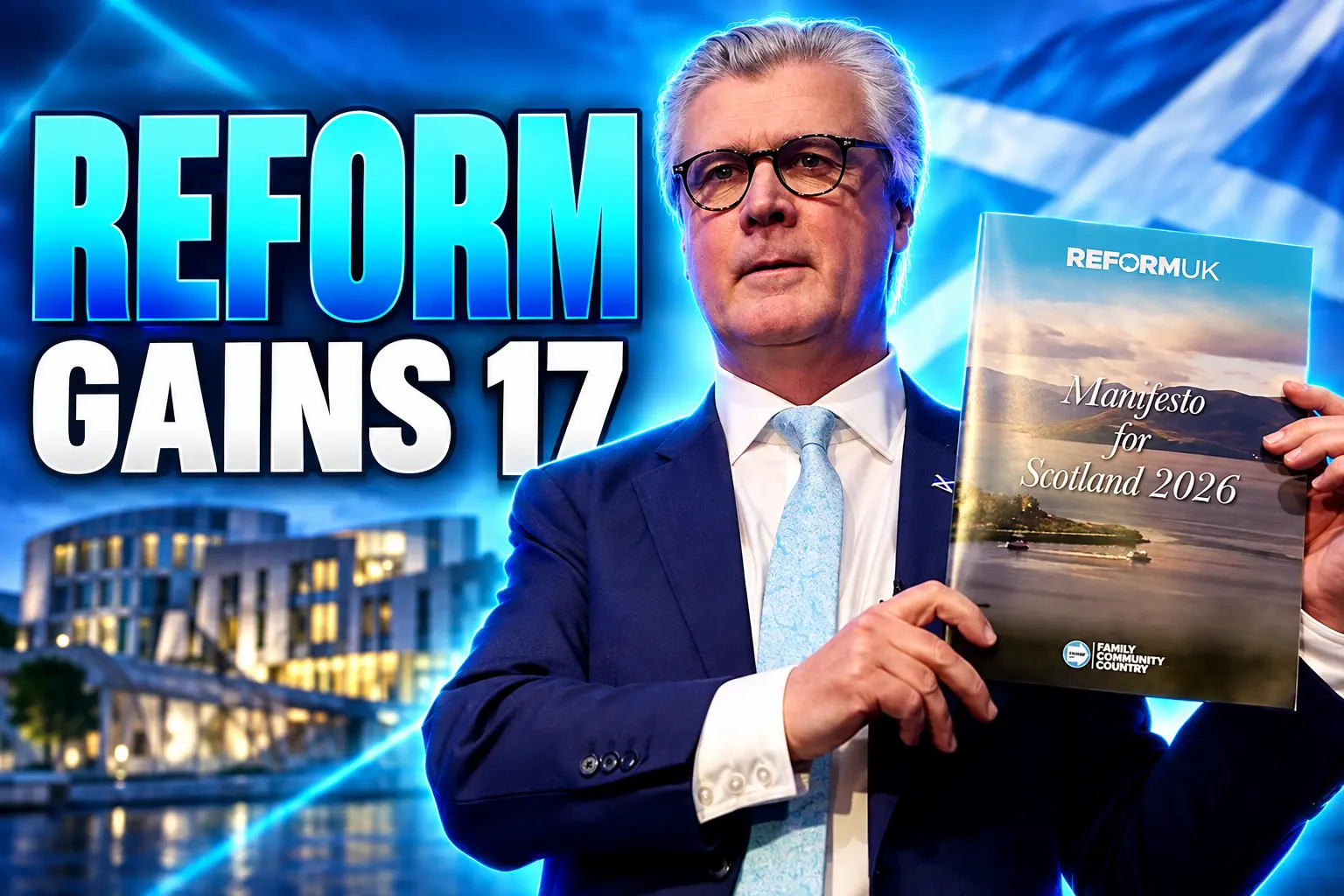
Reform’s 17 MSPs Arrived Without a Constituency
Reform UK had no Holyrood members in 2021. In 2026 it took 15.8% of the constituency vote and 16.7% of the list, overtook the Conservatives, and finished level with Labour. It won 0 of the 73 local seats. Malcolm Offord, named Scottish leader on 15 January 2026 after defecting from the Conservatives, failed in Inverclyde and entered on the West Scotland list.
The additional member system is doing the work the local contests refused to do. D’Hondt on the eight regional lists converted a vote that never topped a constituency into 17 regional MSPs and a full shadow team, with Offord billed as shadow first minister and Thomas Kerr, the Glasgow list member, as deputy. Graham Simpson, already a Conservative-turned-Reform MSP before polling day, came back on the Central Scotland and Lothians West list.
That is a second-place party with no town it can call its own. Holyrood’s chief executive, David McGill, told members the seating plan “should not be taken to indicate any status, particularly in relation to the two second largest parties in Parliament, which have equal numbers of seats.” Reform sits where the Conservatives sat in the last session, with the remaining Tory MSPs behind them. The Conservatives fell from 31 seats to 12, a loss of 19, as their constituency share dropped 10.1 points to 11.8%.
Nigel Farage walked the building with Offord on 28 September, a UK leader visiting a group that still has no constituency MSP.
Nigel Farage visits Holyrood with Malcolm Offord MSP and his team, Edinburgh. 📸 pic.twitter.com/1qLzN3z9ZL
— Reform UK (@reformparty_uk) September 28, 2026
Reform later had to take down social posts from that visit for breaching parliament rules. The episode fitted the first months of Session 7: a list party using Holyrood as a stage, then colliding with the chair.
Slater and Bruce Took Two SNP Heartland Seats
The Scottish Greens stood in only six constituencies and won two of them, the first local Green MSPs Holyrood has had. They also lifted the list share by 5.9 points to 14.0%, which returned 13 regional members and a record group of 15. Lorna Slater took Edinburgh Central with 12,680 votes and a majority of 4,590. Holly Bruce took Glasgow Southside, the seat Nicola Sturgeon used to hold, with 14,048 votes and a majority of 3,101.
Parliament’s research service notes that the SNP lost seven constituencies and gained two. The two Green gains sat inside that net.
WHERE LOCAL SEATS CHANGED HANDS
- Edinburgh Central: Slater beat Labour’s James Dalgleish, with the SNP’s Angus Robertson, then constitution secretary, third on 7,702 and not returned.
- Glasgow Southside: Bruce beat Kaukab Stewart, the SNP equalities minister, who polled 10,947.
- Na h-Eileanan an Iar: Labour took the Western Isles from the SNP.
- Four Liberal Democrat gains: Caithness, Sutherland and Ross; Skye, Lochaber and Badenoch; Edinburgh Northern; and Strathkelvin and Bearsden.
- SNP gains: Shetland from the Liberal Democrats, and Hamilton, Larkhall and Stonehouse from Labour.
- Liberal Democrat local haul: seven constituency MSPs, up from a handful of island and city footholds, plus three list members for a group of 10.
Robertson and Stewart were among the cabinet names the new parliament simply did not send back. Kate Forbes, Shona Robison, Mairi Gougeon and Fiona Hyslop had already chosen not to stand. The SNP still holds 57 local seats, so the map is yellow. The exceptions are no longer confined to the Borders and the north-east Tory pockets.
Why Turnout Fell Back Toward the Holyrood Average
SPICe puts constituency turnout at 53.2% on 2,297,159 votes. That is 10.3 points below 2021’s 63.5%, which remains the only Holyrood contest to break 60%, and a little under the 54.9% average for every Scottish Parliament election since 1999. It is nowhere near the 84.6% who voted in the 2014 independence referendum. The 2021 spike looks, in hindsight, like the outlier.
THE MAY TURNOUT
- Registered: 4,320,981 people were registered to vote.
- Ballots counted: 2,297,159 in the constituency contest, for 53.2% turnout.
- Stayed home: 2,023,822 registered voters did not vote on that ballot, just over two million.
- Postal vote: the Electoral Commission’s election report recorded 851,791 postal ballots, about 20% of the register, with postal turnout at 78.2% and in-person turnout at 47.9%.
Counting did not start when polls closed. The Electoral Management Board ran a next-day count from 9.00am on Friday 8 May, arguing that rested staff and daylight cut risk and cost. The last declaration, Highlands and Islands, came at 1:30am on Saturday 9 May. Reform took two of those seven list seats, including Vic Currie, who had polled poorly in the Shetland constituency and still arrived via D’Hondt.
Awareness of the election was not the problem. The Commission found 97% of people knew it was happening. The people who stayed home are now a political fact Reform recites every week, because a parliament elected by 53.2% is easier to call a bubble.
Labour and Reform Take Turns at First Minister’s Questions
Kenneth Gibson, the SNP MSP for Cunninghame North, was elected presiding officer on 14 May 2026 and left the party whip for the post. He split First Minister’s Questions into two 30-minute blocks, Tuesdays and Thursdays, with no questions published in advance. Labour, Reform and the Greens get three questions each; the Conservatives and Liberal Democrats get two. Labour and Reform rotate who stands first.
That rota is the hung parliament in procedural form. There is no single official opposition. Anas Sarwar led Labour into the election on 17 seats, five down on 2021, with 19.2% of the constituency vote. By September Michael Marra was leading the group in the chamber. Neither Labour nor Reform can claim the second-party microphone alone, so both get it in turns.
On 22 September Swinney moved that “Scotland is a nation that has a right to decide its own future.” Offord tried to have the debate pulled, telling Gibson the constitution is reserved. Gibson said, “This is a parliament and it’s free to debate any issue it wishes.” Offord called the debate “not just a farce” but “an insult to the Scottish electorate” and led his MSPs out. The motion passed 84 to 18, with 27 members not voting. Labour and the Greens backed it with the SNP. The Conservatives voted against. Gibson later called the walkout “a gross discourtesy” and said he would not tolerate the chamber being used for “stunts.”
On 1 October Offord put the turnout drop into the FMQ exchange.
Can the First Minister please explain why so much time in this chamber is taken up with meaningless debates on independence, Europe, Gaza, and net zero? Is it any wonder that two million Scots did not vote in the Holyrood election in May?
Malcolm Offord, Reform UK Scotland leader, at First Minister’s Questions, 1 October 2026
The 2,023,822 who did not vote are the constituency he is playing for. The 73 independence MSPs are the majority he is trying to de-legitimise. Both numbers are true at once, which is why the opposition bench cannot agree what the parliament is for.
Swinney Governs on Independence Arithmetic, Not a Coalition
SPICe said in mid-May that the SNP could govern as a minority, seek a cooperation deal like the Bute House Agreement of August 2021 to April 2024, or form a full coalition, because “support from just one of the five other parties” would reach 65. Swinney did not repeat Bute House. By September, Fergus Ewing, the SNP MSP who had opposed the original deal, noted that the first minister “has not repeated the lunacy by bringing the Greens back into government.” The Greens hold the votes that make 73, and they do not hold ministries.
That is a colder arrangement than 2021. The last signed deal put Patrick Harvie and Lorna Slater in office and collapsed when Humza Yousaf tore it up, which then tore up his own premiership. This time Slater is a constituency MSP for Edinburgh Central, the group is almost twice the size, and the price of a deal would be higher. Swinney is using the 73 when he wants a constitutional motion, and shopping for votes elsewhere when he wants a budget.
The money is the bind the campaign barely discussed. The Scottish Government’s medium-term financial strategy set out a nearly £5 billion gap by 2029-30 if nothing changes. Fraser of Allander has already said a planned three-year 9% pay deal looks hard against the awards already made. The first Session 7 budget will need Labour, the Greens, the Liberal Democrats, or an abstention. Reform’s 17 will not be the easy partner on tax or net zero, and they are not trying to be.
SESSION 7, FROM POLLING DAY
- 7 May 2026: Scotland elects 129 MSPs. The SNP finishes on 58, Reform and Labour on 17 each.
- 8 to 9 May 2026: Next-day counting runs from 9.00am; Highlands and Islands declares at 1:30am on the Saturday.
- 14 May 2026: Kenneth Gibson becomes presiding officer and leaves the SNP whip, leaving 57 SNP members on the party roster.
- 21 May 2026: Gibson sets the FMQ rota that treats Labour and Reform as equals.
- 22 September 2026: The right-to-decide motion passes 84 to 18; Reform walks out.
- 28 September 2026: Farage visits Holyrood with Offord’s group.
- 1 October 2026: Offord ties independence debates to the two million who did not vote in May.
Gibson’s election trims the SNP group by one, so the independence arithmetic is 72 voting nationalists and Greens unless the chair uses a casting vote. It is still a working majority on a constitutional motion. It is not a government programme. Swinney has also signed a Cardiff memorandum with the first ministers of Wales and Northern Ireland and talked up a second referendum by 2031. Westminster’s position, as stated by Prime Minister Andy Burnham during that September debate, is that another referendum is “off limits.” Holyrood can pass the motion. It cannot force the poll.
Frequently Asked Questions
How many seats does a Scottish Parliament majority take?
Sixty-five of 129. After Kenneth Gibson became presiding officer on 14 May 2026 and suspended his SNP membership for the post, the SNP group stood at 57, so even a Green pairing is 72 on a whipped vote rather than 73, unless the chair votes.
Did Reform UK win any constituency seats in 2026?
No. Offord lost Inverclyde and came in on the West Scotland list; the party’s entire group of 17 is regional. In 2021 Reform won 5,793 regional votes, 0.21%, and no seats at all.
How does Holyrood’s additional member system elect 129 MSPs?
Each voter has two ballots. Seventy-three members are elected in constituencies by first past the post. Fifty-six are elected from eight regional lists by D’Hondt, which is why a party can take 16.7% of the list and 17 seats without winning a single local contest.
When did the 2026 count finish?
The Electoral Management Board started counting at 9.00am on Friday 8 May rather than overnight, and the last regional result, Highlands and Islands, was declared at 1:30am on Saturday 9 May 2026.
Are the SNP and Greens in a coalition after the 2026 election?
No signed cooperation deal has replaced the Bute House Agreement, which ran from 20 August 2021 until Humza Yousaf ended it on 25 April 2024. The Greens’ 15 seats plus the SNP’s 58 equal 73, and that is a voting bloc on independence, not a shared cabinet.
The next test is not another constitutional motion. It is the first budget that has to close on 58 SNP votes, a Green party that is not in government, and a 17-seat Reform group that has already decided the chamber’s subject matter is the scandal. Swinney can still count to 65 with one partner. He has to find that partner on spending, not on the right to decide.

TCS Opens Q2 as Mid-Cap IT Keeps the Growth

Bitcoin’s Jobs Rally Fails While December Hike Odds Hold

The Heat Turn a Bucks Rematch Into Vice City Night

The G7 Opens Diesel Tanks While Carriers Head East

Kia Bets Fortuner Money on a Made-in-India Sorento

Volkswagen Sells the Osnabruck Plant to Clear a Board Fight

Tata Motors’ Iveco Tender Opens as Holders Still Decide

Saksham Gaur Finds He Is His Own Company’s Client

Onimusha Way of the Sword Preload Hits a Windows 11 Wall

The Frame Pro’s $1,200 Labor Day Cut Needs a Soundbar
-
 AUTO4 weeks ago
Volkswagen Sells the Osnabruck Plant to Clear a Board Fight
-
 AUTO1 month ago
Tata Motors’ Iveco Tender Opens as Holders Still Decide
-
 BUSINESS1 month ago
Saksham Gaur Finds He Is His Own Company’s Client
-
 GAMING1 month ago
Onimusha Way of the Sword Preload Hits a Windows 11 Wall
-
 NEWS4 weeks ago
The Frame Pro’s $1,200 Labor Day Cut Needs a Soundbar
-

 NEWS1 month ago
Apple’s Foldable iPhone Hinges on Samsung Display Supply
-

 BUSINESS1 month ago
SEBI Reopens How F&O Settles After the Closing Auction
-

 BUSINESS1 month ago
The Rs 4.66 Lakh Crore IPO Queue Is Mostly Paper