
BUSINESS
Sunak’s £2,000 Tax Bet Meets Labour’s Real Bills
Full Fact rejected Sunak’s £2,000 family tax figure in the ITV debate. Labour later raised taxes by another route, and the working-people pledge is rated not kept.

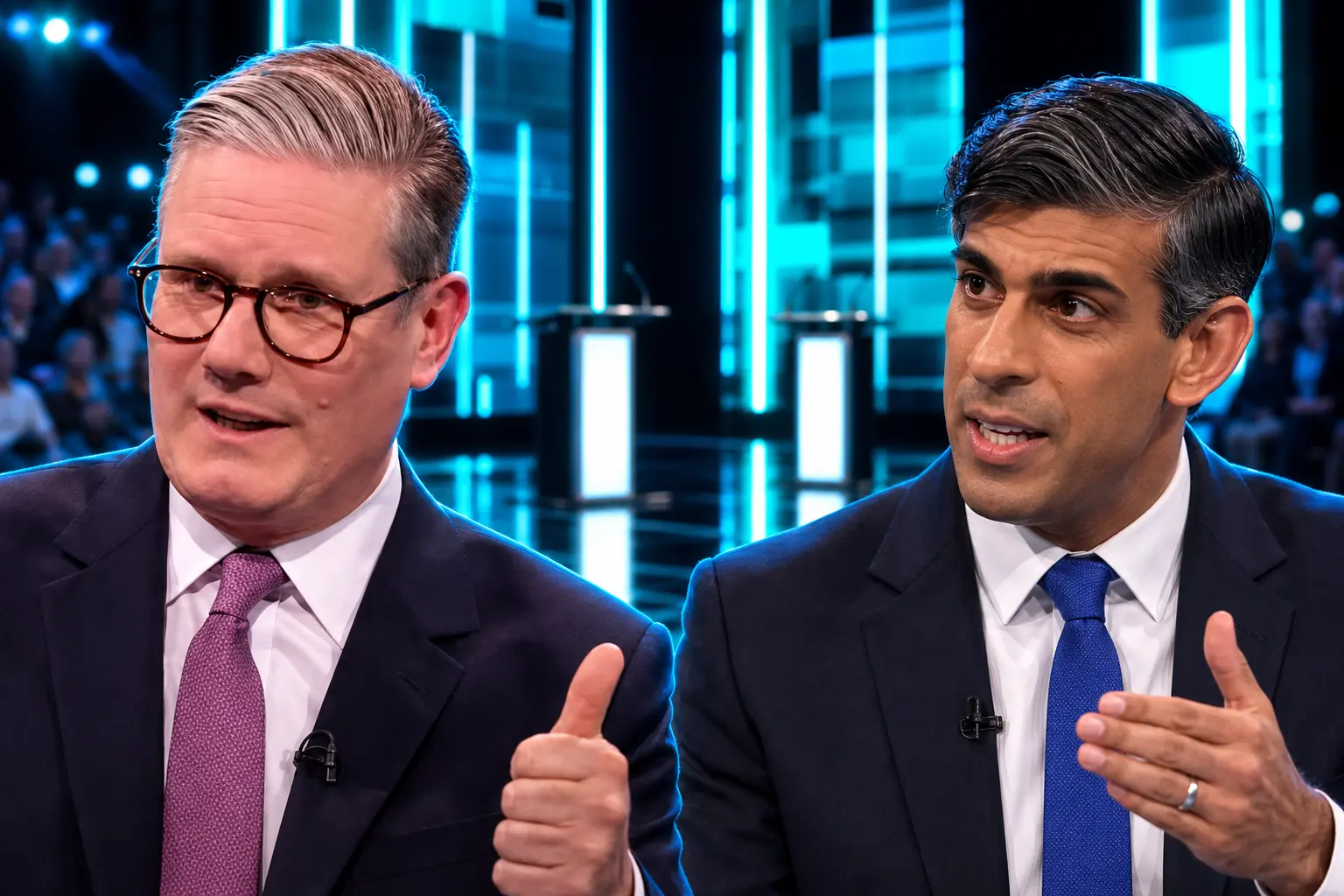
Rishi Sunak told a Salford audience on 4 June 2024 that Labour would mean £2,000 higher taxes for every working family. Keir Starmer called the figure absolute garbage. Full Fact, the fact-checking charity, said the number was unreliable and built on assumptions.
More than two years on, the UK tax take sits high by historic standards, and Full Fact now rates Labour’s promise not to raise taxes on working people as not kept. The bet Sunak placed on that stage did not pay out the way the Conservative dossier described. A tax rise still arrived, through a different door.
The Figure That Ate the Salford Debate
The first televised head-to-head of the 2024 campaign went out on ITV from a live hall in Salford. Sunak returned to the £2,000 line throughout. He also told viewers that independent Treasury officials had costed Labour’s policies and that they amounted to that bill for every working family.
Starmer’s reply was blunt. He called the claim absolute garbage, and Labour later said Sunak had lied about it. Starmer’s dismissal of the tax attack was the clip of the night. It did not stop the number travelling.
Here's what you might have missed. pic.twitter.com/ZGl8ZEiYX7
— Rishi Sunak (@RishiSunak) June 4, 2024
By the next morning the argument had already shifted from whether taxes might rise to whether the civil service had blessed the sum. Claire Coutinho, then energy secretary, said the £2,000 was spread over four years, not a single year. That caveat had not been the way the line landed in the hall.
Conservatives Split £38.5 Billion Across Working Homes
The maths sat in a Conservative paper titled Labour’s Tax Rises. The party costed 19 Labour spending commitments and eight revenue raisers through to 2029 and said the gap was a £38.5 billion black hole over four years. It then divided that total by 18.4 million working households, the Office for National Statistics count of UK homes with at least one person aged 16 to 64 and at least one person in work. The quotient the Conservatives quoted was £2,094.
Full Fact’s verdict on 5 June 2024 was that the figure was unreliable. Even if the gap had been real, there was no rule that it had to be filled by tax, and no reason every working household would pay the same. Consumer finance expert Martin Lewis had already pointed out that a government could borrow instead.
Sunak’s Treasury-officials line did not survive the paperwork. James Bowler, the Treasury’s permanent secretary, had written to Labour’s Darren Jones on 3 June, the day before the debate.
Civil servants were not involved in the production or presentation of the Conservative Party’s document ‘Labour’s Tax Rises’ or in the calculation of the total figure used.
James Bowler, Treasury permanent secretary, letter of 3 June 2024
Many line items did come from published Treasury costings of opposition policies. Bowler added that any costings from other sources should not be presented as civil service work. Special advisers, who are political appointees, had directed several of the assumptions inside those costings.
THE HOLES IN THE DOSSIER
- Insourcing: Conservatives put almost £6.5 billion over four years on bringing services in-house, using a 7.5% efficiency gap and a 50% annual insourcing rate that Labour had not set out.
- Breakfast clubs: The paper used £4.5 billion, assuming breakfast plus childcare and 50% take-up; a Treasury alternative with breakfast only and 30% take-up came to £587 million through 2028/29.
- Mental health teams: Almost £2.3 billion rested on staffing choices, including a youth worker in every A&E, that Labour said were a pilot, not national policy.
- Bus reform: £3.6 billion came with a Treasury note that the costing had been done at pace with limited data and a high risk of error.
Emma Norris, then deputy director of the Institute for Government, said her think tank’s outsourcing work did not support the £2,000 claim, because limited evidence on cleaning contracts could not be stretched across all public services. A Conservative spokesperson said the party had used only clear Labour policies, Labour’s own costings, or official Treasury costings on the lowest assumptions.
How Full Fact Scored the Other Claims
Tax was not the only fight. Full Fact published nine claims from that Salford debate the same night and updated the round-up on 5 June 2024. Several of the supporting lines were softer than they sounded under studio lights.
THE SALFORD SCORECARD
| Claim | Who said it | Full Fact verdict |
|---|---|---|
| Conservatives have a plan to cut inflation | Sunak | Halving inflation was a government priority, but many drivers sit outside ministers, and the Bank of England sets rates |
| 26 tax rises under the Conservatives | Starmer | Unclear how Labour reached 26; it had previously said 25 since the last election; the IFS said there had likely been hundreds of specific rises and cuts since 2019 |
| Taxes at the highest level for 70 years | Starmer | True of the tax burden in 2022/23; it had since fallen slightly, with a rise then forecast over five years |
| Energy bills going up in the autumn | Starmer | Analysts were predicting an October 2024 rise, with a typical cap of £1,762, from a post-invasion low |
| Patient satisfaction at a record high under the last Labour government | Starmer | Peak public satisfaction was recorded in 2010, just after Labour left office; Full Fact found no consistent measure across NHS history |
| Waiting lists high because of industrial action | Sunak | Hard to isolate, though think tanks and the NHS suggested strikes had some effect |
| English schoolchildren the best readers in the Western world | Sunak | Fits PIRLS for 9 to 10-year-olds in 2022; PISA for 15-year-olds had Ireland, Canada and the US ahead of England |
| Small boat arrivals down by a third in the last 12 months | Sunak | Wrong for that window: down 25% in the 12 months to 3 June 2024, not a third; 2023 versus 2022 had been about a third, while 2024 year-to-date was up 38% |
| Labour has not matched a pledge to take defence to 2.5% of GDP | Sunak | Labour said it would do so as soon as resources allow; Conservatives had named 2030 |
Starmer’s 70-year tax line was the cleanest hit he landed on the burden. It described 2022/23. Full Fact already noted that the share had dipped a little after that year, and that official forecasts still pointed back up.
Labour Raised Taxes by Another Door
Labour won the 4 July 2024 election on a manifesto that said it would not raise income tax, National Insurance or VAT on working people. Rachel Reeves, then chancellor, used her first Budget to raise about £40 billion a year, with employer National Insurance among the heavy items. The November 2025 Budget added another £26 billion.
Those packages were not the Conservative dossier turned into statute. They were Reeves filling a fiscal gap she chose to close with tax, then stretching the freeze on income tax and National Insurance thresholds for a further three years from April 2028. She told interviewers she had asked working people to contribute a bit more, and that she had kept that contribution to a minimum.
Full Fact’s later explainer, published on 23 September 2026, put the outturn tax take of 35.9% of GDP in 2025/26, the fourth-highest figure since records began in 1948/49 and the highest since 1950/51. It put the current financial year at 37%, which would be the second highest on record, and 2027/28 at 37.7%, which would be the highest on record. The watchdog’s March 2026 economic and fiscal outlook is the forecast family those later tax-take paths sit in.
THE TAX TAKE AFTER SALFORD
- 2025/26 outturn: Tax revenue equal to 35.9% of GDP, highest since 1950/51.
- Current year forecast: 37% of GDP, second highest on record.
- 2027/28 forecast: 37.7% of GDP, which would be the highest on record.
- Tax wedge: 29.93% for an average worker in 2024, then 32.38% in 2025 after the first Reeves Budget.
That wedge, the OECD measure of income tax plus employee and employer National Insurance against labour costs, is the closest official yardstick to the working-family argument Sunak was trying to have. It was the lowest in the OECD series in 2024, then jumped after Reeves’s first Budget. The Resolution Foundation said the United Kingdom saw the biggest rise in the tax wedge across the OECD between those two years. Dan Neidle, the tax lawyer, still wrote in June 2026 that the country raises a relatively large amount of tax while imposing a relatively low burden on ordinary wages. Both things can be true at once: the state is taking a larger share of national income, and a median wage is not back at a historic peak of direct tax.
Full Fact’s Tracker Calls the Tax Promise Broken
Labour’s 2024 text was careful. It promised not to raise the main rates of income tax, National Insurance or VAT. Extending a freeze does not change a rate. It does pull more pay into tax as wages move, which is why chancellors like it.
Helen Miller, director of the Institute for Fiscal Studies, was asked before the November 2025 Budget whether a freeze would break the letter of the manifesto.
Absolutely yes. Assuming that it’s done the same way that it’s been done so far, it will also be a freeze in National Insurance thresholds, it will therefore also be an increase in National Insurance, and if so in my mind it would also break the letter of the manifesto.
Helen Miller, director, Institute for Fiscal Studies
After the Budget she said she would call the package a breach, because National Insurance would increase. The IFS put the extra bill from the freeze at £220 a year for a basic-rate taxpayer and £600 for a higher-rate taxpayer. Ruth Curtice, chief executive of the Resolution Foundation, said millions of low-to-middle earners would have been better off with a rate rise than with frozen thresholds, because a freeze hits a wider slice of the distribution.
Full Fact’s Government Tracker now rates the working-people tax promise as not kept, on the basis that the 2025 freeze means people will pay more in income tax and National Insurance from April 2028 than they otherwise would have done. Starmer said at the time that the Budget had kept to the manifesto and that Labour had asked everybody to contribute. Reeves refused to accept the word breach. The tracker is a verdict on the freeze, not a rerun of Sunak’s 19-pledge arithmetic.
Boats, Readers and a Letter Nobody Answered
The rest of the Salford card aged in smaller ways. Sunak’s small-boats third was a 2023 calendar-year fall, read onto a 12-month window that Full Fact measured at 25%. Reading was a real PIRLS result asked to cover a different test and a different age group. Defence was a date versus a form of words. NHS satisfaction peaked in 2010 on the survey Full Fact could find, which is not the same as a continuous record high across the service’s whole life.
During the debate Full Fact asked Labour not to repeat the tax-burden claim without context, and asked the Conservatives not to repeat the defence line without caveats. After the programme it asked the Conservatives to correct the small-boats third. Neither party replied.
The £2,000 attack still works as a political memory because it was simple. People arguing on the night treated it either as a knockout or as a lie, and that split showed up immediately around the next day’s papers. The live dispute that actually moved was narrower: whether Treasury officials had produced the total. They had not.
The Bill Arrived Through Frozen Thresholds
Sunak’s number was a four-year average of a contested spending gap, pressed into a household slogan. It was not a forecast of Reeves’s two Budgets, and it did not describe an equal charge on every working home. Full Fact was right about that on 5 June 2024, and the Bowler letter still sits on the same point.
HOW THE BET MOVED
- 3 June 2024: Bowler tells Labour that civil servants did not produce the Conservative total.
- 4 June 2024: Sunak repeats the £2,000 line in Salford; Starmer calls it absolute garbage.
- 5 June 2024: Full Fact publishes the unreliable verdict; Coutinho says the sum runs over four years.
- Autumn 2024: Reeves’s first Budget raises about £40 billion a year, including employer National Insurance.
- November 2025: A further £26 billion package extends the threshold freeze from April 2028.
- 23 September 2026: Full Fact records a 35.9% tax take for 2025/26 and marks the working-people pledge as not kept.
The freeze Full Fact used for that rating does not hit payslips until April 2028. The next Budget is on 28 October 2026. Whatever that statement does to thresholds, the Salford figure remains what it was on the night: a campaign average, not a Treasury total, attached to a warning that tax would go up.

The BMW iX4 Undercuts Mercedes and Trails Its Twin

Scotland’s Ten Big Supermarkets Already Hold the Weekly Shop

Scotland EMS Faces a State Probe After a Wagram Death

Meritz Signs Ripple to Race Korea’s 2027 Token Rules

Pocognoli’s First Camp Leaves Scotland Third and Exposed

Volkswagen Sells the Osnabruck Plant to Clear a Board Fight

Tata Motors’ Iveco Tender Opens as Holders Still Decide

Saksham Gaur Finds He Is His Own Company’s Client

Onimusha Way of the Sword Preload Hits a Windows 11 Wall

Apple’s Foldable iPhone Hinges on Samsung Display Supply
-
 AUTO1 month ago
Volkswagen Sells the Osnabruck Plant to Clear a Board Fight
-
 AUTO2 months ago
Tata Motors’ Iveco Tender Opens as Holders Still Decide
-
 BUSINESS2 months ago
Saksham Gaur Finds He Is His Own Company’s Client
-
 GAMING2 months ago
Onimusha Way of the Sword Preload Hits a Windows 11 Wall
-
 NEWS2 months ago
Apple’s Foldable iPhone Hinges on Samsung Display Supply
-

 AUTO2 months ago
Simple Wave Chases Range as Ather Konarc Cuts Price
-

 NEWS1 month ago
The Frame Pro’s $1,200 Labor Day Cut Needs a Soundbar
-

 NEWS2 months ago
iQOO 16 Locks 8,400 mAh While 100W Charging Holds