
 Ishan Crawford
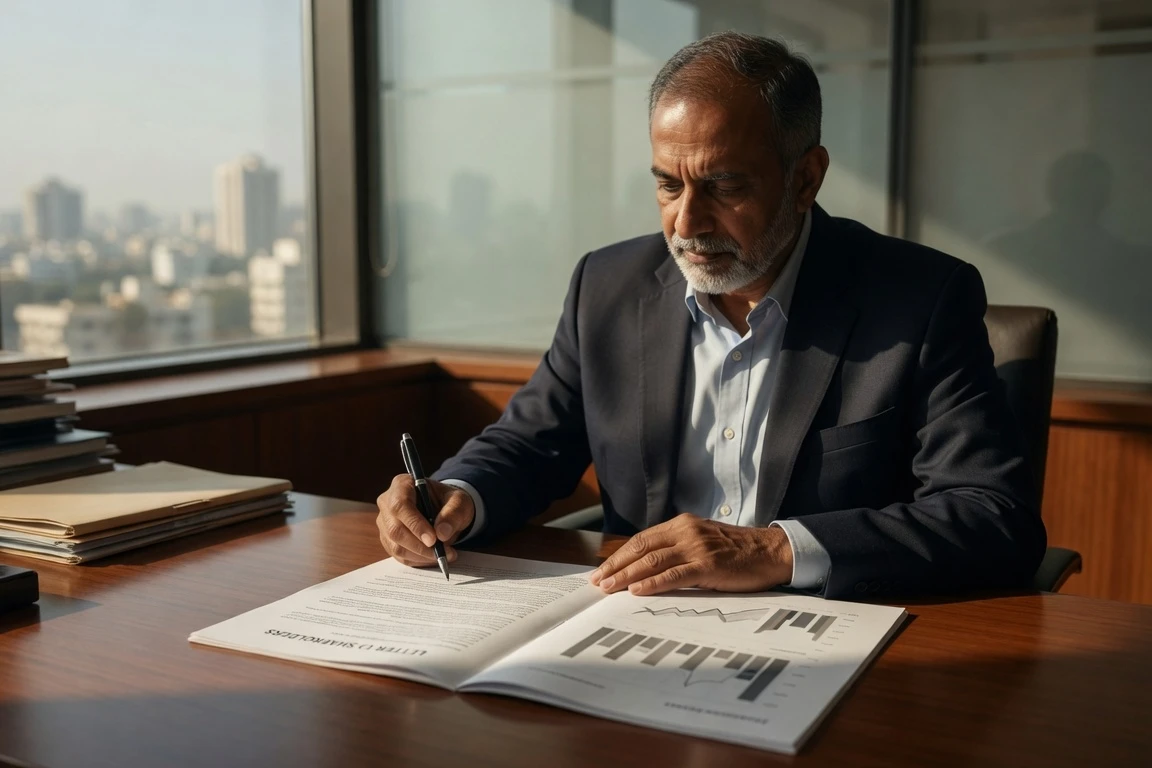
 Info Edge’s startup portfolio is now valued at roughly Rs 41,300 crore against Rs 4,900 crore deployed across 135 companies since 2007. That is an 8.4x multiple and an estimated 33% gross internal rate of return, written into a shareholder letter by founder Sanjeev Bikhchandani and filed with the National Stock Exchange and the BSE on 22 June 2026. Two listed companies built the bulk of that stack.
But the letter, a first-time standalone disclosure of an AI and deeptech sleeve, shows the next chapter of the bet has yet to find its own outlier. The AI and deeptech book, assembled since 2020, has so far returned paper multiples far short of Eternal and PB Fintech, even as three of its companies have won government allocations.
Where the 8.4x Multiple Actually Comes From
The shareholder letter organises the 135-company portfolio into three buckets, each at a different point on the curve from outlay to liquidity. A consumer technology and consumer AI book, started in 2007, accounts for the overwhelming share of the marked value. An AI-only book, started around 2020, sits at a much earlier mark, and a deeptech book also from 2020 sits earlier still.
The older sleeve was built first. As of March 2025, the combined value of Info Edge’s shareholding in Eternal and PB Fintech alone stood at Rs 31,500 crore, a sum larger than the marked value of the entire AI and deeptech sleeve. The newer sleeves are still compounding quietly, with the standalone AI book returning 2.1x at a ~31% gross IRR. The deeptech book returns 1.2x at ~15%, and neither is yet a Zomato.
Here is how the three disclosed sleeves line up. Figures for each sleeve are drawn from the shareholder letter filed on 22 June 2026 as reported by the Economic Times, MediaNama and YourStory. The total across all 135 companies, including older bets not allocated to one of these three sleeves, is roughly Rs 4,900 crore in and roughly Rs 41,300 crore out, at the 8.4x multiple Bikhchandani cites. Across the company’s AIFs, the combined gross IRR stands at ~22%.
| Sleeve | Companies | Capital deployed | Marked value | Multiple | Gross IRR |
|---|---|---|---|---|---|
| Consumer tech and consumer AI (since 2007) | 45 | Rs 2,755 crore | Rs 37,214 crore | 13.5x | ~34% |
| AI (since 2020) | 28 | Rs 614 crore | Rs 1,268 crore | 2.1x | ~31% |
| Deeptech (since 2020) | 30 | Rs 455 crore | Rs 559 crore | 1.2x | ~15% |
Two Listed Bets Built Most of the Wealth
The 13.5x multiple on the consumer technology sleeve is not a broad-based outcome. It rests on two companies. Info Edge first invested in Policybazaar in 2008 and in Zomato in 2010, at pre-money valuations of approximately Rs 21 crore and Rs 9.4 crore respectively, the same figures the letter flags to push back against the venture consensus that entry price no longer matters at the early stage. Both companies are now listed.
Eternal houses Zomato and Blinkit under a single corporate roof. PB Fintech operates the Policybazaar insurance aggregator and the Paisabazaar credit marketplace. Together they are the only two listed exits among the 135 portfolio companies, and the value of Info Edge’s shareholding in them, at Rs 31,500 crore as of March 2025, makes up the great majority of the 13.5x multiple. The remaining 43 consumer technology holdings in the sleeve have collectively produced much smaller markups so far.
The 2020 Bet on 54 AI and Deeptech Companies
The AI and deeptech sleeve was assembled before either sector was a global consensus trade. Info Edge deployed over Rs 1,003 crore across 54 AI-native and deeptech companies between 2020 and March 2026, spanning enterprise AI, robotics, semiconductors, space tech, biotech and electric mobility. The combined fair value of those 54 holdings stood at Rs 1,827 crore as of March 2026, a 1.8x multiple on a much younger book, per MediaNama’s reporting of the letter.
Of the 28 pure-AI companies in the sub-sleeve, 15 have already raised externally led follow-on rounds from institutional investors including Insight Partners, Peak XV, SIG and Vertex. Of the 30 deeptech companies, 13 have attracted external institutional capital. The standalone AI sub-book returns 2.1x at ~31% gross IRR, while the deeptech sub-book returns 1.2x at ~15%, with most bets still at the IP and R&D stage. The letter calls the deeptech book younger, riskier, and backed almost entirely at the IP and R&D stage.
Three of the 54 companies have already pulled state capital into the portfolio, validating the 2020 timing in a different register than markups. Each one is now tied to a flagship government programme. The grants are designed to crowd in private capital alongside the state cheque.
- Gnani.ai, a voice-first agentic AI platform for enterprises, was selected under the IndiaAI Mission and received Rs 177 crore of government GPU compute credits. The company was featured at the IndiaAI Summit 2026.
- ePlane, an electric aircraft maker, secured Rs 285 crore under the new Research, Development and Innovation (RDI) Scheme, the single largest national allocation out of 22 approved proposals.
- Manastu Space, a satellite propulsion startup, received Rs 115 crore under the same RDI Scheme. Both RDI allocations are conditional on the startups raising matching capital from private investors.
The deeptech sleeve’s standout operating business is Unbox Robotics, a profitable swarm-robotics company for warehouse automation that has built a substantial international deployment footprint. In January 2026, Unbox closed a Series B round of $28 million, about Rs 243 crore, led by ICICI Venture with participation from Redstart Labs, a subsidiary of Info Edge, according to Unbox Robotics’ $28 million Series B round details. Beyond Unbox, the deeptech sleeve includes ePlane, Manastu Space, Bharat Semi, Matter Motors, Temple and LAT Aerospace, the last two associated with Zomato co-founder Deepinder Goyal.
Why Intermediate Markups Are Not Exits
Every multiple in the letter is a paper number until it is converted to cash. A higher mark on the AI book, for example, rests on the price a later institutional investor agreed to pay in a fresh funding round, or on an independent valuation, not on money that has been banked. Info Edge revises a company’s value upward only when an outside investor enters at a higher valuation, or an independent valuer agrees the business merits it, and marks it down when a company underperforms or raises at a lower price. This is why the company calls its current gains intermediate markups rather than profits.
Bikhchandani is explicit about this. The letter treats interim return figures with a generous pinch of salt. ‘We await either exits from investments or IPOs of companies to fathom the real IRRs,’ he writes. Early stage investing, he notes, requires seven to ten years before results become legible, and several portfolio companies still carry early-stage mortality risk even after being marked up.
- 135 startups in the portfolio since 2007
- ~Rs 4,900 crore total deployed by Info Edge and external AIF partners
- 8.4x multiple on the marked value of the portfolio
- 22 RDI Scheme approvals in the inaugural cohort, of which one Info Edge company took the largest
- 7 to 10 years the average wait to convert an early-stage markup into a real exit
The Operating Model Behind 18 Years of Patience
Two structural choices explain why Info Edge has been able to stay invested across cycles. The first is duration. The company runs 12-year funds with a 2-year extension, the longest in Indian venture, and deliberately keeps fund corpuses small. Fund size, Bikhchandani argues in the letter, is the enemy of returns: large funds force managers to deploy capital into weaker deals and exit too early. The second is balance-sheet funding. Cash flows from Naukri.com, the jobs portal the company launched in 1997, fund a significant portion of the AIF corpus, freeing the investing team from the fundraising cycle that constrains most venture managers.
This gives our investing team an unfair advantage: they don’t have to spend an inordinate amount of time raising money and can instead focus on the real job of identifying and investing in startups.
On entry prices, the letter pushes back against a now-popular view in venture circles that price paid should not matter at the early stage. The company likes to come in early and be disciplined about the entry price, the letter says, since expensive early rounds almost always hinder a company’s ability to raise capital during difficult periods. The 2008 Policybazaar and 2010 Zomato entries anchor that view in practice.
The letter also quantifies the discipline behind deal selection. Info Edge evaluates a few hundred companies every quarter, the company says, and invests in only three to four. The filter looks for team quality, an interesting unsolved problem, early operational traction, the potential to build intellectual property, product innovation and emerging network effects. The company is willing to increase its stake in proven winners, the letter states, citing the 2008 Policybazaar and 2010 Zomato entries as the very cornerstone of what it does. Sanjeev Bikhchandani’s biography and business background covers his career and the early years of Info Edge.
Future Value Rests on Three Themes
The letter identifies three themes as the primary drivers of future value: artificial intelligence, deeptech and consumer technology. ‘In our view, India is entering a period where globally relevant technology companies will increasingly be built from India, not just for India,’ it states. The same themes anchor Info Edge’s operating businesses as well as its investment portfolio.
That shift is already visible inside the parent. Naukri.com is now deploying AI across search, matching, recruiter productivity and candidate engagement. Shiksha, the education classifieds business, has had to pivot its model under AI-driven traffic shifts. The investor question, which Bikhchandani does not pretend to answer, is whether the AI and deeptech sleeve can produce an outlier on the scale of Eternal or PB Fintech. As he puts it in the letter’s closing line, ‘a large part of the value in our recent investments, we believe, remains unrealised and ahead of us.’ That is the bet still working itself out.
Frequently Asked Questions
How much has Info Edge invested in startups in total?
Info Edge and its group companies have put in approximately Rs 3,600 crore across 135 startups since 2007. External limited partners in Info Edge’s AIFs added about Rs 1,300 crore, taking gross capital deployed to roughly Rs 4,900 crore, per the 22 June 2026 shareholder letter.
What is the current value of Info Edge’s startup portfolio?
The 135-company portfolio is now carried at roughly Rs 41,300 crore, an 8.4x multiple on invested capital and an estimated 33% gross IRR, according to the same shareholder letter filed on 22 June 2026.
Which Info Edge bets are worth the most?
Eternal, the listed parent of Zomato and Blinkit, and PB Fintech, the listed parent of Policybazaar. As of March 2025, Info Edge’s combined shareholding in the two companies was worth Rs 31,500 crore, the bulk of the portfolio’s marked value.
How much has Info Edge put into AI and deeptech?
Over Rs 1,003 crore across 54 AI-native and deeptech companies since 2020, including Rs 614 crore in 28 AI companies and Rs 455 crore in 30 deeptech companies. The combined fair value of those 54 companies stood at Rs 1,827 crore as of March 2026, per the shareholder letter as reported by MediaNama.
How long does Info Edge hold its investments?
Info Edge runs 12-year funds with a 2-year extension, among the longest in Indian venture, and uses balance-sheet cash flows from Naukri.com to fund the AIF corpus.
Disclaimer: This article is for informational purposes only and does not constitute investment advice. Venture capital returns, particularly the intermediate multiples cited here, are paper markups until converted to cash through exits or IPOs. Readers should consult a qualified financial professional before making any investment decision. Figures are accurate as of 22 June 2026.
 Windows 11 KB5095093 Lands With Point-in-Time Restore and 35-Day Pause
  Meta Cuts Smart Glasses to $299 to Outflank Snap and Apple
  Messi Leads the 2026 World Cup Golden Boot Race After Two Matches
  Australia March On as Athapaththu Ton Lights Up T20 World Cup
  Galaxy Z Fold 8 Leak Reveals Colors, Storage, and a New Ultra Variant
  Ronaldo’s Six-World-Cup Record Leads a Matchday Full of Milestones