
 Ishan Crawford
 BP has launched a formal process to market its entire UK North Sea oil and gas business, ending six decades of production in the basin and putting five hubs that delivered about 117,000 barrels of oil equivalent per day up for sale. The move, announced by new chief executive Meg O’Neill, forms part of a wider portfolio cleanup aimed at higher-return assets elsewhere and lower debt.
The decision lands hardest on Aberdeen and the north-east of Scotland, where the last major international operator is preparing to leave, even as specialist buyers circle and the region’s offshore wind pipeline shows only limited new momentum.
Five Hubs, 1,100 Jobs and a $2 Billion Tag
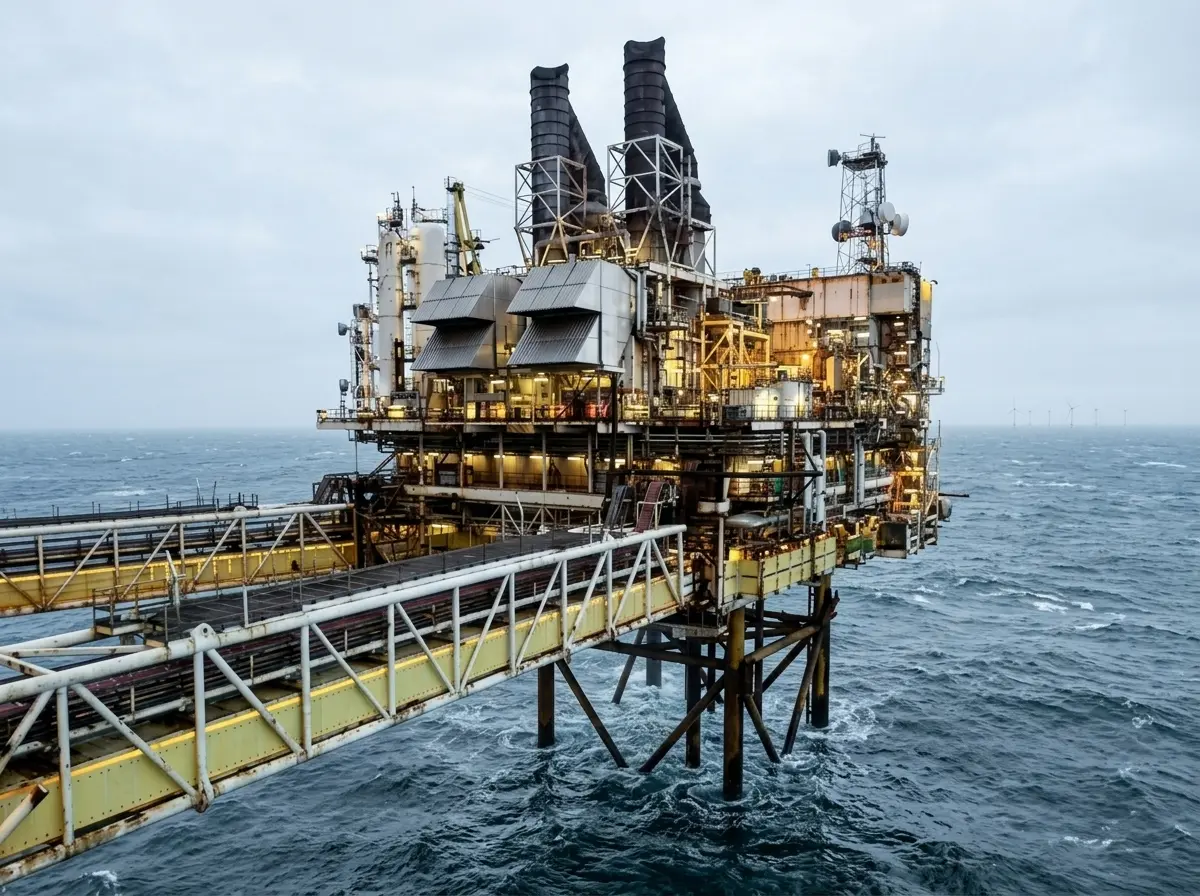
BP’s North Sea portfolio comprises five production hubs west of Shetland and central North Sea waters: Andrew and ETAP in the centre, plus Glen Lyon, Clair and Clair Ridge to the west. Clair remains the largest field on the UK continental shelf. In 2025 the business produced roughly 117,000 boed, about 5 percent of BP’s global output of 2.3 million boed. The company has already agreed to sell its Culzean stake, cutting UK volumes by a further 25,000 boed.
About 1,100 people work directly in the North Sea unit out of nearly 14,000 BP employees across the UK. Rystad Energy puts a risked value of roughly $2.6 billion on the package; industry sources have floated a sale price near $2 billion, with decommissioning liabilities expected to complicate any deal. Earlier talks with Ithaca Energy reportedly fell through.
| Hub | Location | Role |
|---|---|---|
| Clair / Clair Ridge | West of Shetland | Largest UKCS oil field complex |
| Glen Lyon | West of Shetland | Production hub |
| Andrew | Central North Sea | Production hub |
| ETAP | Central North Sea | Eastern Trough Area Project hub |
BP will keep its UK aviation fuel network, retail sites, EV charging, trading desk and London headquarters. O’Neill stressed continuity of safe operations during the process.
The North Sea remains integral to the UK’s energy system. However, as we focus our portfolio and direct capital to our highest-value opportunities, we believe our North Sea business will be better positioned as part of another company.
Meg O’Neill, BP chief executive, said the business still holds world-class people, resilient assets and a proud heritage that should attract an owner ready for its next chapter.
Why the Majors Keep Walking Away
UK North Sea operating costs average about $25.20 per barrel of oil equivalent in 2026 against a global average near $10.60, according to Rystad. Overall basin output has fallen to around 1 million boed from 4.5 million at the turn of the millennium. ExxonMobil, Chevron, ConocoPhillips, Shell, TotalEnergies and Eni have all reduced or exited exposure in recent years.
O’Neill’s overhaul since taking over in April has already restructured BP into two segments, sold the Gelsenkirchen refinery and launched a process for the Archaea biogas business. The North Sea call is framed as value discipline, not sentiment. UK policy uncertainty and the tax regime have repeatedly been cited by industry as deterrents to the long-cycle capital majors prefer.
Who Picks Up the Assets and Who Feels the Loss
Likely bidders include existing North Sea specialists: Ithaca Energy, the Shell-Equinor Adura joint venture, and NEO NEXT+ (linked to Total). Smaller or private-equity-backed operators have already been absorbing mature assets that majors no longer want, running them with lower overheads and extending field life.
- Independents and joint ventures gain scale and remaining reserves at a moment when commodity prices remain elevated by Middle East conflict.
- Aberdeen and the north-east supply chain lose a major anchor employer and the training pipeline that once fed both oil and emerging renewables work.
- The UK Treasury risks lower long-term receipts as large operators with complex tax affairs depart; smaller players may generate less absolute revenue even if they keep production going longer.
- Energy security arguments intensify because every major departure increases reliance on higher-emission imports while domestic gas output continues its steep drop in North Sea gas output.
Russell Borthwick of the Aberdeen & Grampian Chamber of Commerce called the exit another reminder that confidence has been shaken by policy uncertainty and what the industry terms punitive taxation. Scottish energy minister Stephen Gethins warned of uncertainty for workers and said reserved tax decisions were accelerating decline before renewables were ready. Reform and Conservative voices demanded approval of Jackdaw and Rosebank plus an end to the levy. Scottish Greens countered that most North Sea oil is exported and does little for domestic security.
Crowd reaction on X has been blunt: many in the north-east see a tax-driven catastrophe for home-based supply-chain workers who cannot simply follow the majors overseas, while others note that the same exit opens a clearer path for lean operators who specialise in late-life fields.
The Tax Reset Still Has to Prove Itself
Oil and gas firms currently face a headline rate of 78 percent: 30 percent ring-fence corporation tax, 10 percent supplementary charge and a 38 percent Energy Profits Levy. The EPL is due to run until March 2030 unless price floors are triggered earlier. Industry bodies have long argued the combination deters investment and that investment allowances have been tightened.
Treasury draft legislation replaces it with a permanent Oil and Gas Revenue Levy. The 35 percent levy on revenues above thresholds of $90 a barrel for oil and 90p a therm for gas will apply only in high-price periods, with thresholds rising annually by CPI. It sits on top of the 30 percent and 10 percent charges and is designed to capture exceptional profits while leaving normal returns less distorted.
Key tax numbers
- Current headline: 78 percent (30 + 10 + 38 EPL)
- New OGRL rate: 35 percent on revenue above $90/bbl or 90p/therm
- Thresholds: CPI-linked from the base levels
- Timing: after EPL ends in 2030 or earlier via the energy security mechanism
Whether the shift restores enough certainty for new capital remains untested. Companies still wait for clearer signals on field approvals and licensing.
Wind Projects Face Their Own Drag
Business leaders and campaigners agree renewables form Aberdeen’s long-term future, yet the expected manufacturing and operations work from roughly £26 billion of planned Scottish offshore projects has arrived more slowly than hoped. Only two Scottish projects secured contracts-for-difference in the latest government auction: SSE’s Berwick Bank phase and the Pentland floating project.
The January 2026 AR7 round was otherwise strong nationally, locking in 8.4 GW overall and the Berwick Bank and Pentland floating awards. Berwick Bank is the first new Scottish fixed project since 2022 and is planned as one of the world’s largest. Still, developers in northern Scotland point to transmission charging rules that favour generation closer to English demand centres. Supply-chain executives warn that if engineering expertise continues to migrate and local firms miss contracts through the rest of the decade, the broader transition becomes harder to sustain.
Parallel efforts such as North Sea hydrogen partnership plans aim to reuse skills and infrastructure, but they too depend on policy clarity and investment that has been slow to convert into steel in the water.
Rosebank, Jackdaw and the Political Fork
Public consultations on the Rosebank oil field and Jackdaw gas field have closed or are closing, leaving final decisions with Energy Secretary Miatta Fahnbulleh. Both projects earlier received consent that courts later found unlawful for failing to account for scope-3 emissions; revised environmental information has been submitted. Rosebank holds hundreds of millions of barrels; Jackdaw could supply a material share of UK gas.
Prime Minister Andy Burnham has signalled a “pragmatic” approach to North Sea resources, telling US President Trump the resource cannot be ignored while people struggle. That marks a shift in emphasis from the earlier manifesto stance against new licences, though existing commitments are still to be honoured. Fahnbulleh has said her priority is protecting workers and the local community through the BP sale process and that she remains in close contact with the company.
What we know
- BP sale process is live; no buyer or timeline confirmed.
- Headline tax moves from 78 percent EPL package toward a permanent high-price revenue levy.
- Two Scottish offshore wind projects won the latest CfD round.
- Basin production continues its multi-decade decline.
What remains unconfirmed
- Identity and terms of any BP North Sea buyer.
- Final government decisions on Rosebank and Jackdaw.
- Whether the new tax regime unlocks material new investment before 2030.
- Speed of Scottish supply-chain work from the wider ScotWind and related pipeline.
Climate groups including Uplift continue to urge rejection of the two fields so capital can move faster into new industries. Industry figures counter that domestic output supports security during the transition and cuts reliance on higher-emission imports. A recent survey also showed continued public backing for North Sea oil among Scots even alongside climate goals.
Aberdeen’s Dual Bet Gets Harder
BP’s departure does not shut the North Sea. Specialists have a track record of extending late-life fields that majors walk away from. Production will continue under new ownership if a deal closes. Yet the symbolic weight is real: the company that helped open the basin is leaving, and with it goes a training culture and balance-sheet depth that smaller operators do not automatically replace.
For Aberdeen the loss arrives while offshore wind work is still uneven and transmission rules remain a complaint. The skills that once moved from oil into renewables may now leave the region entirely if engineering houses follow the capital. The winners of the BP process will be the buyers who can run the five hubs leaner and the remaining independents who consolidate. The losers are the communities and supply chains that counted on a smoother bridge between the old industry and the new one, and a Treasury that may collect less over the longer run as the major operators thin out.
The sale process itself will test whether UK policy has left enough value on the table for a clean handover, or whether the mature basin simply becomes a smaller, quieter place.
 SEBI CAS Forces Options Traders to Recalibrate Closing Risk
  Sensex Drops 400 Points as Oil Spike Tests Market Resilience
  Ardee Industries IPO Rides Lead Recycling Boom at Discount
  Gold Nears 4300 but Iran Risks Cap Gains Ahead of NFP
  Scotland Construction Stalls as Skills and Tariffs Blunt Infra Gains
  Lok Sabha Bill Opens UPI Charges Path for Banks Over Merchants