
 Ishan Crawford
 Argonne National Laboratory and University of Chicago researchers released PyRET, an open-source Python package that calculates radiative and nonradiative resonance energy transfer rates between localized defects in solids from first principles. The code bridges electronic structure at the atomic scale with light propagation over device-relevant distances, a gap that has limited how far prior methods could guide real optical and quantum hardware.
Swarnabha Chattaraj, an Argonne postdoctoral appointee who led the software, and collaborators including Giulia Galli and Supratik Guha showed that a photonic cavity can raise or lower those transfer rates by nearly two orders of magnitude. That control points directly at denser optical memory and clearer pictures of energy and information loss in quantum systems.
What the Package Computes
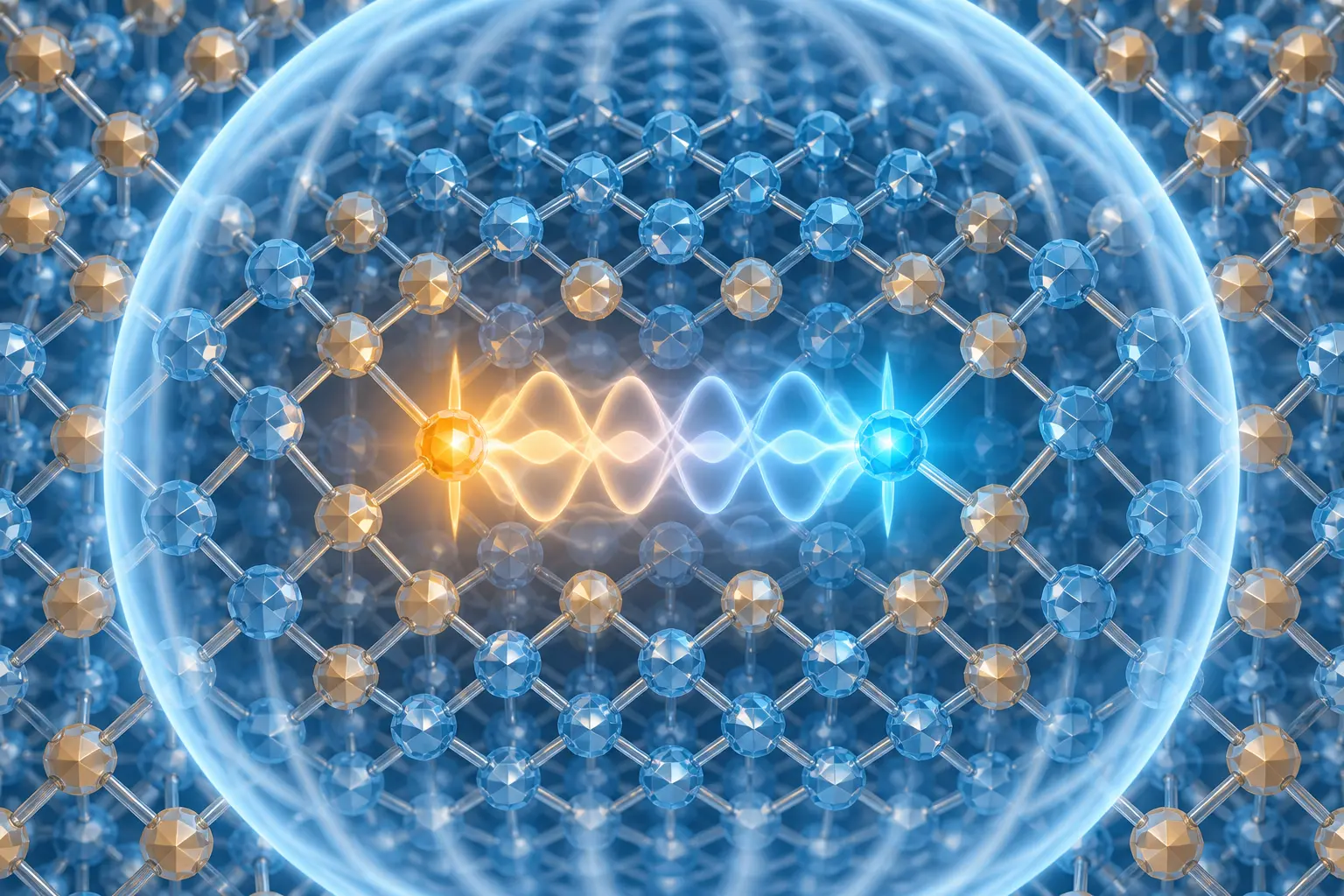
PyRET stands for Python package for Resonance Energy Transfer. It models the process in which one defect is excited, releases energy, and a nearby defect absorbs it. The calculation starts from the atomic structure and known physical laws rather than fitted experimental parameters or rough approximations.
The software takes wavefunctions from plane-wave density-functional codes such as Quantum ESPRESSO. It can also pull many-electron states from quantum defect embedding theory as implemented in the WEST code. It treats both radiative and nonradiative channels and uses a quantized multipolar basis for the photon modes under a generalized Pauli-Fierz description of light-matter interaction that includes orbital and spin degrees of freedom.
- Radiative and nonradiative resonant energy transfer rates between localized defects
- Input from single-particle orbitals and multireference many-body states
- Coupling to Quantum ESPRESSO wavefunctions and WEST quantum defect embedding
- Parallel execution via mpi4py for larger systems
Documentation and usage examples sit on the project site, and the PyRET repository on GitHub carries the GPL-3.0 code, install instructions, and example scripts.
The Scale Gap Device Designers Hit
Electronic behavior around a defect lives on a scale smaller than one nanometer. Light inside a material or device can travel tens or hundreds of nanometers. First-principles electronic-structure methods handle the former well but struggle when the system must grow to the size of a working device. Classical electromagnetic treatments of light often reduce emitters to point dipoles and lose the many-body and spin character of real defects.
| Aspect | Atomic electronic scale | Device light scale |
|---|---|---|
| Typical length | Less than 1 nm | Tens to hundreds of nm |
| Main physics | Defect orbitals, many-body states, spin | Photon modes, cavities, propagation |
| Common prior limit | Small supercells only | Dipole approximation, fitted rates |
| PyRET role | Imports DFT/QDET states | Adds multipolar photon continuum and cavity response |
Chattaraj put the problem plainly: if researchers want to design real devices, they have to understand both the atom-scale behavior of the defects and the longer-range movement of light. PyRET brings those two pieces together.
If we want to design real devices, we have to understand both the atom-scale behavior of the defects and the longer-range movement of light. PyRET brings those two pieces together.
That statement comes from Chattaraj in the Argonne announcement. The same point appears across the supporting papers: without a quantitative bridge, energy transfer remains either an uncontrolled leak or an unexploited resource.
Cavities Shift Rates by Nearly Two Orders
In the second Physical Review Research paper, the team applied the framework to a concrete case: energy transfer from a dipole-like source to an F center in MgO inside a spherical cavity. They found that tuning the cavity mode relative to the emitter transition can enhance or suppress specific spin-conserving and spin-flip channels.
Key numbers from the calculations include:
- ~10 to 100 times higher resonant energy transfer rate at roughly 10 nm separation with a moderate cavity quality factor Q ~ 400
- Comparable suppression when the cavity is deliberately detuned from the transition energy
- Applicability to micro-spheres, core-shell nanoparticles, and dielectric Mie resonators as well as other cavity geometries
The Argonne release summarizes the same result as a change of nearly two orders of magnitude. That swing is large enough to matter for write and read operations in a proposed class of ultra-dense optical memories. In the picture developed in the papers, an ensemble of narrow-band source emitters can transfer excitation to nearby trap defects; a cavity mode selectively activates the transfer for a chosen subset of emitters, turning the memory write process on or off.
The full theoretical development and MgO example appear in the first-principles cavity energy-transfer paper (arXiv:2505.15752, later Phys. Rev. Research). An earlier companion paper laid out the homogeneous-medium near-field framework.
Open Code and the MICCoM Pipeline
PyRET is public so other groups can run, test, and extend it. Chattaraj noted that open access helps build a community around the problem and is part of doing open science. The work sits inside the broader effort of the Argonne-based Midwest Integrated Center for Computational Materials, which develops interoperable open-source tools and data aimed at functional materials for low-power electronics and quantum technologies.
Funding came through the Extreme Lithography & Materials Innovation Center, a DOE Office of Science Microelectronics Science Research Center. That placement ties the software directly to the materials challenges of shrinking microelectronics and introducing new defect-based components. Readers following how advanced ceramics entering chip supply chains are reshaping materials options will recognize the same pressure: predictive tools for defects and interfaces are becoming as important as new physical materials themselves.
Installation is standard: clone the repo, install with pip after pymatgen and parallel h5py, then add westpy if embedding calculations are needed. The full PyRET documentation and examples walk through wavefunction extraction and rate calculations. The same ecosystem that produced WEST and related defect codes now offers a dedicated RET layer on top.
Where Denser Memory and Quieter Qubits Meet
In some systems energy transfer is the feature. Optical memory concepts that store far more data in the same volume rely on controlled hand-off from addressable emitters to trap sites. Cavity-mediated rates give a physical handle on that hand-off. In other systems the same process is the bug: unwanted transfer near a carefully prepared defect becomes an energy or information leak that shortens coherence or blurs a signal.
PyRET gives device teams a way to quantify both sides before a wafer is cut. Designers can ask how far two defects can sit before transfer becomes significant, whether a cavity of realistic Q can gate the process, and which spin channels dominate. Those answers feed layout choices for photonic crystals, micropillars, whispering-gallery resonators, and hybrid classical-quantum chips.
The longer-term payoff listed by the team includes better maps of decoherence pathways in solid-state quantum platforms and support for next-generation materials that store and move information more efficiently. Because the method stays first-principles and many-body, it can travel with new host crystals and new defect species rather than requiring a fresh round of experimental fitting for each combination.
Design Practice Shifts Once Rates Become Predictable
Previous workflows often mixed small-cell electronic structure with classical Green-function electromagnetics under the dipole approximation. That combination works for quick estimates but breaks when multireference character, spin selection rules, or non-local multipolar coupling matter. PyRET removes the need to choose one side of the scale divide. A researcher can keep the full electronic description of the defects and still fold in a continuum of cavity-modified photon modes.
The immediate practical change is workflow order. Instead of fabricating a cavity and measuring transfer after the fact, groups can screen cavity geometries and defect placements in simulation, then build only the promising candidates. For optical-memory concepts that require selective addressing of dense emitter ensembles, that screening step can decide whether a given host and cavity Q are even viable. For quantum devices, the same step flags geometries that suppress leak channels while leaving desired optical interfaces intact.
Because the code is open and tied to widely used packages (Quantum ESPRESSO, WEST), it can slot into existing high-performance computing pipelines rather than demanding a new software stack. The MICCoM open computational materials tools already emphasize interoperable codes for defects and interfaces; PyRET extends that family into the energy-transfer problem that sits between spectroscopy and device layout.
No broad public conversation has formed on X or similar channels yet. The release is only a day old and the audience is specialized. Early use will almost certainly appear first as citations and method sections in follow-on computational papers, then as design inputs inside microelectronics and quantum groups that already run defect calculations.
Frequently Asked Questions
What does PyRET stand for and what problem does it solve?
PyRET means Python package for Resonance Energy Transfer. It computes rates for energy moving from one localized solid-state defect to another, including both light-mediated and nonradiative channels, starting from atomic structure and electronic wavefunctions instead of experimental fitting constants.
How much can a photonic cavity change the transfer rate?
Calculations for an F center in MgO show roughly 10- to 100-fold enhancement at about 10 nm separation with a moderate cavity quality factor near 400; detuning the cavity produces similar suppression. The Argonne announcement rounds the same swing to nearly two orders of magnitude.
Which electronic-structure codes does PyRET connect to?
It reads plane-wave wavefunctions from Quantum ESPRESSO and many-body defect states from quantum defect embedding theory in WEST. Parallel HDF5 support and mpi4py keep the workflow usable on larger systems.
Is the software free to use and modify?
Yes. The code is released under the GPL-3.0 license on GitHub, with documentation, installation steps, and example scripts published on the project website so any research group can install, run, and extend it.
Who funded the work and which institutions are involved?
Development was supported by the Extreme Lithography & Materials Innovation Center under the DOE Office of Science, in partnership with the Midwest Integrated Center for Computational Materials at Argonne. Lead developers are at Argonne and the University of Chicago; other contributors include Supratik Guha and Giulia Galli.
 ONGC licence frees Venezuela cash and operatorship talks
  Anthropic Hits $65 Billion Run Rate and Flips the AI Cash Test
  Supreme Court grounds the fare free-for-all with three-week clock
  Gold Nears $4400 as Soft Data Meets Oil Inflation Risk
  Nifty Slips as Zaggle Circuits and Dhoot Debuts Big
  Diesel Crack Tops $100 as Iran Rhetoric Lifts Crude