
 Ishan Crawford
 Historic Environment Scotland has told its own board that Stirling Castle needs urgent repair work the agency cannot yet fully fund. Board papers cite health and safety risks, ageing electrical wiring and a Great Hall overdue for attention. The castle draws 600,000 visitors a year, HES’s second highest total after Edinburgh Castle, and the agency now calls it a top priority within current funding constraints.
The Architectural Heritage Society of Scotland (AHSS) says this is exactly what it has been warning about: years of spending tilted toward gift shops, lighting and visitor apps, not the stonework and wiring holding the building up.
Board Minutes Flag Wiring, Stonework and Safety Risks
The warning came out of a recent board meeting of HES, the public body that cares for Stirling Castle on behalf of Scottish Ministers. According to the minutes, members raised concerns about the condition of the site, covering both marketing and engagement and health and safety risks, and were told this is a top priority within current funding constraints. A fuller understanding of capital requirements is still being developed, the minutes state.
A spokesperson for HES said a number of routine maintenance projects had been identified, with a funding request due to go before the board. The proposed work spans several categories:
- Historic fabric repairs – across the site, including the Great Hall
- Structural repairs – to buildings and supporting infrastructure
- Mechanical and electrical upgrades – covering ageing systems such as visitor lighting
- Education and interpretation spaces – upgraded facilities for school groups and visitors
The spokesperson described it as part of a regular cycle, building on a refresh of the main gift shop, roof repairs across the site and earlier electrical upgrades. The castle’s own visitor page already reflects some of the strain: it currently warns that its car park is closed to most vehicles because of structural issues, with visitors redirected to a park and ride service instead.
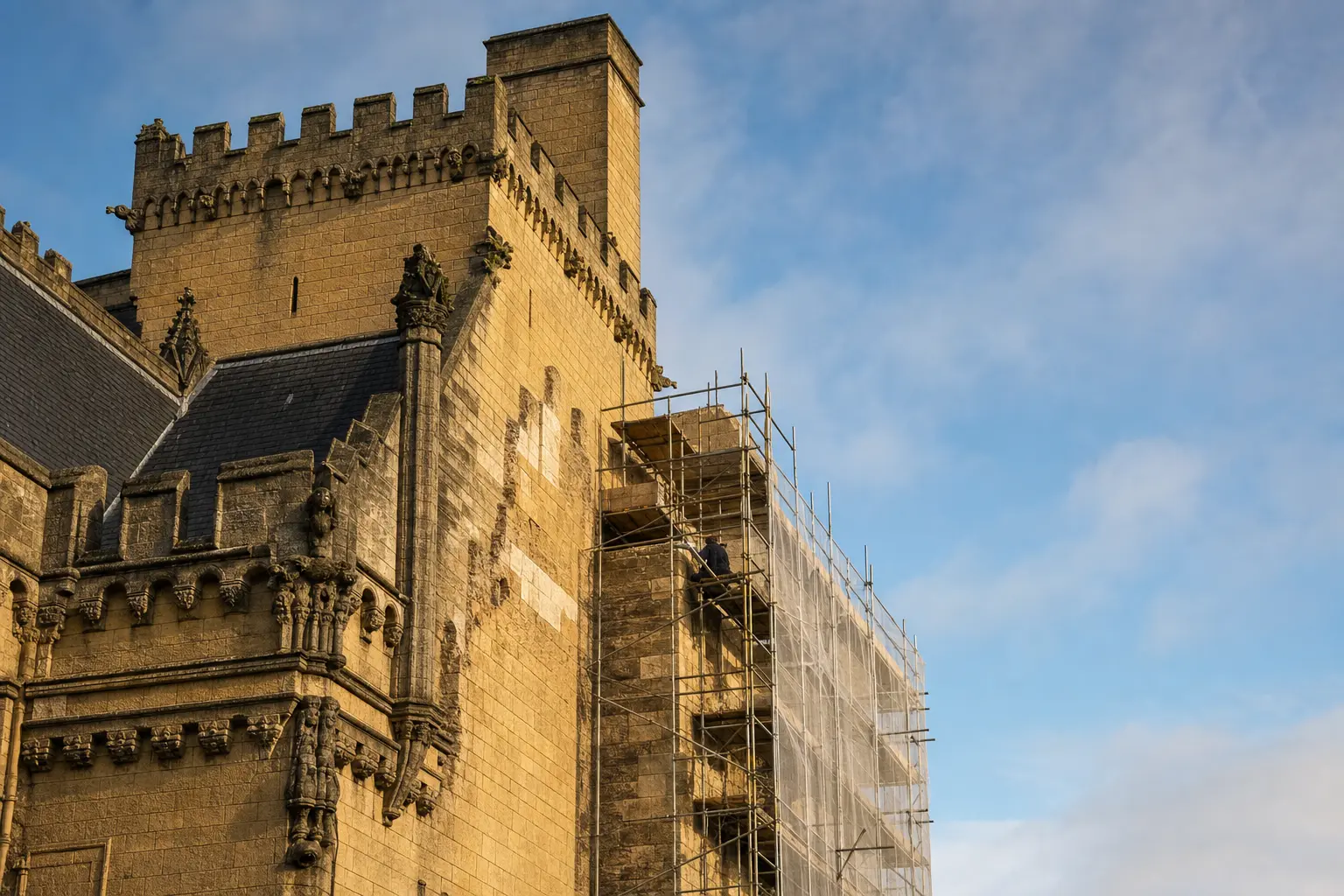
A Great Hall Bill Twenty-Five Years in the Waiting
Stirling Castle’s story stretches back nearly a thousand years, and the Great Hall at its center carries centuries of royal use. The timeline behind the current warning runs like this:
- Early 1100s – the first fortifications rise on Stirling’s volcanic crag above the River Forth.
- 1496 – the King’s Old Building is completed for King James IV.
- 1503 – the Great Hall, the castle’s grandest medieval space, is finished.
- 1603 – the Union of the Crowns ends the pattern of monarchs living, being crowned or dying at the castle.
- 1999 – a ten-year, £8.5 million refurbishment of the Great Hall wraps up.
- 2026 – HES’s board records Stirling Castle as a top priority within current funding constraints.
Jocelyn Cunliffe, chair of the AHSS, said HES had likely carried out a fabric condition report that uncovered the problems. She noted the maths behind the timeline herself, pointing out the castle is now roughly 25 years past its last major overhaul, meaning building services in particular are due a rethink.
The Funding Numbers Behind the Warning
Stirling Castle’s troubles sit inside a wider financial squeeze across Scottish heritage. A pre-budget scrutiny paper prepared for the Scottish Parliament’s Constitution, Europe, External Affairs and Culture Committee shows HES saw a roughly £2 million cut to its Scottish Government grant in aid in 2025-26, offset partly by a £2 million rise in its capital budget. The same evidence estimated the wider historic environment sector’s capital maintenance backlog runs into the tens of millions of pounds, with rising energy costs, rent and materials pricing described by many organizations as unsustainable.
Here is where the numbers stand right now:
| Metric | Latest Figure | Period |
|---|---|---|
| Stirling Castle annual visitors | 600,000 | Current; HES’s second busiest site |
| HES grant in aid change | Cut of about £2 million | 2025 to 2026 |
| HES capital budget change | Increase of about £2 million | 2025 to 2026 |
| Heritage sector maintenance backlog | Tens of millions of pounds | Sector-wide estimate |
| New heritage jobs needed nationally | 10,000 | Over the next decade |
| Properties in HES’s statutory care | 336 | 2024 to 2025 report year |
HES also told the committee that 68% of employers it surveyed expect a heritage skills shortage within five years, in trades such as stonemasonry and lime plastering. That is the same workforce Stirling Castle will need to fix its Great Hall and its wiring.
Fabric First Versus the Visitor Experience
Cunliffe said the AHSS has previously raised concerns about HES focusing on visitor experience rather than sticking to regular repair schedules. Some properties in care generate significant revenue and some do not, she said, and Edinburgh and Stirling are the two big earners. From the AHSS’s perspective, the group takes issue when HES spends more on visitor experience and interpretation than on keeping the fabric in good repair.
Recent additions to Stirling’s visitor offer include after-hours tours through the castle’s hidden corners, alongside handheld guides and touchscreen displays. Cunliffe said high-tech interpretation tools cost a lot to maintain and can become obsolete when technology moves on. She is not arguing against interpretation altogether. Her point is that a visitor can experience a space without it if money is tight.
HES frames the same spending as necessary to meet rising visitor expectations at a site facing ageing facilities, climate change and construction cost inflation, according to its own statement. The agency has also opened a consultation on a long-term strategy for targeting care at the sites that need it most, a document that explicitly names climate change and rising costs as pressures shaping future decisions.
Admission Prices May Climb to Cover the Gap
Board papers also reveal that a rise in admission prices is being considered. Members want any increase reinvested into the specific properties generating it, particularly Edinburgh and Stirling castles, with the minutes noting the importance of ringfencing income from pricing changes for those key sites.
Cunliffe is uneasy about that plan.
It does worry me that they are pricing themselves beyond the pocket of Scottish families.
Cunliffe argues HES is increasingly appealing to international visitors already used to paying steep admission fees elsewhere. Funding repairs through ticket price rises does not sit right with her. She believes the money should instead come from the Scottish Government’s block grant or other funding sources, not from the entrance gate. The tension echoes a wider pattern across Scotland, where heritage bodies keep weighing preservation against commercial pressure, as seen recently in a Glasgow venue’s redevelopment despite heritage objections.
Is Stirling Castle’s Repair Bill a Scotland-Wide Problem?
Yes. Stirling Castle’s wiring and stonework troubles mirror a national pattern: Scotland’s historic buildings are ageing faster than the money to fix them arrives, and electrical systems are a recurring flashpoint. Climate change, construction inflation and a shrinking skilled workforce are squeezing HES and smaller heritage owners alike.
Government data shows 86% of Scots say it matters that the country’s heritage is well looked after, yet only 69% think their local heritage is actually well cared for. Only 15% of all investment in Scotland’s historic environment comes from the heritage sector itself, with homeowners and the private sector covering 60% and the public and third sectors making up the rest.
Ageing electrical systems are not unique to castles. The same fire safety questions have surfaced in old wiring fittings found across ordinary UK homes, a reminder that Stirling’s ageing mechanical and electrical services sit inside a much bigger national maintenance problem, not an isolated castle issue.
HES says the next planning and funding bid cycle opens in the coming months, when the scale of Stirling Castle’s repair bill should finally come into sharper focus.
Frequently Asked Questions
How much does it currently cost to visit Stirling Castle?
Visitor guides put 2026 adult admission at roughly £17.50 to £20, with family bundles covering two adults and up to three children priced around £45 to £50. Historic Scotland typically reviews prices each April, separate from any repair-linked rise the board is now weighing.
Who actually owns and manages Stirling Castle?
Historic Environment Scotland manages the castle on behalf of Scottish Ministers. HES is registered as a Scottish charity, number SC045925, and cares for 336 properties in total under its statutory Properties in Care remit.
What is the Great Hall used for today?
Beyond daytime tours, Stirling Castle markets its spaces, including the Great Hall, as a venue for weddings, private functions and celebrations, giving HES an additional revenue stream tied directly to the building’s upkeep.
How big is heritage tourism in Scotland overall?
Government figures show more than 18 million people visited Scottish heritage attractions in 2019, spending over £3.2 billion, a scale comparable to the country’s shipbuilding and aerospace industries combined.
 ONGC licence frees Venezuela cash and operatorship talks
  Anthropic Hits $65 Billion Run Rate and Flips the AI Cash Test
  Supreme Court grounds the fare free-for-all with three-week clock
  Gold Nears $4400 as Soft Data Meets Oil Inflation Risk
  Nifty Slips as Zaggle Circuits and Dhoot Debuts Big
  Diesel Crack Tops $100 as Iran Rhetoric Lifts Crude