
 Ishan Crawford
 The foldable phone market is bracing for its busiest stretch yet. Apple’s first foldable iPhone is widely expected to ship this fall, joining a release calendar already crowded with new releases from Samsung, Huawei and a fleet of Chinese brands. IDC expects the lineup to lift 2026 foldable shipments by 30% over the prior year.
The sequence is already visible. Samsung is hosting an Unpacked event in London on July 22 with three new Galaxy foldables on the bill, while Huawei lines up the next entries in its Mate X family. An iPhone at $2,000-plus is widely tipped for September, alongside the iPhone 18 lineup. DIGITIMES reported the wider view on Monday, and Counterpoint Research has framed 2026 as a new competitive phase for the category.
IDC Forecasts a 30% Lift as the Launches Stack Up
The foldable category has spent most of its history as a niche. Counterpoint Research put it at 1.6% of the overall smartphone market in 2025, a small share carrying almost all of the industry’s premium pricing. The two forecasts now covering 2026 both say that share is about to grow fast, and for related reasons.
IDC’s Worldwide Quarterly Mobile Phone Tracker projected on December 9, 2025 that foldable shipments would climb 30% year-on-year in 2026, an upgrade from the 10% growth IDC had pencilled in for 2025 at 20.6 million units. The 30% foldable shipment forecast for 2026 anchors the optimistic read of the year. Counterpoint’s March 2026 outlook lands more conservatively at 20% year-on-year growth, smaller than IDC’s number but still a step-change for a category that has rarely cleared single digits. Both forecasts read the same way: 2026 is the year the form factor closes the gap with the rest of the smartphone market.
The math behind both forecasts is similar: Samsung opens the year with its first mass-market tri-fold phone, Huawei’s HarmonyOS Next foldables gain momentum through the year, and Apple’s late entry is expected to drag demand higher. Counterpoint expects early Apple buyers to come mostly from the existing iPhone base, with Android switchers floating over from book-type devices.
Samsung’s Galaxy Z TriFold, on sale in Korea from December 2025 and now rolling out across additional markets, “will kick start 2026,” Nabila Popal, IDC’s senior research director for the Worldwide Quarterly Mobile Phone Tracker, said in the December release. Francisco Jeronimo, vice president of client devices at IDC, framed Apple’s arrival as a turning point for the category, with the first foldable iPhone projected to capture over 22% unit share and 34% of foldables market value in its first year. The expected average selling price of $2,400 is roughly three times the figure for a standard smartphone, per the same release.
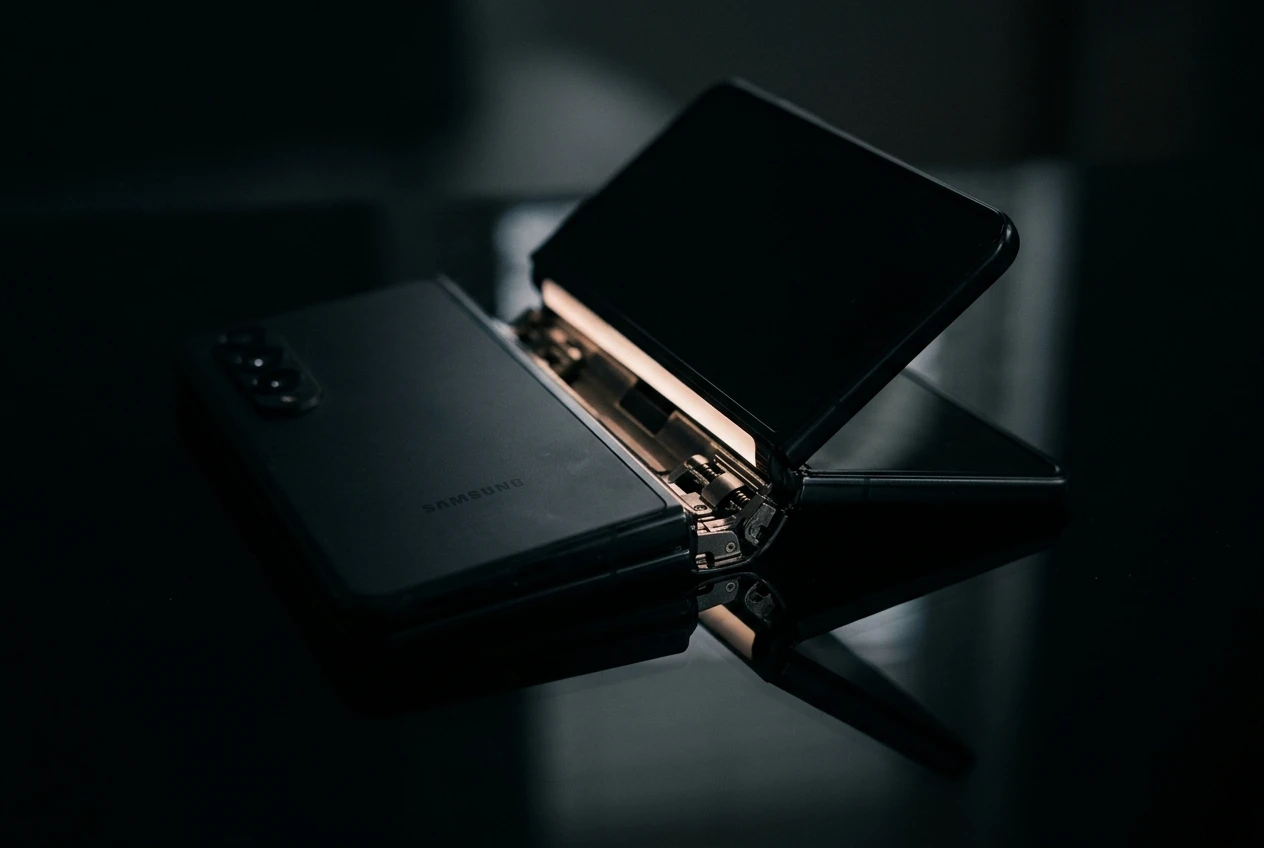
Samsung Goes Three-Wide in London
Samsung is staging its broadest foldable showcase yet. The company will host an Unpacked event in London on July 22, with three new foldables expected on the bill: the Galaxy Z Fold 8, a new landscape-oriented Wide variant and the Galaxy Z Flip 8 clamshell. Pre-orders are expected to open the same day, with shipping roughly two weeks later, putting first availability around August 7. The Wide variant is positioned as a direct counter to Apple’s book-style iPhone Fold, with a 4:3 outer screen built to look more like a tablet when unfolded and a phone when closed. Samsung is leaning on three devices at once to defend the premium foldable ground it defined.
The Galaxy Z Fold 8 Ultra is the tall book-style replacement for the Z Fold 7, with launches expected in the third quarter of the year. The new Galaxy Z Fold 8 Wide is lighter and built around the 4:3 outer screen, designed to compete directly with Apple’s first book-style foldable. The Galaxy Z Flip 8 stays in the clamshell lane, leaving the Ultra as the only vertically tall book-style option in the lineup.
- Galaxy Z Fold 8 Ultra: Tall book-style; Snapdragon 8 Elite Gen 5; 200MP main camera, 50MP ultrawide, 10MP 3x telephoto; 5,000 mAh battery with 45W charging; 4.1mm unfolded thickness; 215 grams; Cream, Graphite, Green Shadow and Violet Shadow finishes; storage 256GB / 512GB / 1TB
- Galaxy Z Fold 8 Wide: New landscape 4:3 design; 5.4-inch cover screen and 7.6-inch inner panel; dual 50MP cameras with no telephoto; 4,800 mAh battery with 45W charging; 201 grams; Snapdragon 8 Elite Gen 5; Cream, Graphite, Lavender and Pistachio finishes; storage 256GB / 512GB / 1TB
- Galaxy Z Flip 8: Clamshell form factor; Exynos 2600 chipset; 256GB or 512GB storage; Cream, Graphite, Mint and Pink color options
The Galaxy Z TriFold sits above the new lineup, and Samsung set the bar with the device’s December announcement. First sold in Korea on December 12, 2025, with additional markets including China, Taiwan, Singapore, the UAE and the U.S. to follow, the TriFold reveals a 10-inch main display when fully unfolded twice. The device measures 3.9 millimeters at its thinnest point and carries a 5,600 mAh battery split across three panels, per the Galaxy Z TriFold product announcement. Samsung described the engineering goal as “the perfect balance between portability, premium performance and productivity” in comments from TM Roh, chief executive of the Device eXperience Division.
Apple’s First Foldable Takes Shape
Apple’s reveal is widely expected to land in September as part of the iPhone 18 family, the tightest reading in a string of leaks that has run through 2024 and 2025. CAD drawings that circulated in late 2025 put the inner screen at 7.76 inches with a 2,713-by-1,920 resolution, dimensions that would make the unfolded device closer to an iPad mini than a phone, with a folded thickness just over 11 millimeters. A January 2026 note from analyst Jeff Pu pegged the inner display at 7.8 inches with a 5.3-inch outer screen. The hinge is reported to use a liquidmetal alloy, with a February 2026 claim that Apple’s design makes the visible crease a quarter of the depth of the Galaxy Fold 7.
- 2024: The rumor mill settles on a 2026 or 2027 launch window after years of repeated slippage
- Late 2025: CAD drawings circulate showing a 7.76-inch internal display, a 2,713-by-1,920 resolution and a folded thickness around 11 millimeters
- December 2025 / January 2026: Analyst Jeff Pu pegs the inner screen at 7.8 inches with a 5.3-inch outer display
- February 2026: A leak claims Apple’s hinge design makes the visible crease a quarter of the depth of the Galaxy Fold 7
- March 2026: Weibo-based pricing sketches 256GB at about $2,325, 512GB at $2,645 and 1TB at $2,905
Display sourcing for the launch year has been settled for some time. Apple is working exclusively with Samsung Display on the foldable OLED under a three-year deal that runs through 2029 or 2030, a detail that makes Samsung Display the single largest supply-side bottleneck for every iPhone Fold sold in year one. Pricing is the open variable. Ming-Chi Kuo forecast a $2,000 to $2,500 range in March 2025, and Bloomberg framed Apple’s opening price as north of $2,000 in its own March 2026 reporting. The most concrete public reading landed on Weibo the same month: roughly $2,325 for the 256GB model, $2,645 for 512GB and $2,905 for the 1TB top configuration. Counterpoint expects Apple to take 28% of foldable shipments in its first year, with the disruption concentrated in North America.
Huawei and the Chinese Field a Triple Play
Huawei opens the China side of the wave. A December 2025 note from Weibo analyst DigitalChatStation, picked up by industry coverage, listed two new Huawei foldables on this year’s roadmap: a large book-type Mate X and a Mate XT 2 triple-fold successor. IDC’s December 2025 release expects Huawei’s HarmonyOS Next foldables to almost double shipments in 2026, on top of a 2025 base that was constrained as much by the software transition as by hardware supply.
The rest of the Chinese field is leaning the same direction. OPPO is working on a Find N6 foldable for a mid-March debut, and Vivo is lining up an X Fold 6 for the second quarter of the year, per the same DigitalChatStation coverage. Honor is set to debut the Magic V6 at MWC in early March, with at least one additional wide-screen fold in the pipeline aimed at Apple’s book-style device. Xiaomi complicates the picture with two book-type designs, a Mix Tri-fold and a Xiaomi 17 Fold, both rumored for 2026.
The collective read from the Weibo leaker is that the top five Chinese foldable makers have moved their roadmaps toward larger book-style designs in 2026, in part because Apple’s arrival forces the premium end of the book-type conversation. Huawei’s Pura X Max wide fold, already on sale in China, gives the company a price and a form factor on every shelf.
Adding a triple-fold sequel puts pressure on Samsung’s TriFold, the one device in the 2026 lineup no other major brand has matched at scale. The Mate X family, last refreshed two years ago, returns to a category that has moved on without it. For Huawei, 2026 amounts to both a re-entry year and a launch year.
Buyers Face a New Price Floor
Pricing is the variable that turns the category’s growth call from encouraging to uncomfortable. IDC’s working assumption puts the Apple foldable’s average selling price at 3 times the figure for a standard smartphone, landing at $2,400 per the same December release. Counterpoint has separately framed category premiumization as the structural driver behind 2026’s lift. The expected $2,000-plus floor on the iPhone pulls the benchmark for every book-style device into a higher tier across the rest of the market.
The Galaxy Z TriFold sits at the announced-price ceiling in 2026, and the Galaxy Z Fold 8 Wide is positioned inside Samsung’s own stack as the lower-priced book-style option despite its premium camera hardware. The Huawei Pura X Max and the planned Mate X cover the Chinese mid-premium tier, and the Mate XT 2 is the Chinese flagship bar. Apple sets a new floor for book-style foldables in most Western markets where the rest of the field will be priced against it. The cheapest entry point in 2026 will not look like the cheapest entry point in 2024, and the devices priced at the very top are heading higher still.
Foldables still represent only a small fraction of the overall smartphone market, suggesting the category has considerable room for expansion as vendors continue improving device durability, usability and software experiences.
That framing comes from Liz Lee, an associate director at Counterpoint Research, in the firm’s March 2026 forecast. The implication for shoppers is concrete: the form factor has stepped up a price tier even as the brand count has widened. A buyer choosing a foldable this year is also locking in a price tier.
Motorola and Google’s Foldable Pushes
Motorola and Google fill out the slate below the four big names. Per Counterpoint Research, Motorola is expected to ship its first book-type foldable, the Razr Fold, in the second quarter of the year, priced broadly in line with other book-type devices. Google is set to refresh its lineup with the next-generation Pixel Fold in the fourth quarter of 2026, with a thinner chassis and a redesigned hinge targeting the ultra-premium tier. The two names do not move IDC’s growth figure on their own, but they expose a category that no longer has a single premium conversation at the top.
Motorola entered foldables with aggressive clamshell Razr pricing in 2025, and a book-type sibling in 2026 is the natural next step. Google’s foldable reputation, built off two generations of Pixel Fold hardware, has so far lagged Apple, Samsung and Huawei in mind share. Counterpoint’s Liz Lee framed North America as the region set to see the most disruption in the firm’s March 2026 note. The combined effect of these two launches and the four big-name wave is that the foldable shelf in a U.S. carrier store in late 2026 will look nothing like the shelf in early 2025. That is also the year the category stops looking like a niche.
Frequently Asked Questions
When will Apple’s foldable iPhone launch?
Most reports point to a fall 2026 window, with September as the expected launch month inside the iPhone 18 family. A handful of leaks has floated a delayed shipment, possibly as late as December 2026.
How much will the iPhone Fold cost?
Ming-Chi Kuo forecast $2,000 to $2,500 in March 2025. A March 2026 Weibo round placed the 256GB version near $2,325, the 512GB at $2,645 and the 1TB at $2,905. IDC’s working assumption puts the average selling price at $2,400.
What new Samsung foldables launch in 2026?
Samsung’s Unpacked event in London on July 22, 2026 is expected to debut three foldables: the Galaxy Z Fold 8 in a new Wide variant, the Galaxy Z Fold 8 Ultra as the taller book-style replacement, and the Galaxy Z Flip 8 as the clamshell. The Galaxy Z TriFold has been on sale in Korea since December 12, 2025 and is the only tri-fold from a major brand.
Why are foldable phone shipments forecast to grow in 2026?
IDC projects 30% YoY growth in 2026, driven by the Galaxy Z TriFold’s Q1 availability, Huawei’s HarmonyOS Next foldables nearly doubling their 2025 base, and Apple’s late-2026 entry. Counterpoint’s separate forecast for the same period lands at 20% YoY growth.
Are foldables still a small share of the smartphone market?
Yes, by a wide margin. Counterpoint Research put foldables at 1.6% of the overall smartphone market in 2025, and IDC expects the category to climb to over 10% of total smartphone market value by 2029.
 ONGC licence frees Venezuela cash and operatorship talks
  Anthropic Hits $65 Billion Run Rate and Flips the AI Cash Test
  Supreme Court grounds the fare free-for-all with three-week clock
  Gold Nears $4400 as Soft Data Meets Oil Inflation Risk
  Nifty Slips as Zaggle Circuits and Dhoot Debuts Big
  Diesel Crack Tops $100 as Iran Rhetoric Lifts Crude