
 Ishan Crawford
 A Chinese Bilibili reviewer put an unofficial RTX 4080M desktop graphics card through a head-to-head test against AMD’s RX 9070 GRE. The Frankenstein card, sold in China without NVIDIA warranty or official drivers, costs roughly 22 to 30 percent less than the Radeon. Across the eight games tested, the modded GPU landed about 6 percent behind the RX 9070 GRE on average, and 17 percent behind in the AAA titles where AMD pulled ahead.
The single number that stands out is power draw. The RTX 4080M pulled around 100W during gaming, well below the 175W ceiling NVIDIA sets for the mobile RTX 4080. That efficiency edge has drawn attention to a category of unofficial cards that has quietly grown since the Trump administration restricted high-end GPU sales to China.
From Cracked Laptop Dies to Chinese Storefronts
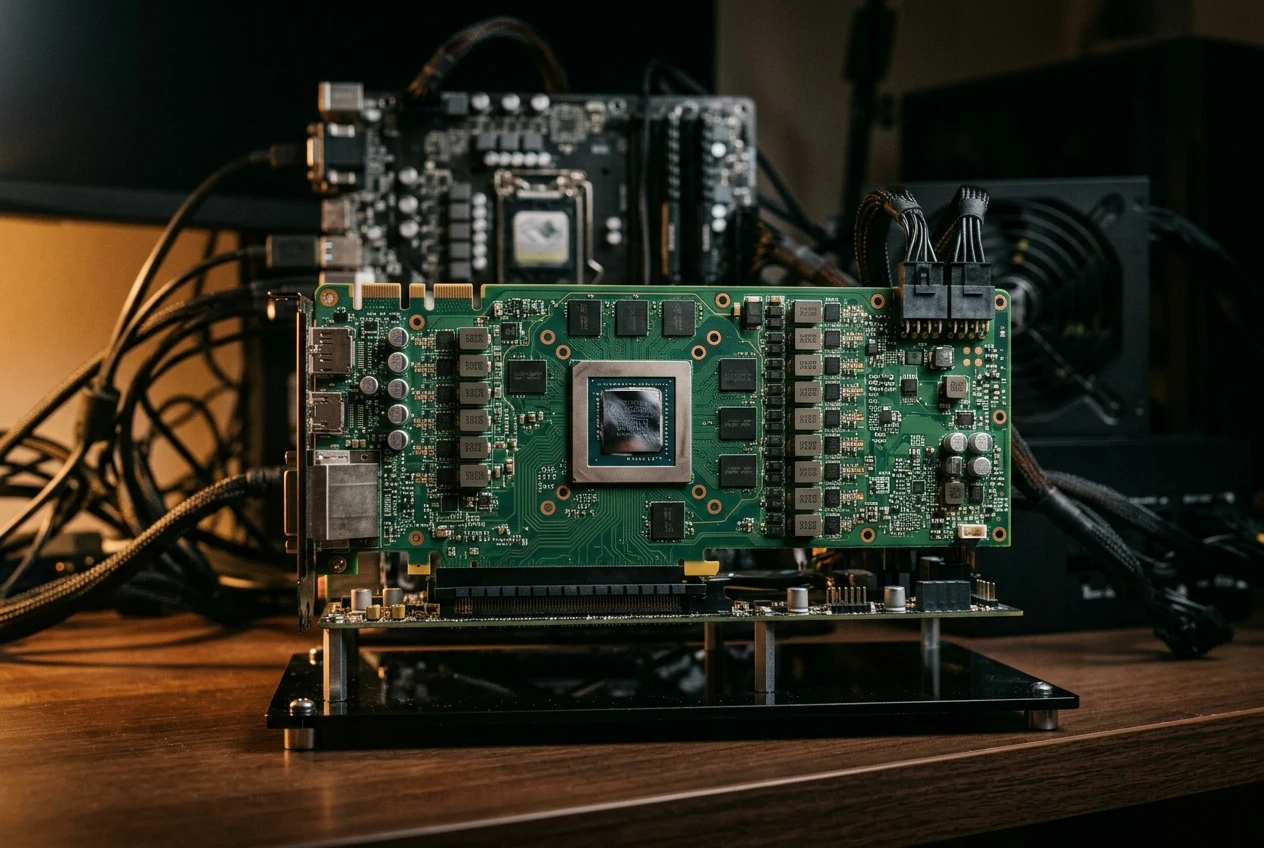
The card in Jie Mou’s test bench was never meant to live on a desktop. Reviewers at PRO Hi-Tech, a separate YouTube channel, traced the source of these Frankenstein desktop boards to defective laptop motherboards and qualification samples that were supposed to be destroyed but ended up at auctions instead. Chinese shops desolder the mobile GPUs and remount them on custom desktop PCBs, a process the PRO Hi-Tech team describes as “hardly a hard task.”
Earlier testing by PRO Hi-Tech found visible cracks on the GPU dies and “QUAL SAMPLE” markings on the chips, evidence the silicon never qualified for retail use. Tom’s Hardware reports the trend grew after the Trump administration banned the sale of RTX 4090 cards into China, pushing local sellers toward unusual alternatives covered in PRO Hi-Tech’s earlier teardown of the Frankenstein cards.
The category is not sanctioned by NVIDIA. Drivers for these cards come from community-built one-click installers, and the silicon sits in a grey zone between enthusiast salvage and outright warranty loss. Tom’s Hardware notes the modified RTX 4090M can cost around 10,000 RMB, roughly $1,470, while the RTX 4080M tested here sells in the $300 to $400 band. For Chinese buyers weighing a 2,700 to 2,800 RMB RTX 4080M against a 3,600 to 4,000 RMB RX 9070 GRE, the gap is closer than the official retail market suggests.
What the Reviewer Ran
The Bilibili reviewer 杰某, who publishes under the name Budget Digital, paired the modded card with an Intel Core Ultra 270K Plus processor on a Maxsun Z890-A motherboard. The system ran 32GB of DDR5-8200 memory, fast enough to keep the GPU fed without bottlenecking the test results. Jie Mou’s bench mirrors what a buyer in China could realistically build around a card in this price band.
In 3DMark Time Spy, the RTX 4080M scored 18,600 points, a respectable synthetic result that Tom’s Hardware flagged as underwhelming once price was factored in. A second user in the Bilibili comment thread reportedly hit 19,500 points with the same card, suggesting the silicon can stretch a little further with tuning. The custom vBIOS or the community drivers may be holding the GPU back from the higher figure.
For gaming comparisons, the reviewer picked the RX 9070 GRE specifically because both cards ship with 12GB of memory and both hover around the same price in China. The matchup isolates GPU performance from memory and pricing noise.
The 100W Surprise
Power consumption is the result the reviewer lingered on, and the numbers deserve the attention. During the gaming run, the RTX 4080M drew around 100W, which is significantly lower than even the mobile RTX 4080’s configured TGP. NVIDIA’s spec sheet allows the mobile chip to push up to 175W in a discrete desktop form factor, and the missing 75W is the puzzle. Tom’s Hardware suggests the custom vBIOS or the unofficial drivers are holding the silicon back, with the power ceiling set conservatively. Whatever the cause, the card runs cooler and quieter than its desktop RTX 4080 cousin.
The 100W figure has no equivalent on the AMD side at this price point. The RX 9070 GRE carries a 220W TDP, more than double the modded NVIDIA card’s measured gaming load. That gap shrinks the moment the system fits inside a small enclosure, where heat and noise budgets matter more than synthetic benchmark wins. Tom’s Hardware argues the RTX 4080M “could thrive” in an ITX build where the available thermal headroom is small, in coverage aggregated from an English-language write-up of the same Bilibili test.
Where the 4080M Wins, Where It Loses
| Game | RTX 4080M | RX 9070 GRE | Difference |
|---|---|---|---|
| PUBG (2K, Ultra) | ~340+ FPS | ~240+ FPS | +100 FPS (~41.7%) |
| Delta Force (4K, Ultra) | ~100+ FPS | ~90+ FPS | +10 FPS (~11.1%) |
| Forza Horizon 5 (2K, Low) | 214 FPS | 297 FPS | -83 FPS (-27.9%) |
| Forza Horizon 5 (4K, High) | 84 FPS | 107 FPS | -23 FPS (-21.5%) |
| Cyberpunk 2077 (2K, Low) | 171 FPS | 184 FPS | -13 FPS (-7.1%) |
| Cyberpunk 2077 (4K, High) | 49 FPS | 76 FPS | -27 FPS (-35.5%) |
| Shadow of the Tomb Raider (2K, Low) | 268 FPS | 274 FPS | -6 FPS (-2.2%) |
| Shadow of the Tomb Raider (4K, High) | 96 FPS | 107 FPS | -11 FPS (-10.3%) |
Across eight games, the results split cleanly between competitive shooters and AAA titles. In competitive games the RTX 4080M held clear leads, including a roughly 41.7 percent gap in PUBG at 2K Ultra. In single-player and racing games the Radeon card pulled ahead, sometimes by more than a third.
The strongest win for the modded card came in PUBG at 1440p Ultra, where it cleared 340 FPS against roughly 240 FPS on the RX 9070 GRE. The strongest loss came in Cyberpunk 2077 at 4K High, where the RTX 4080M managed 49 FPS against the Radeon card’s 76 FPS.
Delta Force at 4K Ultra was close, with the RTX 4080M posting about 100 FPS to the RX 9070 GRE’s 90 FPS, a roughly 11.1 percent lead for the NVIDIA card. Forza Horizon 5 at 1440p Low went the other way, with the Radeon card winning 297 FPS to 214 FPS. Shadow of the Tomb Raider was the most balanced matchup, with the 4080M trailing by 2.2 percent at 1440p Low and by 10.3 percent at 4K High. The competitive-versus-AAA split is a pattern, not noise.
The RX 9070 GRE Problem AMD Can’t Fix
Read against the official channel, the RX 9070 GRE pricing is what the test exposes. AMD launched the card globally on June 2 at $549, and it sits between the RX 9060 XT and the RX 9070 in the RDNA 4 stack. The full rollout context sits in the global RX 9070 GRE launch and pricing context.
In China, where the RTX 4080M test happened, the Radeon card currently lists for 3,600 to 4,000 RMB, roughly $520 to $580. The modded NVIDIA card sells for 2,700 to 2,800 RMB, about $400, making it 22 to 30 percent cheaper on price alone. Both cards ship with 12GB of memory and the Radeon leads in most benchmarks, so the price gap is the only place AMD is exposed.
the RTX 4080M is not a sensible purchase at the current Chinese market prices because similarly-priced new GPUs outpace it with ease
The verdict came from Tom’s Hardware, the US hardware outlet that aggregated the Bilibili tests. The RX 9070 GRE was a China-exclusive SKU when it first launched, with pre-orders opening May 8, 2025 at 4,199 RMB. AMD kept the card off the global market until Computex 2026, where it announced the $549 worldwide price for a June 2 launch. The two-stage rollout gave AMD room to test demand at home before exposing the card to international scrutiny. AMD’s timing meant Chinese buyers could weigh the RX 9070 GRE against the unofficial RTX 4080M before the global price landed.
The card’s specifications underline its mid-range positioning. AMD ships the RX 9070 GRE with 12GB of GDDR6 memory on a 192-bit bus, giving it 432 GB/s of bandwidth, well below the 16GB, 256-bit standard RX 9070. Its TDP sits at 220W, the same as the more expensive Radeon RX 9070. The 48 active Compute Units place it about 14 percent below the RX 9070 and roughly 25 percent below the RX 9070 XT.
The One Build That Actually Wants a 4080M
Strip the price-per-frame argument away and one scenario is left standing. A small form factor build with limited thermal headroom can use the 100W ceiling, because most GPUs in this price range demand 200W or more of cooling. Tom’s Hardware argues the card could power a DIY Steam Machine that undercuts Valve’s pricing while delivering better performance than a console. The pitch is niche, but the niche is real, and Chinese SFF builders already know about it. Outside that use case, the RTX 4080M looks like a side bet rather than a sensible upgrade.
The driver story is the other constraint. Without official NVIDIA driver support, every new game launch is a gamble until the community catches up, and security patches do not arrive on schedule. For most buyers in China and elsewhere, a warrantied RX 9070 GRE or RTX 5060 Ti is the safer pick, as detailed in the Bilibili reviewer’s benchmarks and verdict.
Frequently Asked Questions
What is an RTX 4080M desktop card?
An RTX 4080M desktop card is an unofficial graphics card built by Chinese shops using laptop-class RTX 4080 silicon mounted on a custom desktop PCIe board. The boards carry no NVIDIA warranty and rely on community-built driver installers rather than official GeForce drivers.
Why are Frankenstein GPUs sold in China?
Frankenstein GPUs emerged in China after US export controls restricted the sale of high-end NVIDIA cards to the region. Local sellers responded by sourcing mobile GPUs from defective laptop motherboards and qualification samples sold at auction, then remounting them on desktop PCBs.
Is the RTX 4080M faster than the RX 9070 GRE?
On average across the eight games tested, the RTX 4080M trailed the RX 9070 GRE by about 6 percent, and by 17 percent in the AAA subset where the Radeon card performed best. The RTX 4080M still won the PUBG and Delta Force competitive titles.
How much power does the RTX 4080M draw?
The RTX 4080M drew around 100W during the gaming benchmarks, well below the 175W ceiling NVIDIA sets for the mobile RTX 4080 chip. By comparison, the RX 9070 GRE carries a 220W TDP, more than double the modded card’s measured gaming load.
 Xbox Lays Off 3,200 as Sharma Memo Puts Mojang and King at the Top
  Trent Shares Fall 12% as Q1 Revenue Growth Misses Street Estimates
  Stocks to Watch July 7: Cochin Shipyard OFS Opens, JB-Torrent Cleared
  Sensex, Nifty Set to Open Higher Tracking AI-Led Wall Street Rally
  Naomi Osaka Ousts Sabalenka to Reach First Wimbledon Quarterfinal
  Ford Racing Returns to Le Mans Overall Fight With 2027 Hypercar