
 Ishan Crawford
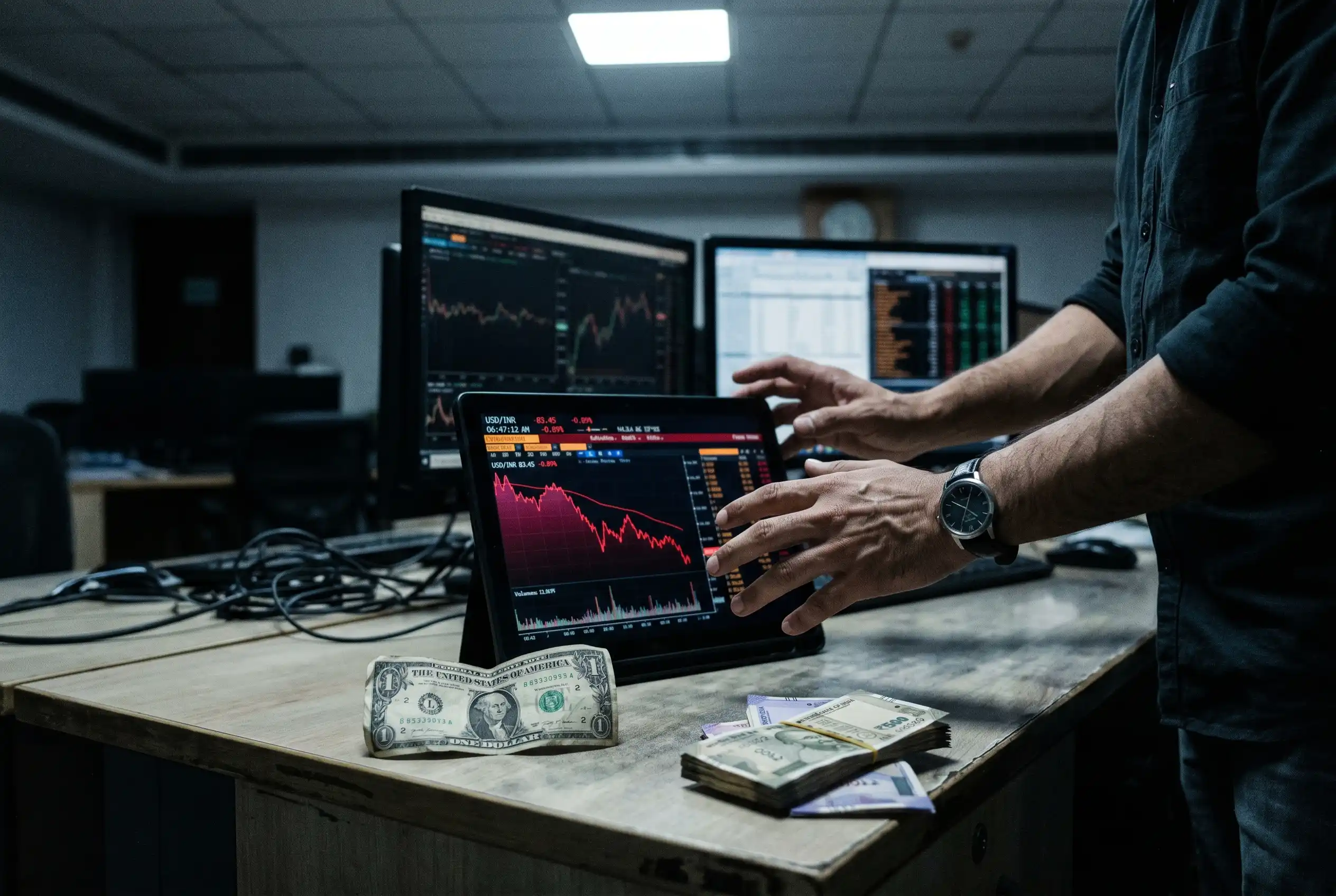
 The Indian rupee fell 21 paise to 94.71 against the US dollar in early Thursday trade, opening at 94.66 at the interbank market. The dollar index rose to a four-month high of 100.23 after a hawkish Federal Reserve decision. Asian currencies had weakened considerably overnight, taking the rupee lower with them in the regional slide. The session also brought two offsetting positives for Indian markets: a US-Iran framework agreement, and a meeting between Modi and Trump on the margins of the G7 Summit, their first in 16 months.
The rupee’s drop came a day after it had gained 10 paise to close at 94.50 on Wednesday. The dollar index’s climb to 100.23 reflected the Fed’s signal that at least one quarter-point rate hike could come later in 2026. Equities and crude futures also moved lower, tracking the broader regional risk-off mood.
Rupee Opens at 94.66 and Slides to 94.71 in Early Trade
The rupee’s slip brought it back below the 94.50 level it had closed at on Wednesday, a session in which it had gained 10 paise against the dollar. The 21-paise move came in a single session. The 0.14% rise in the dollar index to 100.23 was the immediate trigger forex traders pointed to. With the Fed now seen leaning more hawkish than markets had priced in, the rupee had few natural buyers in early trade, according to the 21-paise fall to 94.71 at the interbank market.
Forex traders attributed the move to the Fed’s June 17 decision, which held interest rates steady but signalled that at least one quarter-point rate hike could come later this year. With the dollar strengthening, the rupee joined a regional retreat. Anil Kumar Bhansali, head of treasury and executive director at Finrex Treasury Advisors LLP, framed the morning in a single line. Foreign portfolio investors were net buyers of Indian equities on Wednesday to the tune of ₹101.59 crore, a modest flow that did not offset the currency weakness. The rupee’s slide was therefore best read as a function of cross-asset flows rather than any India-specific shock.
By mid-morning trade, the rupee had settled in a tight range around 94.70 against the greenback. The dollar index, which gauges the US currency against a basket of six major currencies, was trading 0.14% higher at 100.23, its highest level in four months. The Brent crude benchmark fell 1.68% to $78.21 per barrel in futures trade, a move that would normally support the rupee by trimming India’s import bill. The combination suggested the rupee was reacting more to dollar strength than to any shift in India’s underlying fundamentals.
The Dollar Index Climbs to a Four-Month High
The 0.14% climb in the dollar index to 100.23 marked its highest level in four months, traders said. The move reflected the Fed’s June 17 decision to keep interest rates unchanged while flagging that a rate increase remained possible later in 2026. Markets had positioned for a hold, but the upward tilt in the policy signal was enough to push the greenback higher against most emerging market currencies, as captured in the Federal Reserve’s June rate decision.
For emerging market currencies, the read-through is direct: a stronger dollar typically forces central banks to choose between defending their currency and supporting growth. India depends heavily on dollar-denominated oil imports. The rupee’s slide, paired with the drop in Brent crude to $78.21 per barrel, illustrates how dollar flows and oil prices can move on separate tracks. Lower crude would normally cushion the rupee by trimming India’s import bill, but the dollar’s renewed strength overwhelmed that relief on Thursday. Foreign portfolio investors were net buyers of Indian equities on Wednesday to the tune of ₹101.59 crore, according to exchange data, a flow that did little to lift the rupee.
The Fed’s June statement narrowed the gap between US policy and the easing cycle several other major central banks have begun. That gap typically funnels capital into dollar assets, lifting the dollar index. With the Fed now seen leaning more hawkish than markets had priced in a week ago, the rupee had fewer natural buyers in offshore morning trade. Recent sessions had already seen the rupee under pressure against a firming dollar, a pattern captured in coverage of the rupee’s recent moves against the dollar.
Against the 100.23 reading on the dollar index, the rupee’s opening of 94.66 reflected regional pressure more than any India-specific shock. The pattern is familiar: a hawkish Fed, a stronger dollar, an emerging market selloff. Thursday’s 21-paise move came directly on top of Wednesday’s 10-paise gain, reversing the recovery in a single session.
Three factors drove the morning’s move against the rupee:
- The Federal Reserve’s June 17 decision to keep interest rates steady while signalling a possible quarter-point rate hike later in 2026.
- The dollar index’s climb to 100.23, its highest level in four months.
- Broader weakness across Asian currencies against the dollar overnight.
Why the Rupee Joined the Regional Selloff
The rupee did not fall alone. Asian currencies had weakened considerably into Thursday’s session, taking the rupee lower as a result. Most asset classes had fallen against the dollar in the overnight session, leaving the greenback well bid while other currencies were well offered. The pattern was broad-based rather than India-specific, traders noted, with the rupee’s move falling in line with regional weakness rather than breaking from it.
Bhansali said the cross-currency backdrop had left the rupee little room to outperform. He framed the morning’s price action as a function of dollar strength, not rupee weakness, a distinction that matters for how traders position into Friday’s session. The dollar index’s gain to a four-month high was the dominant variable, and Asian currencies were trading as a basket against it. The rupee’s 21-paise loss was therefore best read as a relative price move against the dollar rather than a sign of any India-specific stress. By mid-morning, the dollar was bid across most Asian pairs.
Asian currencies had also weakened considerably, taking the rupee lower this morning. Most asset classes had fallen against the dollar keeping it well bid while the asset class was well offered.
Bhansali was speaking to Business Standard on Thursday morning as the rupee opened lower. His framing was that the dollar’s overnight strength was the dominant variable, not any India-specific shock. That distinction is the one Mumbai-based traders will weigh into Friday’s session. The US-Iran signing in Geneva could shift the regional picture, but the dollar index’s path is the bigger near-term driver.
Indian Equities Follow the Rupee Lower
Indian equities opened lower on Thursday. The BSE Sensex fell 111.23 points to 77,044.39, while the NSE Nifty slipped 26.85 points to 24,058.85. Both moves tracked the broader risk-off mood across emerging markets, with the dollar’s renewed strength dragging regional benchmarks lower on a day when the rupee hit a four-month low against the dollar.
The equity market reaction was modest relative to the currency move, reflecting that the morning’s shock was external rather than domestic. Foreign portfolio investors had been net buyers of Indian equities on Wednesday to the tune of ₹101.59 crore, a flow that helped cushion Thursday’s open. The rupee’s slide came alongside a 1.68% drop in Brent crude to $78.21 per barrel in futures trade, a divergent signal that would normally support the rupee. The two cross-asset moves partially offset each other in the early hours of trade.
Indian markets now face a familiar sequence: a hawkish Fed, a stronger dollar, and a regional selloff that weighs on both currencies and equities. FII flows have remained net positive even as the rupee has weakened, with ₹101.59 crore in net purchases recorded on Wednesday. The interplay between dollar strength and the oil price drop will define the rupee’s path through Friday’s session.
The Brent crude drop to $78.21 per barrel would normally have supported both the rupee and oil-sensitive stocks, but the dollar’s strength overwhelmed that relief on Thursday morning. The Sensex’s 111.23-point fall and the Nifty’s 26.85-point slide reflected the regional risk-off tone rather than any India-specific shock. The cross-asset picture on Thursday showed a stronger dollar offsetting cheaper oil in emerging markets. Indian markets will now look to Friday’s session for direction from the US-Iran framework and the dollar index. The rupee’s recent slide fits a broader pattern of record-low moves against the dollar this year, traced in coverage of the rupee’s slide toward record lows this year.
A Partial Offset from the US-Iran Deal
The same session carried one piece of geopolitical relief. The United States and Iran electronically signed a memorandum of understanding on Thursday aimed at ending hostilities and creating a framework for negotiations on Iran’s nuclear programme, as detailed in the US-Iran memorandum of understanding. The deal matters for Indian markets in two ways. The framework eases one of the major upside risks to global crude prices, with Brent already at $78.21 per barrel in futures trade. For India, which imports the bulk of its oil needs, that ceiling on crude is a direct positive for the trade balance. CR Forex Advisors MD Amit Pabari framed the agreement as a clear sentiment boost, with one caveat.
The agreement has improved market sentiment considerably, although President Trump simultaneously warned that military action could resume if Iran fails to comply with the framework.
Pabari made the point in Thursday morning commentary. The takeaway was that the agreement’s market effect was positive, even with Trump’s parallel warning about renewed military action if Iran failed to comply. Friday’s Geneva meeting will be the next checkpoint for the framework. Indian markets will watch for any signal that the deal is holding.
Modi-Trump Talks Reset the Trade Track
Beyond the currency market, the morning brought a political milestone for India. Prime Minister Narendra Modi and US President Donald Trump held their first bilateral talks in 16 months on the margins of the G7 Summit, an attempt to rebuild the strained bilateral relationship. The two leaders directed their officials to work towards a balanced, mutually beneficial and commercially meaningful trade agreement at the earliest.
The trade track has practical implications for the rupee. US Trade Representative Jamieson Greer is scheduled to visit India next week to take forward the talks on the proposed trade deal, per coverage of Greer’s planned India visit after the G7. For Indian markets, the Greer visit is the next concrete checkpoint in a trade process that has been moving slowly. The rupee has reacted to US-India trade headlines in past cycles, and Friday’s session will be tested by both the Geneva meeting and the trade news.
Modi and Trump have not held bilateral talks in 16 months, a gap that reflected the strain in the relationship. The trade deal is the most concrete deliverable expected from the renewed engagement. Indian markets will watch Greer’s visit for signs of progress on the negotiations, with broader rupee reaction depending on whether the talks produce a near-term framework or remain at the discussion stage.
Disclaimer: This article is for informational purposes only and does not constitute investment or trading advice. Currency markets carry significant risk, and readers should consult a qualified financial professional before making investment decisions. All figures are accurate as of publication on June 18, 2026.
 ONGC licence frees Venezuela cash and operatorship talks
  Anthropic Hits $65 Billion Run Rate and Flips the AI Cash Test
  Supreme Court grounds the fare free-for-all with three-week clock
  Gold Nears $4400 as Soft Data Meets Oil Inflation Risk
  Nifty Slips as Zaggle Circuits and Dhoot Debuts Big
  Diesel Crack Tops $100 as Iran Rhetoric Lifts Crude