
 Ishan Crawford
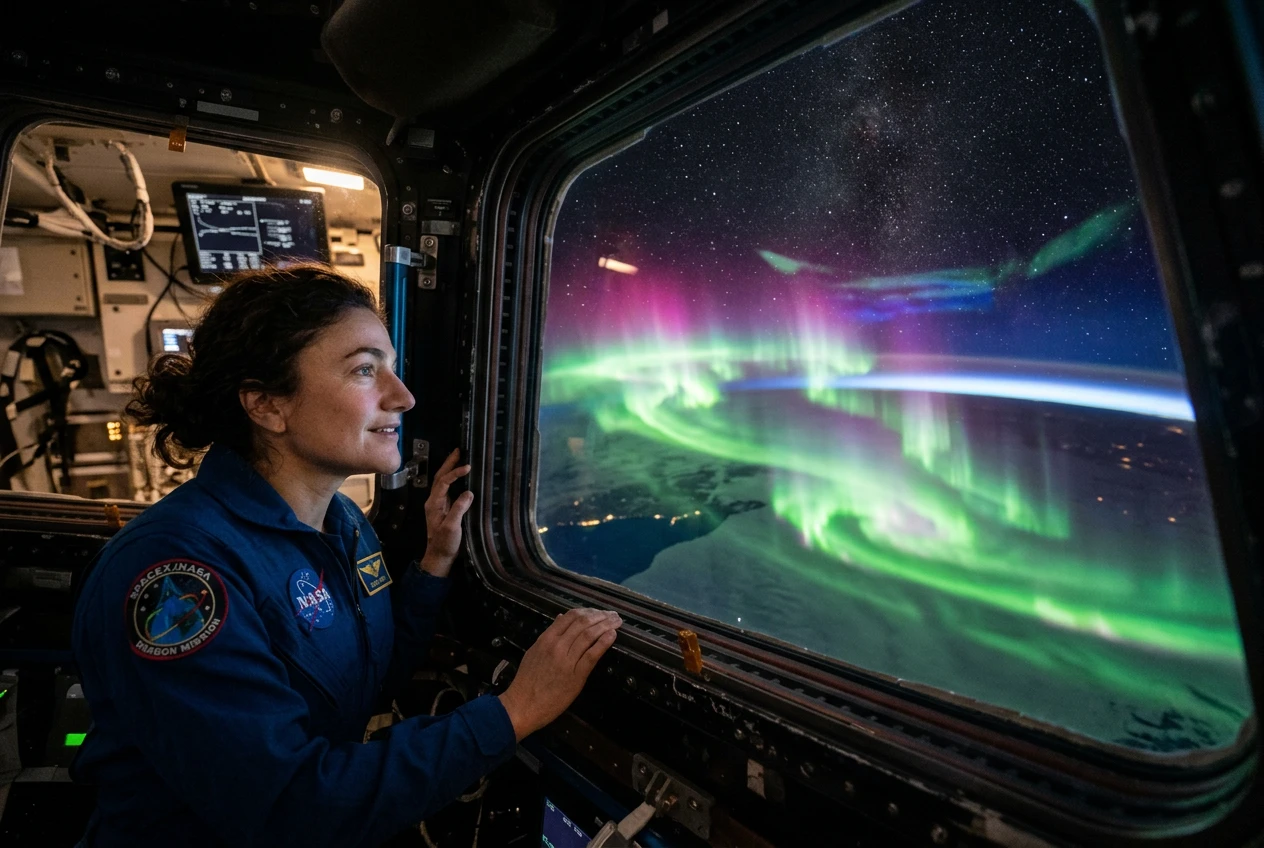
 A NASA astronaut has shared a timelapse of the Southern Lights filmed from a window on the SpaceX Dragon spacecraft. The video shows green and magenta ribbons of aurora australis snaking below the Dragon’s orbital path.
Jessica Meir, commander of the SpaceX Crew-12 mission to the International Space Station, posted the clip to her social media accounts this week. A news page that carried the timelapse reported on the footage, describing the Southern Lights as common as their northern counterpart but far less observed. The reason, per the same report, is the geography of the southern hemisphere, where little populated land sits in the latitudes where the lights appear.
A Timelapse From the Dragon Window
The Crew-12 launch and docking mission page records that SpaceX Crew-12 launched from Cape Canaveral on February 13, 2026, and that the Dragon capsule docked with the International Space Station the next day. Four months into the mission, the crew’s commander, NASA astronaut Jessica Meir, has begun sharing the views from the cupola. The latest to circulate is a timelapse of aurora australis, the Southern Lights, glowing below the spacecraft as it passed over the night side of Earth. The clip captures the southern aurora in motion, with ribbons of light shifting and curling as the Dragon passes overhead.
Meir described the display in two sentences she posted alongside the video. “As opposed to the previous aurora I’ve seen, this one danced and snaked its way directly below us, putting on quite a show,” she wrote. “I am in awe of this ethereal and emotionally evocative phenomenon,” she added. The Guardian, which published the clip on June 10, 2026, said the display was captured by a camera pointed out of the Dragon’s window and that the auroras “create shimmering curtains of colour” where charged solar particles meet the atmosphere.
As opposed to the previous aurora I’ve seen, this one danced and snaked its way directly below us, putting on quite a show.
From the Dragon, a few hundred kilometres above the surface, the aurora is no longer a streak on the horizon. It is the entire floor of the visible world, and the spacecraft the only moving object in the frame. The timelapse condenses minutes of motion into seconds.
Why Meir Says This Aurora Was Different
Meir’s phrase “as opposed to the previous aurora I’ve seen” carries a quiet admission. The astronaut has logged prior spaceflights and spacewalks across two missions, and has watched auroras from the ground and from orbit. From the Dragon, she said, the aurora did something the previous displays did not. It moved directly beneath the spacecraft, snaking in a way auroras at the horizon do not. From the Dragon’s altitude, an aurora at lower latitudes can look like a glow on a distant screen. An aurora directly below becomes a textured surface, with movement, structure, and depth.
Southern Lights are a routine feature of the night sky over Antarctica, and a routine feature with an audience problem. Most of the planet’s telescopes, all-weather research stations, and a long list of commercial flight paths are tuned to the Northern Hemisphere. The bulk of high-quality aurora footage in circulation, from film reels to Instagram, is aurora borealis.
The Science Behind the Southern Lights
Aurora australis is the southern counterpart of aurora borealis, and the physics is identical. The Sun throws off a constant stream of charged particles called the solar wind, and Earth’s magnetic field channels those particles toward the planet’s two magnetic poles. When the particles arrive, they collide with atoms in the upper atmosphere, and the resulting energy release is the light. The southern aurora is what happens when that process unfolds over Antarctica, the South Pacific, and the Southern Ocean. The northern aurora is the same process run over the Arctic, northern Canada, Scandinavia, and Siberia. Both displays are the same physical event, lit up in two different latitudes.
Per the explainer page on the aurora australis, the particles that drive the show “smash into the Earth’s magnetic field at more than 6 million kilometres per hour.” Most are deflected by the magnetosphere, the magnetic bubble that shields the planet. A small fraction make it through the field lines and race down toward the south and north poles, colliding with atoms of nitrogen and oxygen; as those atoms shed the energy they absorbed, they glow. Green, blue, and violet hues dominate, with red more often seen when the collisions happen at higher altitudes.
The Southern Lights’ colour palette goes further than the Northern Lights’. Per the same source, the southern palette goes “beyond the green and blues commonly seen at the Northern Lights, to include pinks, purples, oranges and golds.” The reason is the same collision physics, but the gases involved and the altitudes at which they meet vary enough from event to event to shift the dominant colour. From orbit, both versions of the display show the full range. From the ground, the southern show’s wider palette is harder to catch, because so few land-based observers see it at all.
- Solar wind particles strike Earth’s magnetic field at more than 6 million kph
- The atmosphere that glows is composed of nitrogen and oxygen
- Dominant aurora colours are green, blue, and violet; red shows at higher altitudes
- The Southern Lights palette includes pinks, purples, oranges, and golds beyond the north’s greens and blues
- Antarctica’s average winter temperature falls to around negative 50 degrees Celsius
How the Same Solar Wind Paints Both Skies
The aurora australis and aurora borealis are the same display run twice, with the solar wind as the common input and Earth’s magnetic field as the routing system. The northern oval sits over the Arctic, drawing cruise ships, photographers, and the bulk of social media footage. The southern oval sits over a continent with no permanent residents and an ocean that swallows most of the rest. The light is the same in both hemispheres. The south has no permanent settlement under the southern oval, and the next landmass north of it, Australia, only sees the lights during the strongest solar events. The difference is what the camera is pointing at, and how much of the planet’s land sits underneath the oval when the light shows up.
The colours the two displays produce depend on the gases hit and the altitude of the collision, not the hemisphere. From the ground, the two are hard to compare directly because so few people have watched both. From orbit, the symmetry is plain to see, with the same handful of atoms, nitrogen and oxygen, lighting up in both directions.
A single solar event can drive auroras in both hemispheres at the same time, with the displays running as near mirror images of each other.
The same solar wind that lights up the Arctic on a given night is also lighting up the Antarctic on the same night. The visual symmetry is broken by the land underneath the two ovals. The northern oval sits over snow-covered forest and tundra; the southern oval sits over ice shelf and open ocean.
Where the Aurora Australis Reaches
Antarctica itself is the surest vantage, and the most punishing. Per the same source, of the continent: “nothing beats the continent itself. From here, the lights are at their most vibrant, most visible and most impressive.” The catch is that the average Antarctic winter temperature falls to negative 50 degrees Celsius, and travel in those months is, in the guide’s words, “discouraged and practically impossible, unless you are on a research expedition.” The practical alternative is South Georgia Island, which the same source names as the best place in the world to see the Southern Lights. It is one of the most southerly landmasses on Earth, and it is encased in ice for most of the year. When the weather warms, around 2,000 people populate the island, mostly via cruise ship, and basic facilities are made available.
For most of the year, that is the only way to get close. The deck of a cruise ship is the standard viewing platform, with photographers advised to use a sturdy tripod and a camera with manual mode for long exposures. Sightings have also been reported as far north as New Zealand’s South Island, Tasmania, and southern Argentina when the solar cycle is at its optimum, and the aurora Meir caught from the Dragon is one of the few looks the southern oval gets that is not gated by ice, weather, or cruise ship season.
| Location | Position | What to know |
|---|---|---|
| Antarctica | The southernmost continent | Per the same source, the lights are “at their most vibrant, most visible and most impressive” here |
| South Georgia Island | One of the most southerly landmasses on Earth, ice-covered most of the year | Reached by cruise ship in the southern summer; around 2,000 people on the island when weather warms |
| New Zealand (South Island), Tasmania, southern Argentina | Northernmost limit of reported sightings | Sightings reported “as far north as” these during optimum solar conditions |
Why the Southern Lights Stay the Underdog
Land is the simplest answer. The Northern Lights hang over a hemisphere loaded with Canada, Scandinavia, Iceland, and Russia, and a long list of cities where the lights are visible from a backyard. The Southern Lights hang over a hemisphere dominated by ocean and one largely empty continent. Antarctica has no permanent residents. The Southern Ocean has no cruise routes in winter. Australia, the next landmass north, sits at latitudes where the aurora appears only during the strongest solar events, and even then, the colours tend to be the lower-altitude greens and reds rather than the southern palette’s wider mix.
Aurora borealis has a centuries-long head start in folklore, tourism, and photography. The Northern Lights have Sami legends, Norwegian cruise itineraries, and a small industry of photographers who shoot them in long exposure from snow-covered coastlines. The Southern Lights have ice shelf logistics, a six-month shipping window, and a much smaller catalogue of widely circulated footage. When aurora australis does make it into the wider feed, it is usually from a research station, a satellite, or a passing ship. The Northern Lights, by contrast, sometimes reach as far north as the UK, as this red aurora that lit up Scotland in October 2024 showed.
Meir’s clip is the kind of high-resolution, time-compressed view of the southern oval that almost never makes it into the public eye. The Dragon timelapse is also a record of an astronaut looking down at a phenomenon that, for most of the southern half of the planet, exists mostly as a line in an explorer’s diary.
When and How to See Them in Person
For anyone who would rather see the Southern Lights in person, the practical window is narrow. Per the same source, the peak viewing season is between March and September, the Antarctic winter, when the long polar night and the active solar cycle combine. The depths of the season, June and July, are the coldest and the most logistically hostile, with temperatures at the coast and inland stations routinely falling to negative 50 Celsius or lower. The southern summer, from November to February, is the only season cruise ships reach the continent, and even then the lights are typically less active.
Photographers chasing the display on a cruise ship will want a sturdy tripod, a camera with manual mode, and a long exposure setting to bring the light into the lens. Warm clothing is the basic survival gear, and the deck of the ship the standard viewing platform. A southern aurora, when it appears, can run for hours, and the show can shift in shape and colour from minute to minute. Meir’s clip is one version of what it looks like from above. The view from a cruise deck is slower, lower, and depends on the night the aurora picks to fire.
Frequently Asked Questions
What did Jessica Meir film from the SpaceX Dragon?
Meir, the commander of NASA’s SpaceX Crew-12 mission to the International Space Station, posted a timelapse of aurora australis, the Southern Lights, filmed from a camera pointed out of the Dragon’s window. The clip, published by The Guardian on June 10, 2026, shows green and magenta ribbons of aurora snaking below the spacecraft as it passed over the night side of Earth.
How is the aurora australis different from the aurora borealis?
The two are the same phenomenon run in different hemispheres. Both are produced when charged particles from the solar wind collide with nitrogen and oxygen in the upper atmosphere, channelled there by Earth’s magnetic field. The Southern Lights occur over Antarctica, while the Northern Lights occur over the Arctic. Per the same source, the southern palette goes beyond the green and blue typical of the north to include pinks, purples, oranges, and golds.
Where is the best place to see the Southern Lights?
Antarctica itself offers the most vibrant view, but it has no permanent population and a winter that is hostile to travel. The same source names South Georgia Island as the best practical viewing spot. It is one of the most southerly landmasses on Earth, ice-covered most of the year, and reached by cruise ship in the southern summer. Viewers have caught the aurora as far north as New Zealand’s South Island, Tasmania, and southern Argentina when the solar cycle is at its peak.
When is the best time of year to see the Southern Lights?
March through September, the Antarctic winter, is the peak window. The deepest part of the season, June and July, sees temperatures that fall to roughly negative 50 Celsius, and travel during that period is discouraged. Cruise ships can reach the latitudes where the lights show only in the southern summer, from November to February, when conditions are easier but the lights are less active.
How fast do the solar wind particles that drive the aurora travel?
Per the same source, charged solar particles arrive at Earth’s magnetic field at more than 6 million kph. The magnetosphere, the magnetic bubble that wraps the planet, deflects most of them. A small fraction travel along the field lines to the magnetic poles, where they collide with atoms of nitrogen and oxygen in the upper atmosphere and produce the visible light.
 HDFC Bank Fines CEO Jagdishan Weeks Before Reappointment Call
  Zepto’s IPO Valuation Target Sinks to $3 Billion From $7 Billion
  Man Jailed Under a Rare Lifelong Order for Edinburgh Rape
  Tata Power’s ₹6,675 Crore Bet on Solar Self-Reliance in Odisha
  South Korea and Japan Chip Stocks Crash as China Surges
  Scotland’s Social Work Registration Overhaul Carries a Staffing Cost