
LIFESTYLE
Words to Describe a Dancer: A Ballet Movement Guide
Words to describe a dancer should name the action and the direction. These 21 ballet terms cover the bend, the line, the jump, and the turn you see.

Graceful, fluid, and strong say how a movement felt. Words to describe a dancer get specific when they name the bend, the line, the jump, or the turn the body actually did.
Ballet kept a French vocabulary for that job, and twenty-one of those words cover the movements you are most likely to need in class, in a rehearsal note, or in a sentence about what you saw. This guide gives each word in plain English, marks where the schools do not share a name, and shows how to put the action and the direction in one line.
How Do Ballet Words Name a Movement?
A ballet word is a picture of the body, not a compliment. Plié means the knees bend. Jeté means a jump that looks thrown. Arabesque means a profile line from the fingertips to the toes. You can still add light, sharp, or sustained after the action. If the action is missing, the reader cannot see the step.
French stayed the studio language because the five positions of the feet were set there. Pierre Beauchamp, maître de ballet of the Académie Royale de Musique et de Danse from 1671 to 1687, established those positions, and every classical step begins and ends in one of them. American Ballet Theatre’s ballet dictionary, taken from the standard technical manual, is the set of definitions used here whenever a school difference changes the picture.
The feet are shared across methods. The arms are not, and neither is the number of named arabesques. A careful description names the step and, when it matters, the school the speaker trained in.
Seven Actions Every Ballet Step Uses
Teachers sort the whole technique into seven actions, and every word below hangs on one of them. The seven ballet actions on this student sheet are the same list dance courses hand to students: bend, stretch, rise, glide, jump, dart, and turn.
- Plier: To bend, which is the plié on two legs and the fondu on one.
- Étendre: To stretch, which is the battement tendu along the floor and the développé into the air.
- Relever: To rise, which is the relevé onto pointe or demi-pointe.
- Glisser: To glide, which is the glissade that links other steps.
- Sauter: To jump, which covers sauté, jeté, and assemblé.
- Élancer: To dart, the sudden traveling push inside a thrown or driven step such as a jeté.
- Tourner: To turn, which is the pirouette, the fouetté, and any turn named with them.
A sentence that starts from one of those seven is already clearer than a sentence that starts from a mood. The twenty-one words are the studio names for those actions, plus the lines and the direction words that finish the picture.
The Bend, the Stretch, and the Rise
These five words are the barre. They show up inside jumps and turns later, so a description that skips them makes the bigger step look as if it started from nowhere.
The Knees in a Plié
Plié [plee-AY] is a bending of one knee or both. Dancers practice it in the five positions of the feet, though the third position is usually left out, and it comes in two sizes. In a grand plié the knees bend until the thighs are horizontal. In a demi-plié the bend is halfway, and the heels stay on the floor.
THE TWO PLIÉS
- Grand plié: Thighs reach horizontal; heels rise in first, third, crossed fourth, and fifth, and they stay down in second and in open fourth.
- Demi-plié: A half bend with the heels down; every step of elevation begins and ends here.
- Both sizes: Legs turn out from the hips, knees sit over the toes, and the weight stays spread on both feet.
The knees should be at least half-bent before the heels of a grand plié are allowed to rise, and the body comes up at the same speed it went down. If you describe a jump and leave out the demi-plié, you have left out the takeoff and the landing. Depth and turnout are judged by a teacher in the studio, not by copying a definition at home.
Battement Tendu and Développé
A battement is a beating action of the extended or bent leg, and it splits into large battements and small ones. Battement tendu [bat-MAHN tahn-DEW] is the stretched small one: the working foot slides from first or fifth out to second or fourth, the toe never leaves the floor, and both knees stay straight. It is the start and the finish of a grand battement, which lifts the leg from the hip and brings it down with the accent on the downward path, the rest of the body quiet.
Développé is the slow unfolding. The working leg draws up to the knee of the supporting leg, then extends into the air and holds, to the front, the side, or the back, at 45 degrees or at 90 degrees. The hips stay level and square to the direction the dancer faces. Cecchetti brings the toe to the side of the knee before the leg opens. The Russian and French schools bring the toe to the front of the knee before a forward extension, and to the back of the knee before a back one.
Relevé and Fondu on One Leg
Relevé [ruhl-VAY] is a raising of the body onto pointe or demi-pointe. The French school rises in one smooth path. The Cecchetti method and the Russian school use a small spring. In Russian class the same word can also mean a slow lift of the stretched leg, so it is worth asking which relevé the speaker means before you write it down.
Fondu [fawn-DEW] is a sinking made by bending the knee of the supporting leg. Saint-Léon wrote, “Fondu is on one leg what a plié is on two.” The word also covers a soft ending, as in a jeté fondu, when the working leg meets the floor in a gradual way rather than a bump. If both knees bend, call it a plié. If only the standing knee bends, call it a fondu.
The Line From Fingertips to Toes
Arabesque and attitude are the two poses people mean when they say a dancer has a line. They are not the same picture, and the back knee is the fastest way to tell them apart.
| What you see | Arabesque | Attitude |
|---|---|---|
| Supporting leg | Straight, or in demi-plié | On the flat foot, pointe, or demi-pointe |
| Working leg | Straight, extended behind at a right angle | Lifted behind, knee bent to 90 degrees, knee higher than the foot |
| Arms | Placed for the longest line from fingertips to toes | Arm on the raised-leg side curved over the head, the other arm to the side |
| Body | In profile, shoulders square to the direction | Several facings, including croisé, effacé, and de face |
Arabesque takes its name from a form of Moorish ornament. Dancers use it to close a phrase, both in the slow movements of adagio and in the brisk movements of allégro. The number of principal arabesques is not the same in every method, which is why two correct arabesques can still look unlike each other. The Royal Ballet and Opera film the line in a short glossary clip, and the square shoulders are the detail to watch.
Penché and Port de Bras
Penché [pahn-SHAY] means leaning or inclining. An arabesque penchée tips the torso as the back leg rises, so the line gets steeper than the ordinary right angle. Use penché only when the body inclines. A high arabesque with a level torso is a high arabesque, not a penché.
Port de bras [pawr duh brah] is the carriage of the arms, and the term has two jobs. It is the path the arms take from one position to another, and it is a group of exercises built to make that path smooth. The Cecchetti method sets eight of those exercises. The arms move from the shoulder rather than the elbow, they stay softly rounded, and they pass through a middle place called the gateway. That gateway is fifth position en avant in Cecchetti, and first position in the French and Russian schools. The hands stay plain, and the head and a hint of shoulder placement join the arms.
Attitude, the other half of the line, comes from Carlo Blasis, who took the pose from Giovanni da Bologna’s statue of Mercury. A bent back knee at a right angle, with that knee higher than the foot, is the mark. Straighten the knee and you have left attitude for arabesque.
Jumps, Glides, and the Landings
A jump word should tell you which foot leaves, which foot arrives, and whether the legs meet while you are in the air. These seven cover the family.
- Sauté: Added to another name, it means the step is done while jumping.
- Jeté: A jump from one foot to the other, the working leg brushed so it looks thrown.
- Assemblé: The working foot slides, both legs join in the air, and both feet land together in fifth.
- Glissade: A linking glide that starts and ends in a demi-plié.
- Échappé: Both feet escape together from a closed position to second or fourth.
- Piqué: A step straight onto pointe or demi-pointe, the other foot already raised.
- Ballon: Not a step name. It is the elastic quality of the jump itself.
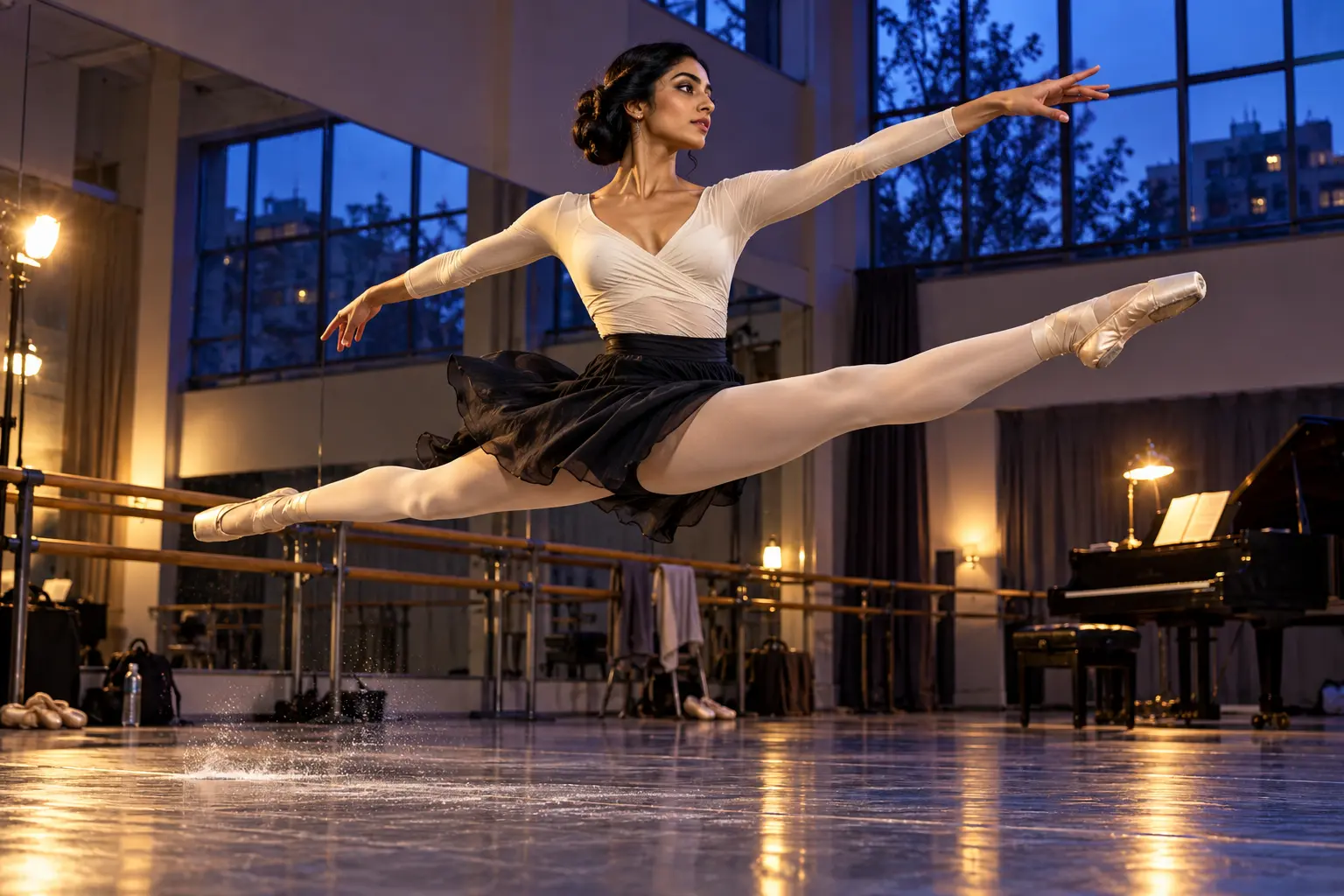
Grand jeté en avant needs a run or a glissade for the push. The front leg is thrown to a right angle, as in a grand battement, the dancer tries to hold an attitude or an arabesque in the air, and the landing plié is soft and controlled. In the Cecchetti assemblé both knees draw up so the flat of the toes meet while the body is still off the floor. Échappé sauté springs from fifth and finishes in a demi-plié in the open position. Échappé onto pointe rises with straight knees once the feet have opened.
Ballon is the word for the bound itself: the dancer goes up, pauses a moment in the air, and comes down lightly enough to rebound, the way a ball does. Use it when the rebound is the point, whether the jump is small or large. Piqué [pee-KAY] belongs in the same breath as a traveling step onto the pointe, as in a piqué en arabesque, because the dancer steps directly onto the point or demi-pointe instead of pushing up from a plié in place.
Which Way Does a Pirouette Turn?
Pirouette [peer-WET] is a complete turn of the body on one foot, on pointe or demi-pointe. The body stays centered over the supporting leg, the back is held strongly, and the hips and shoulders stay aligned. The arms supply the force, then stay quiet during the turn. The head is the last to leave the front and the first to arrive as the body comes around, with the eyes fixed on one point at eye level. That use of the eyes is called spotting.
The direction word is the piece most descriptions leave off, and it decides the turn. En dehors [ahn duh-AWR] means outward. On a pirouette it turns toward the working leg. En dedans [ahn duh-DAHN] means inward, toward the supporting leg. The same pair describes circles of the leg. En dehors travels clockwise. En dedans travels counterclockwise from back to front, as in a rond de jambe à terre en dedans.
The Royal Ballet and Opera clip shows the turn with the spot, which is easier to copy with your eyes than to rebuild from a sentence. A pirouette can finish at the ankle, in attitude, in arabesque, or with the leg to the side. The position after the turn is part of the name.
Rond de Jambe and Fouetté
Rond de jambe à terre [rawn duh zhahnb a tehr] draws circles on the ground with one leg. Both legs stay straight, the movement comes from the hip, and the toe does not rise off the floor or pass beyond fourth position front or back. There are two kinds, en dehors and en dedans. Rond de jambe en l’air keeps the thigh still and circles the lower leg, the pointed toe passing at about the height of the supporting knee, with the accent when the foot reaches second in the air.
Fouetté [fweh-TAY] means whipped. It can be a short whip of the foot as it passes the supporting leg, or a sharp whip of the whole body from one direction to another. The turn people mean in a fast coda is fouetté rond de jambe en tournant: a series of turns on the supporting leg, driven by a whipping leg held at hip level, the foot closing in to the supporting knee. Those fouettés go en dehors or en dedans, and the Russian path of the whip is not the same as the Cecchetti path.
A grande pirouette à la seconde is usually danced by men. The free leg stays to the side at 90 degrees. A series runs 8 or 16 turns, then closes into pirouettes with the foot at the ankle. “A pirouette,” with no direction and no position, names the family and stops there.
How to Describe a Dancer’s Movement in One Line
Use three pieces in this order: the action, the direction or the facing, and one quality. “Pirouette en dehors in arabesque, held and quiet” tells a dancer what happened. “A graceful spin” tells a reader that you liked it. Adagio is the slow tempo, where lines and balances are the point. Allégro is the brisk tempo, where jumps and quick turns carry the phrase. An arabesque can end a phrase in either, so the tempo word earns its place beside the pose.
ONE SENTENCE THAT SHOWS THE STEP
- Name the action: She steps through a glissade into a grand jeté.
- Add the direction: The glissade and the jeté both travel en avant, toward the audience.
- Add one quality: She holds the arabesque in the air and lands in a soft demi-plié.
Put together, that is a glissade en avant into a grand jeté en avant, an arabesque held in the air, and a soft demi-plié on the landing. Change en avant to en arrière and the jump travels away from the audience, and bend the back knee and the shape in the air is an attitude.
Quality words that stay honest once the step is named include light, sharp, sustained, soft, and quick. Stacking graceful, elegant, and beautiful on the same line does not add a second fact. Match the word to the reader. In class, use the label your teacher’s method uses, and keep en dehors or en dedans attached. In a review or a note to yourself, the English of the action is enough if you also give the direction. From the audience, arabesque versus attitude is the split that changes what you think you saw.
Ballet Schools That Use Different Names
The positions of the feet are standard across methods. The labels for everything above the feet drift. A student trained in ABT’s national training curriculum meets French, Italian, and Russian ideas of the same steps in one studio, which is why one action can arrive with two names.
| What you see | Cecchetti | Russian (Vaganova) | French |
|---|---|---|---|
| Principal arabesques | Five | Four | Two |
| Arm positions | Five, plus a derivative of fourth and two of fifth | A preparatory position and three | A preparatory position and five |
| Brush of the foot just off the floor | Battement dégagé, about four inches up | Battement tendu jeté | Battement glissé |
| How the relevé rises | A small spring | A small spring; also a slow leg lift | A smooth, continuous rise |
| Développé opening forward | Toe to the side of the knee first | Toe to the front of the knee first | Toe to the front of the knee first |
The four inches of a Cecchetti dégagé are the same action as the Russian tendu jeté and the French glissé. If a review mixes those three names as if they were three steps, the reader will look for a difference that is only a label. Ask which school named the step before you treat a second word as a second movement.
Mix-Ups That Change the Step You Mean
Most wrong words are near-misses. The body is almost right, and one joint or one direction is not. These five swaps are the ones that change the picture.
- Straight or bent: A straight back leg at a right angle is an arabesque. A back knee bent to 90 degrees, higher than the foot, is an attitude.
- Two legs or one: A plié bends the standing legs together. A fondu sinks on the single supporting knee.
- Placed or traveling: Devant means the working leg is in front. En avant means the step travels forward, toward the audience. Derrière is behind the body. En arrière travels backward, away from the audience.
- Floor or air: À terre keeps the working foot on the ground. En l’air takes it off the floor. A rond de jambe changes job completely between those two.
- Passé or retiré: The dictionary name for the pointed toe placed at the supporting knee is retiré. In many American classes that same position is called passé.
En dehors on a pirouette is not the same instruction as en dehors on a rond de jambe, though both mean outward. Keep the noun and the direction together. Drop the direction and you have described a family of steps, not the one the dancer did.
Frequently Asked Questions
What Does Adagio Mean Beside Allégro?
Adagio is the slow tempo, the part of class where extensions, balances, and long lines are held. Allégro is the brisk tempo, built from jumps and quick turns. An arabesque can close a phrase in either tempo, so the tempo word belongs in the same sentence as the pose when you want the speed to show.
What Does Petit Mean Next to Grand?
Petit is the smaller form of a step and grand is the larger form. A petite cabriole beats the legs at 45 degrees, a grande cabriole beats them at 90 degrees, and an assemblé is petit or grand according to the height of the battement. The step’s name stays the same, and the size word is what changes the height you should picture.
Can You Describe a Dancer’s Movement Without French?
You can, with the seven actions in English: bend, stretch, rise, glide, jump, dart, and turn, plus a direction such as forward, back, or to the side. French is the better choice when a teacher or another dancer has to picture one agreed step, because plié, jeté, and arabesque already share a shape in class.
What Does En Croix Ask a Dancer to Do?
En croix means in the shape of a cross. The exercise goes to fourth position front, then to second, then to fourth position back, or in the reverse order. Battements tendus are practiced this way so the working leg is trained in each direction, not only in the direction that feels familiar.
How Do the Feet Meet the Floor After a Jump?
After a jump the tips of the toes reach the floor first, then the sole, then the heel. On the way up, the foot leaves in the reverse order. That path is what lets a sauté, a jeté, or an assemblé land quietly, and it sits inside the demi-plié that finishes every step of elevation.
The next time a dancer crosses the floor, name the action and the direction before you reach for a compliment. A glissade en avant into a jeté, an arabesque held in the air, a pirouette en dehors with the eyes spotting: those words show the movement, and they give the next step somewhere to start.

Edinburgh Opens a 2027 Tour Built for Time Trials

Korda Maps Auður From Meðalland to Irvine Bay

Apple Music Films Its New Logo in Mineral Oil

Oppo Prices the Pad Mini Above India’s iPad Mini

Austen Soaks Scotland Before Boelo Brings Weekend Gales

Volkswagen Sells the Osnabruck Plant to Clear a Board Fight

Apple’s Foldable iPhone Hinges on Samsung Display Supply

Saksham Gaur Finds He Is His Own Company’s Client

Tata Motors’ Iveco Tender Opens as Holders Still Decide

Hyderabad 22-Carat Gold Jumps After a False Bargain
-
 AUTO2 months ago
Volkswagen Sells the Osnabruck Plant to Clear a Board Fight
-
 NEWS2 months ago
Apple’s Foldable iPhone Hinges on Samsung Display Supply
-
 BUSINESS2 months ago
Saksham Gaur Finds He Is His Own Company’s Client
-
 AUTO2 months ago
Tata Motors’ Iveco Tender Opens as Holders Still Decide
-
 BUSINESS2 months ago
Hyderabad 22-Carat Gold Jumps After a False Bargain
-

 TECHNOLOGY3 years ago
What Is SD on Amazon Prime?
-

 GAMING2 months ago
Onimusha Way of the Sword Preload Hits a Windows 11 Wall
-

 NEWS2 months ago
The Frame Pro’s $1,200 Labor Day Cut Needs a Soundbar