
 Ishan Crawford
 Scotland’s swift bricks law will put bird nesting spaces into new buildings, making the country the first part of the UK to require the feature through building regulations. The measure, in the Natural Environment (Scotland) Act 2026, tells ministers to set rules for swift nest boxes where installation is reasonably practicable and appropriate.
The move takes a wildlife campaign into the construction code. A brick-sized cavity that once sat in council policy and voluntary housebuilder schemes will now sit in regulations, with the detailed standard still to be written after consultation.
A Building Rule With a Bird-Sized Gap
Section 41 of the Act is short. Scottish ministers must make regulations under the Building (Scotland) Act 2003 for the installation of swift nest boxes in buildings described by those regulations. The duty applies where the work is reasonably practicable and appropriate, language that gives ministers room to set exemptions for building type, height, material, location and technical constraints.
That wording is why Scotland’s move is stronger than guidance. A planning authority can ask for a wildlife feature through a local plan or a planning condition. A building regulation puts the issue into the system that checks design and construction before a building warrant is granted and a completion certificate is accepted.
The Scottish Government’s nature restoration announcement said swift nest boxes would be required in all new buildings, supporting urban biodiversity, and described swifts as cavity-nesting birds that historically used gaps and holes in older buildings. Conservation groups call Scotland the first UK country to move from encouragement to a legal duty.
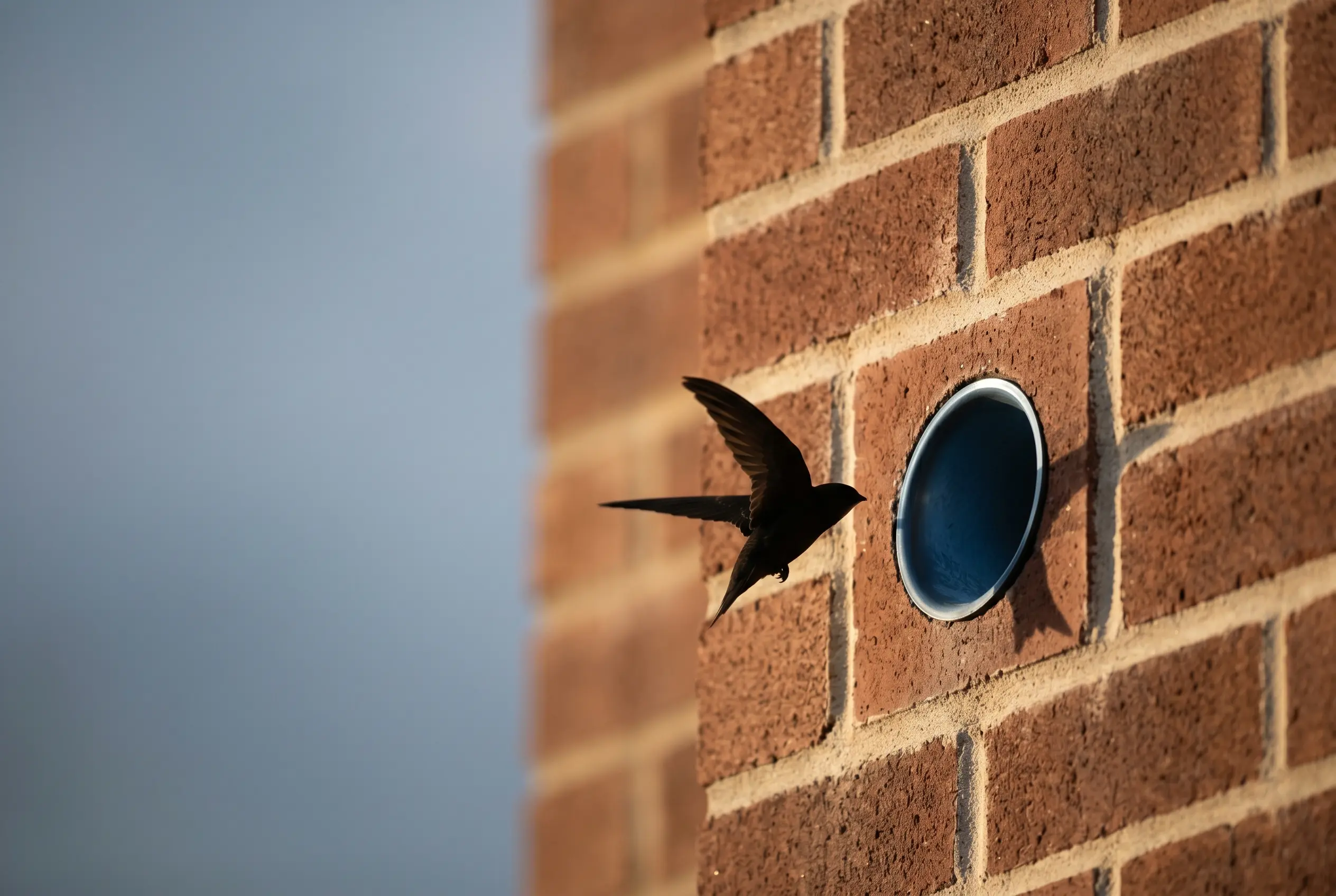
The Act Puts the Nest Box in Regulations
The final Act leaves the working detail outside the primary legislation. Ministers must define the buildings covered, the technical standard, the timing and the cases where installation would make little sense. That matters for Scotland’s builders because the eventual rule has to work for stone, brick, timber frame, modular systems and high-rise developments.
The wider law also sets biodiversity targets and changes rules on national parks, deer management, wildfires, forestry, marine protection and fishing penalties. The swift provision is only one line in a larger nature law, yet it is the part most visible to a buyer standing outside a newly built home.
- 12 months: the Act gives ministers that period after section 41 comes into force to make the swift nest box regulations.
- 68% decrease: the British Trust for Ornithology records that fall in the UK breeding swift population from 1995 to 2023.
- 59,000 pairs: the BTO’s UK breeding population estimate for swifts, based on its 2016 figure.
Those numbers explain why the rule has been attached to buildings instead of parks. Swifts feed in the air and migrate long distances, yet their breeding season depends on a dry, protected cavity in a wall or roofline.
The Decline Behind the Brick
Swifts are built for flight. The British Trust for Ornithology says the species is the long-distance migrant most associated with people because it chooses to nest among urban dwellings, returning to Britain and Ireland in early May. Its Swift BirdFacts entry lists the bird as Red listed under UK Birds of Conservation Concern.
The pressure comes from several directions. BTO notes likely causes including poor summer weather, lower insect food and continued loss of suitable nesting sites. The building part is the one a housing rule can touch. Older homes left small spaces under tiles, around eaves and within rough masonry. New homes are tighter, warmer and more sealed, which is good for energy performance and weatherproofing. It also removes the gaps that swifts, house sparrows and starlings used without a builder ever drawing them on a plan.
Swifts often return to the same nesting site. Renovation, roof work or demolition can erase a breeding place that a colony used for years. A built-in nest brick tries to replace that lost space at the moment when a wall is being made, which is cheaper and neater than retrofitting boxes to finished homes.
The Price Tag in the Bill Papers
The cost argument in Scotland’s bill papers is unusually concrete. The revised financial memorandum for the bill gave an indicative range of £35 to £100 for swift bricks and boxes, depending on type and specification. It then applied those unit costs to 19,797 housing completions in Scotland in the 2024 calendar year.
| Estimate | Unit Assumption | Housing Completion Base | Illustrative Total |
|---|---|---|---|
| Low | £35 per unit | 19,797 homes | £692,895 |
| High | £100 per unit | 19,797 homes | £1,979,700 |
The memorandum called those figures a theoretical maximum because the regulations had not been drafted and exemptions could reduce coverage. It also listed £66,073 of Scottish Government set-up cost for the swift nest box regulations.
For a developer, the brick itself is the smaller line. The work still has to be specified, bought, placed in the correct part of the wall and checked. A regulation has to say enough about location and product type to stop a token feature being placed where no bird can use it.
Which Species Get the Space?
The name points to swifts, but the standard used by designers is broader. The BS 42021:2022 integral nest box standard covers selection and installation of nest boxes for new developments, including residential, commercial, industrial and public buildings. It also covers renovation and refurbishment of those buildings.
The British Standards Institution says the standard principally covers these species:
- Swift, known scientifically as Apus apus.
- Starling, a cavity-nesting bird that has also declined in the UK.
- Great tit, a familiar garden bird that uses enclosed nesting spaces.
- Blue tit, another small cavity nester often found around homes.
- House sparrow, a species closely tied to buildings and streets.
That list is useful for planners because a single design feature can support more than one bird. It also matters for builders because the box has to be compatible with the wall system. The standard excludes exterior bird boxes and certain building surfaces, including primarily glass surfaces, where the hazard to birds is already well known.
England Has Chosen Guidance So Far
Scotland’s law lands after a long argument at Westminster over whether swift bricks belong in national building rules. In a UK Parliament written answer on swift bricks published on 5 January, Matthew Pennycook, housing minister at the Ministry of Housing, Communities and Local Government, said the government recognised swift bricks as a vital way to address the long-term decline of the breeding swift population.
The English route named in that answer was the National Planning Policy Framework (NPPF, the main planning policy document for England). The consultation described by Pennycook proposed a policy requiring developments to include swift bricks unless compelling technical reasons would prevent their use or make them ineffective. He said the expected end result would be at least one swift brick in every new brick built house unless there were legitimate reasons against installation.
| Place | Route Described | Status for Builders |
|---|---|---|
| Scotland | Building regulations required by the Natural Environment Act | Details still to be set through secondary legislation |
| England | NPPF consultation described in a ministerial written answer | Policy expectation, with technical exceptions proposed |
The difference is procedural. Planning policy shapes decisions before construction. Building standards follow the project into design details, warrant checks and completion. Scotland has chosen the route that makes the cavity part of the building file.
A Simple Rule Still Needs Building-Site Discipline
The nest brick is physically small, so failure will be easy to miss. A drawing can show the right feature, a supplier can deliver it, and a wall can still be built without the unit in the correct place. The regulations will have to give verifiers and builders enough detail to check the work without turning a low-cost feature into a paperwork exercise.
Several practical questions sit ahead of the final rule. The regulations need to define covered buildings, minimum performance, acceptable siting, treatment of non-brick materials, and the evidence a builder provides at completion. They also need to handle rural buildings, exposed coastal sites and structures where a cavity would be unsuitable.
The lesson from Scotland’s Act is that urban nature policy has moved into ordinary construction. No land purchase is needed. No new reserve has to be declared. A protected space for a bird can be designed at the same time as the insulation, the wall tie and the ventilation route.
Until the regulations are made, Scotland has the duty on the statute book and the construction detail still to publish.
 Windows 11 KB5095093 Lands With Point-in-Time Restore and 35-Day Pause
  Meta Cuts Smart Glasses to $299 to Outflank Snap and Apple
  Messi Leads the 2026 World Cup Golden Boot Race After Two Matches
  Australia March On as Athapaththu Ton Lights Up T20 World Cup
  Galaxy Z Fold 8 Leak Reveals Colors, Storage, and a New Ultra Variant
  Ronaldo’s Six-World-Cup Record Leads a Matchday Full of Milestones