 Ishan Crawford
 NASA is moving the launch of its $4.3 billion Nancy Grace Roman Space Telescope forward by eight months, targeting early September from Kennedy Space Center instead of the May 2027 commitment date. The headline number most outlets are running is the price tag and a 100,000-exoplanet forecast. The number worth tracking is three: the count of dedicated dark-universe observatories that will, for the first time, be returning data simultaneously.
ESA’s Euclid telescope started routine science in February 2024 and dropped its first data preview in March 2025. The NSF-DOE Vera C. Rubin Observatory in Chile released its first-light images on June 23, 2025, and begins its ten-year Legacy Survey of Space and Time later this year. Roman is the missing infrared piece. Once it reaches the Sun-Earth L2 Lagrange point about a million miles from Earth, cosmologists will hold the first cross-mission, multi-wavelength dataset against which the leading dark energy theories can be tested in parallel rather than in sequence.
The Telescope Built for One Specific Question
Hubble was a general-purpose optical workhorse. Webb is an infrared deep-field machine. Roman was sized, instrumented, and orbited to answer one set of questions: what is dark matter doing to galaxy shapes, what is dark energy doing to the rate at which space expands, and how many planets sit outside the reach of every other survey currently running.
Its primary mirror is 2.4 meters across, the same size as Hubble’s, and was originally a donated National Reconnaissance Office optic. What changes the math is the camera behind it. Roman’s Wide Field Instrument is a 300.8-megapixel near-infrared sensor with a 0.28 square-degree field of view, roughly 100 times wider than the equivalent Hubble camera. Survey speed scales with field area, so Roman will image up to 1,000 times more sky per unit time at comparable sensitivity.
The second instrument, the Coronagraph, is a technology demonstration that suppresses starlight by a factor of about a billion to image planets directly. If it works at design contrast, it becomes the proving ground for the much larger Habitable Worlds Observatory that NASA wants to fly in the late 2030s.
Over its five-year primary mission, Roman is projected to archive 20,000 terabytes of imaging data, examine billions of stars, hundreds of millions of galaxies, and run microlensing campaigns expected to detect at least 2,000 new exoplanets with thousands more through transits.
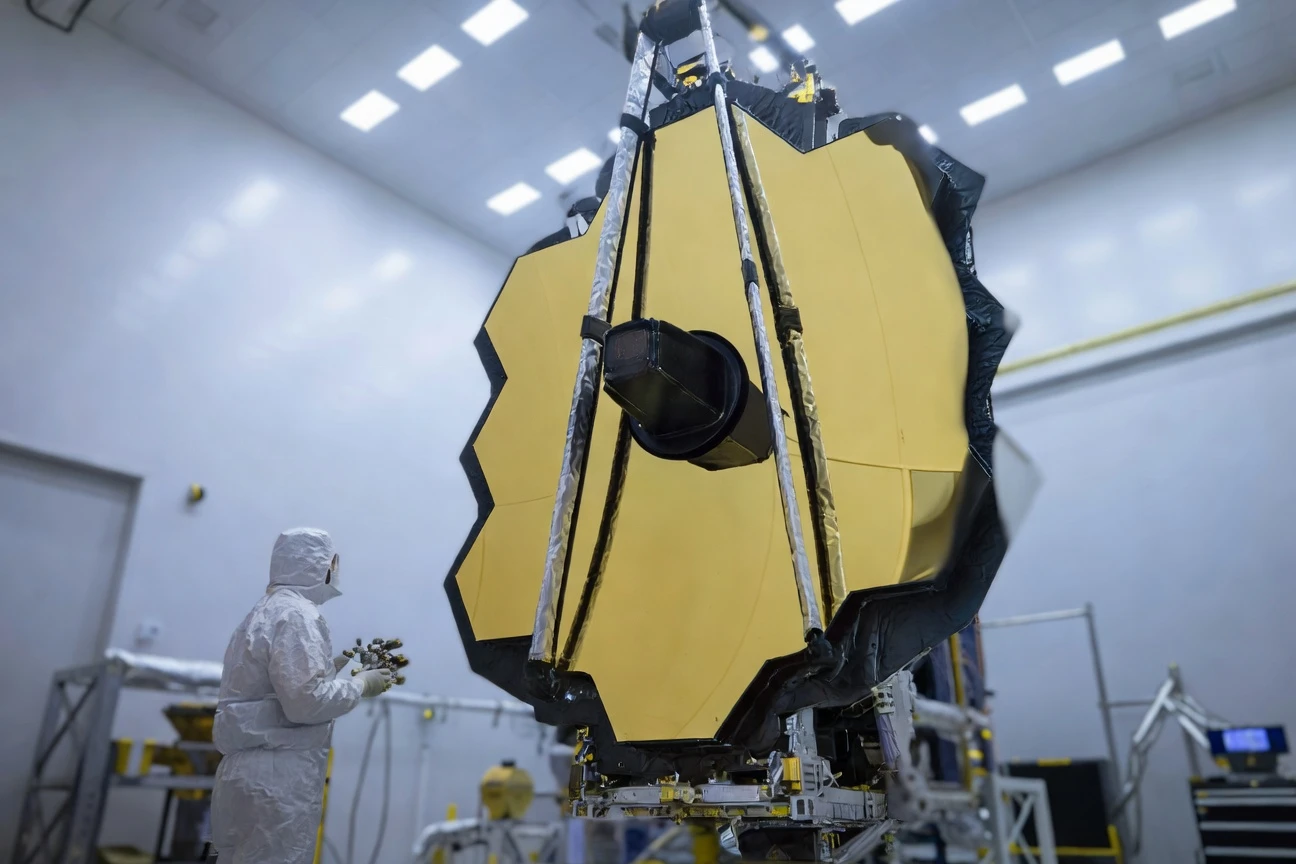
Roman, Euclid, and Rubin Triangulate the Dark Universe
The three observatories are not redundant. They cover different wavelengths, different sky areas, and different observing cadences, and cosmologists have spent the past five years writing joint-analysis papers that assume all three would be returning data at the same time. Roman’s September slot makes that assumption real.
| Observatory | Operator | Mirror | Primary Wavelength | Survey Focus | First Cosmology Data |
|---|---|---|---|---|---|
| Nancy Grace Roman | NASA | 2.4 m | Near-infrared (0.48 to 2.30 microns) | Deep wide-area infrared imaging, microlensing, weak lensing | Late 2026 onward |
| Euclid | ESA, with NASA contribution | 1.2 m | Visible + near-infrared | 14,000 square degrees of galaxy shape survey | October 2026 |
| Vera C. Rubin Observatory | NSF and US Department of Energy | 8.4 m | Visible (ground-based) | Time-domain survey of the southern sky every few nights | Late 2025 onward |
Roman’s job inside that trio is to provide the deepest infrared anchor. Rubin maps the southern sky fast and shallow from the ground. Euclid maps roughly a third of the sky from space at moderate depth. Roman goes deeper than either in a narrower band, then hands its precision distances and photometric redshifts back to the other two for calibration. A joint Type Ia supernovae analysis paper projected that combining the three datasets tightens dark energy constraints by factors the missions cannot reach individually.
Why Pulling the Launch Forward Changes the Race
An eight-month head start is not just calendar bragging. It pulls Roman’s commissioning, instrument checkout, and first science observations into the same window when Euclid’s first full cosmology release lands in October 2026 and when Rubin’s first survey year is producing repeat-cadence transient data.
What the acceleration buys, in practical terms:
- Overlap with Euclid Q1 cosmology release. Joint shear and clustering analyses that previously required waiting a year for Roman first light can begin almost immediately.
- Cross-calibration with Rubin’s first year of Legacy Survey output. Roman’s higher-resolution near-infrared imaging can resolve the galaxy blends that confuse Rubin’s ground-based photometry.
- An earlier start on the Galactic Bulge Time-Domain Survey, which monitors dense star fields for microlensing events that flag distant or rogue exoplanets.
- More margin against political risk. The current administration’s draft NASA budget proposed cuts to several science programs; an on-orbit observatory is harder to cancel than one still on the ground.
Roman by the Numbers
The figures NASA released alongside the September target sketch the scale of what is coming back from L2. They are also the numbers cosmologists will hold the mission to in five years.
- 2.4 meters primary mirror, identical in diameter to Hubble’s, originally a National Reconnaissance Office optic donated to NASA.
- 0.28 square degrees per Wide Field Instrument exposure, around 100 times the Hubble Advanced Camera for Surveys field.
- 20,000 terabytes projected data archive across the five-year primary mission.
- 100,000 exoplanets forecast through transit signatures, plus more than 2,000 expected from microlensing alone.
- $3.934 billion approved maximum lifecycle cost, including the Coronagraph technology demonstration and five years of operations.
Three Surveys, One Five-Year Window
Roman’s observing time was apportioned earlier this year by the Roman Observations Time Allocation Committee. The three Core Community Surveys eat the majority of the schedule and each one targets a different physics question.
The High Latitude Wide Area Survey
Roman will image roughly 2,700 square degrees of sky in the near-infrared H band at depths comparable to Hubble’s, but covering an area Hubble would need decades to reach. The galaxy shapes captured here feed weak-lensing measurements: the tiny shear that background galaxies pick up as their light bends around foreground dark matter. Euclid’s survey covers about 470 square degrees of that footprint, giving an immediate cross-check.
The High Latitude Time Domain Survey
This one revisits a smaller patch of sky repeatedly, hunting Type Ia supernovae out to redshifts where Hubble loses sensitivity. Roman’s infrared reach captures these stellar explosions in the rest-frame optical, the wavelength where their brightness is most reliable as a distance ruler. That cleaner distance ladder is the lever that lets cosmologists tighten the equation of state for dark energy.
The Galactic Bulge Time Domain Survey
Pointed inward toward the crowded center of the Milky Way, this survey watches for microlensing brightenings that betray planets too far from their stars for the transit method to catch. NASA expects more than 2,000 microlensing planet detections, including a population of rogue worlds drifting without any host star at all.
The $4 Billion Bill and the Politics Behind It
Roman was approved for implementation with a development cost cap of about $3.2 billion and a lifecycle ceiling near $3.934 billion. Public reporting that lands on the figure of roughly $4.3 billion typically includes additional ground-system and operations spending. By NASA flagship standards that is restrained: Webb finally came in around $10 billion, and the Habitable Worlds Observatory now in formulation is expected to exceed both.
Crucially, Roman was assembled on schedule and under cost, finishing construction on November 25, 2025. That history is the reason the September pull-forward survived a White House budget proposal earlier this year that targeted multiple NASA science programs for cuts.
Roman’s accelerated development is a true success story of what we can achieve when public investment, institutional expertise, and private enterprise come together to take on the near-impossible missions that change the world.
That was NASA Administrator Jared Isaacman at the Goddard Space Flight Center press conference earlier this year, framing the early launch as evidence the agency can still hold a flagship cost line. The launch vehicle is a SpaceX Falcon Heavy from Launch Complex 39A, the same site that flew the Intelsat 40e mission carrying a NASA Earth science payload.
What September Sets Up
The first useful science images will not arrive at launch. Roman has to transit out to L2, cool its instruments, run wavefront sensing on the primary, and then commission the Wide Field Instrument and Coronagraph one filter at a time. Realistic first-light science from the High Latitude surveys lands somewhere between three and six months after launch, with the Galactic Bulge campaign queued behind that.
By the spring after launch, three things become testable. Whether the Coronagraph hits its billion-to-one starlight suppression spec, which decides whether the Habitable Worlds Observatory architecture is on solid technical ground. Whether Roman’s H-band photometry agrees with Euclid’s optical-and-infrared photometry in the overlap region, which decides how much joint analysis is possible in year one. And whether Roman’s first weak-lensing maps come in tighter than Rubin’s, looser, or pulling in a different direction on the dark energy equation of state. If Roman, Euclid, and Rubin converge on the same value, the standard cosmological model survives another decade. If they diverge by more than their error bars allow, the next crisis in cosmology starts in 2027.
 Azithromycin Fails Preschool Wheezing Trial Despite Killing Bacteria
  Karuppu Crosses Rs 141 Crore Worldwide as Monday Hold Vindicates Suriya’s Wager
  MV Hondius Hantavirus Outbreak Stress-Tests a Hollowed WHO
  Moon Phase Tonight: 9% Crescent Opens Climb to May 31 Blue Moon
  Salman Khan Clarifies ‘Alone, Lonely’ Post After Salma Khan Worried
  The Night Sky Is Brightening 10% a Year, From Below and Above