
 Axel Piper
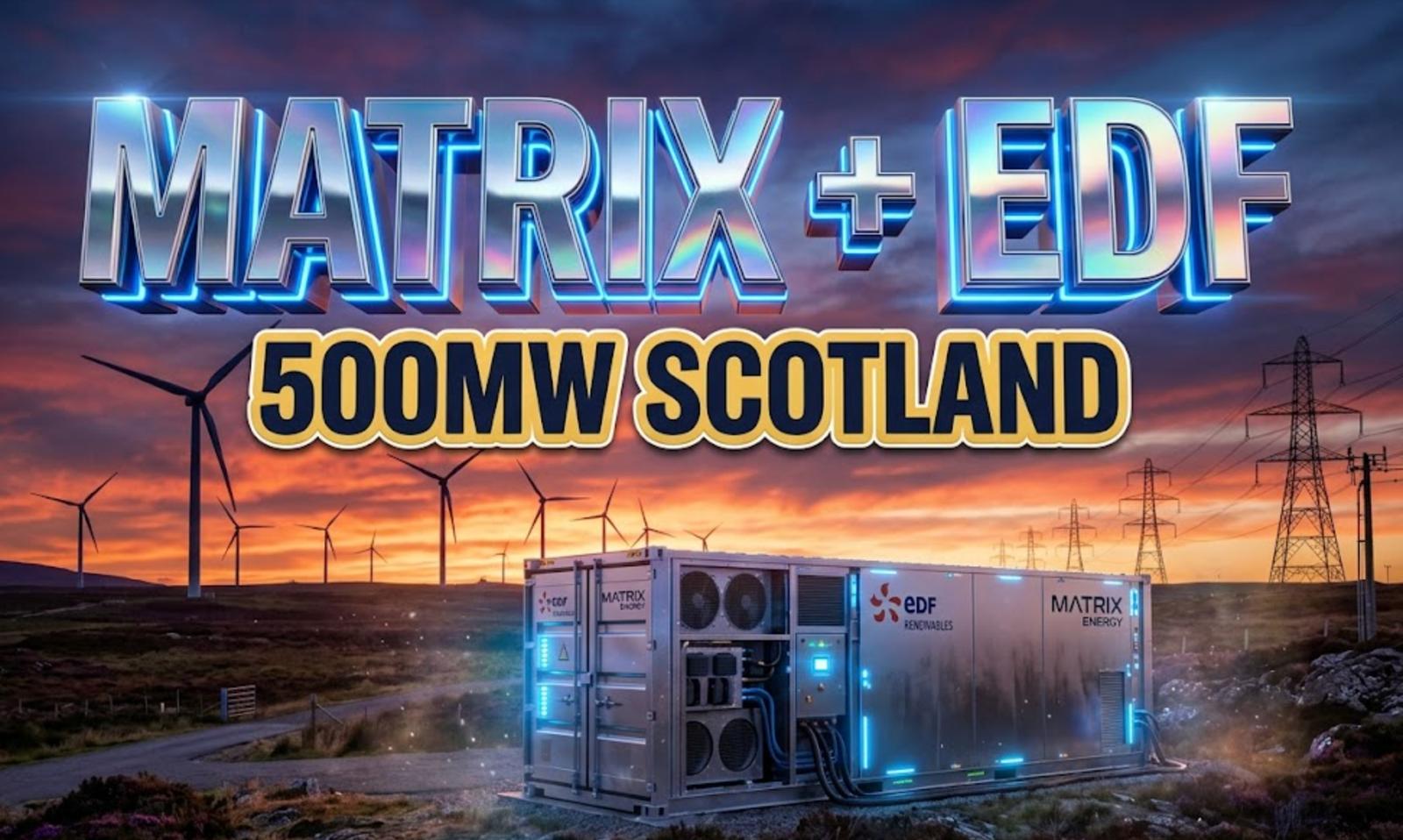
 Matrix Renewables and EDF have locked in a major deal to optimize a 500MW battery storage facility in Scotland, marking one of the largest energy storage projects set to reshape Britain’s power grid. The agreement signals a significant push toward grid flexibility as the UK races to meet its clean energy targets.
Battery Storage Giant Takes Shape in Scotland
Matrix Renewables has secured a long-term battery optimization agreement with EDF for its 500MW/1GWh battery energy storage system currently under construction in Eccles, Scotland. The facility is expected to begin operations in summer 2027.
The project represents Matrix Renewables’ first standalone battery storage development in the UK and will rank among the largest in the British electricity system when completed. The battery will capture excess renewable energy during low-demand periods and dispatch it when the grid needs it most.
EDF will handle route-to-market services and manage the battery’s performance across UK power markets using its Powershift platform. The technology will optimize the battery in real time to support grid stability and integrate more low-carbon generation.
Strategic Location Boosts Grid Resilience
The Eccles facility sits between critical transmission routes connecting Scotland and England. This positioning allows the battery to play a vital role in strengthening grid resilience and enabling efficient electricity distribution across borders.
Scotland generates substantial wind power that often exceeds local demand. The battery storage system will help balance this surplus by storing excess energy and releasing it during peak consumption hours in England and other regions.
The timing couldn’t be better. Britain’s grid faces mounting pressure to accommodate rapidly growing renewable capacity while maintaining stability. Battery storage provides the flexibility needed to manage intermittent wind and solar generation.
EDF Powershift Platform Takes Control
Stuart Fenner, EDF’s commercial director of business and wholesale services, emphasized the project’s importance for Britain’s energy transition. “Delivering EDF’s mission to build an Electric Britain depends on flexible assets that can respond instantly to the needs of the system,” he stated.
The Powershift platform will manage the battery’s operations across multiple revenue streams, including:
- Frequency response services to stabilize grid voltage
- Peak demand management to reduce strain during high consumption
- Energy arbitrage to capitalize on price differences
- Renewable energy integration support
EDF brings extensive experience in battery optimization, having managed similar projects across Europe. The company’s technical expertise will be crucial for maximizing the Eccles facility’s performance and revenue potential.
Tesla Partnership Powers Construction
In December 2025, Matrix Renewables signed a comprehensive engineering, procurement, and construction contract with Tesla to design, build and commission the Eccles battery facility. Tesla’s involvement brings proven battery technology and construction expertise to the project.
The facility has cleared all planning requirements and received full approval. Construction is proceeding on schedule for the targeted summer 2027 completion date.
Chris Matthews, Matrix Renewables’ chief commercial officer, highlighted the project’s broader significance. “We are proud to be delivering one of the UK’s largest battery storage projects and to partner with EDF for its commercial optimization. Battery storage will play a critical role in enabling the continued growth of renewable energy while strengthening the resilience and flexibility of the electricity system.”
Ambitious Expansion Plans Ahead
Matrix Renewables isn’t stopping at Eccles. The company has ambitious plans to develop over 3GW of battery storage capacity across the UK in the coming years. This expansion aligns with Britain’s Clean Power 2035 goals and Net Zero 2050 target.
The UK government has identified battery storage as essential infrastructure for achieving its clean energy ambitions. Current projections suggest Britain will need between 20GW and 30GW of battery storage capacity by 2035 to support a renewable-dominated grid.
Market conditions favor rapid battery deployment. Falling lithium-ion battery costs and improving energy density make large-scale storage increasingly economical. Government policies and grid connection reforms are also accelerating development timelines.
The Eccles project sets a benchmark for future battery storage facilities in scale and strategic positioning. As renewable generation continues expanding, more projects of this magnitude will be necessary to maintain grid stability and maximize clean energy utilization. The partnership between Matrix Renewables and EDF demonstrates how developers and utility companies can collaborate to build the flexible infrastructure Britain needs for its energy transition.
Share your thoughts on how battery storage will transform the UK’s energy system in the comments below.
 ONGC licence frees Venezuela cash and operatorship talks
  Anthropic Hits $65 Billion Run Rate and Flips the AI Cash Test
  Supreme Court grounds the fare free-for-all with three-week clock
  Gold Nears $4400 as Soft Data Meets Oil Inflation Risk
  Nifty Slips as Zaggle Circuits and Dhoot Debuts Big
  Diesel Crack Tops $100 as Iran Rhetoric Lifts Crude