
 Ishan Crawford
 Valve has priced the Steam Machine at $1,049 for the 512GB entry model, with a 2TB bundle topping out at $1,428. The small-form-factor gaming PC ships from June 29, but only to buyers who clear a randomized reservation queue that closes June 25.
The starting price lands $449 above the digital PlayStation 5 and $400 above the Xbox Series X. Valve says the gap is the cost of selling an open PC at no subsidy, and of paying for memory and storage in a market where its own original pricing target had become “no longer viable.”
The Four Configurations and What They Cost
Valve is selling the Steam Machine in four SKUs. The cheapest is the 512GB model at $1,049. Adding a Steam Controller lifts the price to $1,128. The 2TB model with two extra faceplates runs $1,349, and the 2TB model with faceplates and a Steam Controller costs $1,428.
| Configuration | Storage | Bundle extras | Price |
|---|---|---|---|
| Steam Machine | 512GB | None | $1,049 |
| Steam Machine + Controller | 512GB | Steam Controller | $1,128 |
| Steam Machine | 2TB | Red fabric and solid walnut faceplates | $1,349 |
| Steam Machine + Controller | 2TB | Faceplates and Steam Controller | $1,428 |
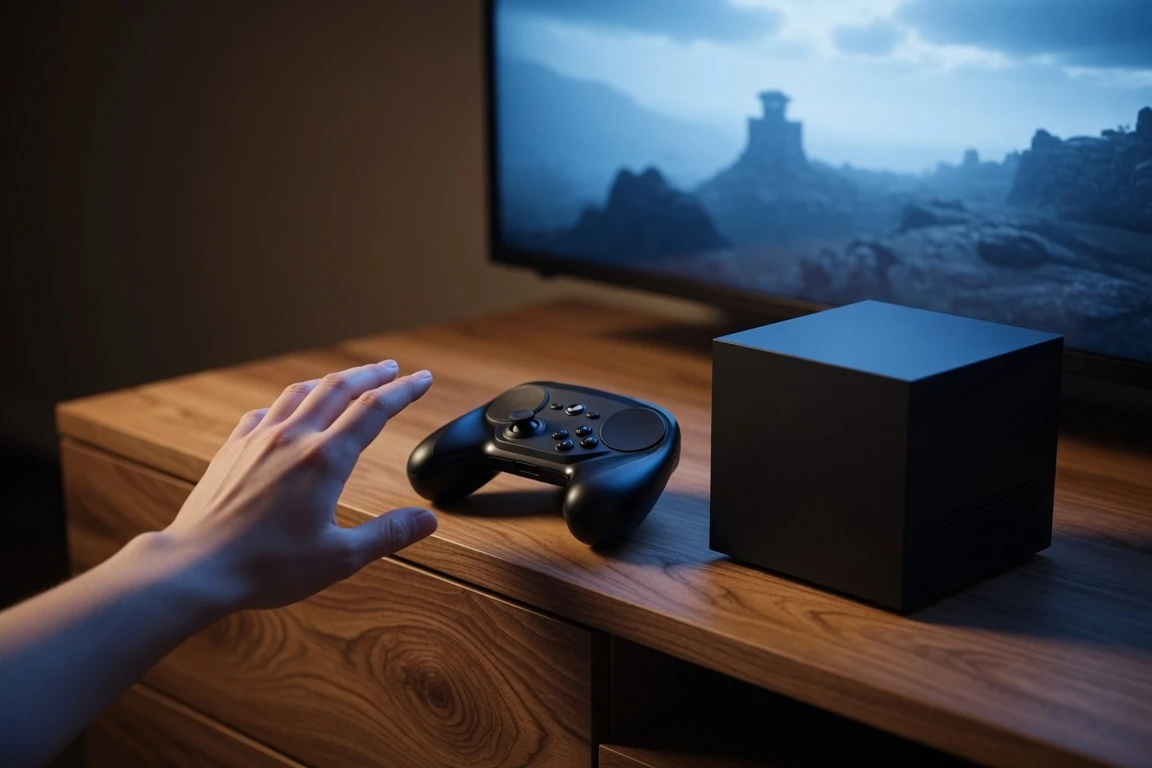
The 2TB versions ship with two interchangeable faceplates, “red fabric” and “solid walnut,” on top of the standard black finish. Every model runs SteamOS 3, the Linux-based operating system Valve also ships on the Steam Deck, and pairs a six-core, twelve-thread semi-custom AMD Zen 4 CPU with a semi-custom RDNA 3 GPU carrying 28 compute units. Memory is 16GB of DDR5 plus 8GB of GDDR6 VRAM, and connectivity covers Wi-Fi 6E, Bluetooth 5.3, and gigabit ethernet. The whole unit fits in a roughly six-inch cube with an integrated Steam Controller wireless adapter built in.
The Memory Crisis That Pushed the Price Up
The reason the price sits where it does is the same reason the launch slipped out of early 2026. Valve told the company blog explaining the new Steam Machine pricing that increases in component costs drove the reset. “The overall effect is that our original goal for the price of Steam Machine is no longer viable,” the post reads. “So the prices we’re sharing today reflect the state of the world for manufacturing; or, more accurately, it reflects the price [of] the components as we’ve secured them over the past 6 months.”
Memory and storage are doing more than raising the sticker. Valve’s own blog said the company was, “at times, unable to get the parts it needed to build Steam Machines at any price,” per the components shortage that delayed the Steam Machine launch. That cap on supply is the reason the reservation system exists in the first place: there are not enough boxes to put on a shelf, and Valve is choosing to allocate the ones it has rather than let bots and scalpers buy them out.
Steam Deck owners have lived with the same constraint through 2026, with the handheld console frequently out of stock for the same memory and storage reasons. The Steam Machine is the larger, more expensive version of that squeeze.
The No-Subsidy Bet Against Closed Consoles
Valve is also making a deliberate choice to sell at cost. The same blog post frames subsidized console hardware as a route to a closed platform, a position the company has held in various forms since the Steam Controller launch. Tom’s Hardware quoted the post: “When companies sell their hardware under cost for competitive advantage, or buy exclusive content for it, they’re doing that to build a more closed system, one where you don’t get to choose what software you want to use.”
When companies sell their hardware under cost for competitive advantage, or buy exclusive content for it, they’re doing that to build a more closed system, one where you don’t get to choose what software you want to use.
That framing puts the Steam Machine in competition with custom-built budget PCs and small-form-factor living room builds, rather than subsidized consoles. Sony and Microsoft routinely sell hardware at a loss and make it back on software and platform fees. Valve runs Steam, a software store, and chooses to keep the hardware at the cost of building it, the same playbook the Steam Deck has run on.
The Reservation Lottery: How to Try to Buy One
Reservations are open now on Steam and run through Thursday, June 25 at 10 a.m. PT / 1 p.m. ET. Buyers need a Steam account in good standing with a purchase made before April 27, 2026, and Valve limits each household to one reservation across payment methods, shipping addresses, and other signals it uses to flag duplicates.
The system is a one-time randomization. When the window closes, Valve shuffles every sign-up into a final order and emails results the same day. Two outcomes are possible: a place in the reservation queue, with a unit reserved and waiting to ship, or a place on the waitlist, with future batches to follow as Valve manufactures more units.
- The first batch of purchase emails goes out the week of June 29, starting on the 29th itself.
- Recipients get 72 hours to complete checkout before Valve skips to the next person in line.
- Buyers can sign up for multiple configurations. If a buyer lands a spot for more than one, Valve books the highest-end model and drops the other reservations.
- Regional queues are split: North America, the United Kingdom, the European Union, and Australia each get their own line.
- Valve expects the queue to run through the rest of the year, per Tom’s Hardware’s coverage.
Anyone who signs up after the June 25 cutoff joins the end of the waitlist rather than the randomized draw. Valve added the system, per Tom’s Hardware, to keep bots, fast-internet buyers, and people with the free time to camp a checkout page from sweeping up the available stock.
What Buyers Get: A Living Room PC, Not a Closed Console
Positioning matters. The Steam Machine runs SteamOS 3, the same Linux-based operating system that powers the Steam Deck, and treats the user’s existing Steam library as its catalogue. There is no separate first-party store on top, no platform-exclusive software tax, and no walled garden in the console sense. Valve markets the device as a living room gaming PC, not a PlayStation or Xbox replacement, and the hardware works as a regular PC for non-gaming tasks as well.
For buyers who would rather build their own, Valve has confirmed that SteamOS 3.8 will be installable on DIY rigs, with AMD GPUs supported first. The same announcement positions the Steam Machine as one option inside a wider PC market, the company’s preferred framing for a device that needs to clear a higher price bar than subsidized competitors.
- 512GB model: $1,049
- 2TB model with faceplates: $1,349
- CPU: 6-core / 12-thread semi-custom AMD Zen 4
- GPU: 28 compute units, semi-custom RDNA 3
- Memory: 16GB DDR5 plus 8GB GDDR6 VRAM
- Form factor: ~6 inch cube
The Wider Reckoning for Gaming Hardware in 2026
Valve is not the only hardware maker absorbing the memory and storage squeeze. Sony raised US PlayStation prices on April 2, 2026, moving the standard PS5 to $649.99, the PS5 Digital Edition to $599.99, and the PS5 Pro to $899.99, per the PlayStation Blog post on the price change. Microsoft’s Xbox Series X 1TB model is now listed at $649.99 on the company’s own Xbox console store. That is the market Valve is walking into with a $1,049 small-form-factor PC.
Valve’s framing is that buyers pay extra for openness, getting a box that does not lock them into a single storefront, can run non-game software, and ships with a controller wireless adapter built in. Reservation lotteries, randomized queues, and a queue that Valve says will run through the end of 2026 are the new buying experience for a PC that costs more than the consoles it sits next to under the TV. Valve has yet to announce pricing or release details for the Steam Frame VR headset, which it unveiled alongside the Steam Machine.
For more on the price delay, see earlier Steam Machine coverage of the price delay.
Frequently Asked Questions
How much does the Valve Steam Machine cost?
Valve priced the 512GB model at $1,049, the 512GB bundle with a Steam Controller at $1,128, the 2TB model with two extra faceplates at $1,349, and the 2TB bundle with faceplates and a Steam Controller at $1,428.
When does the Steam Machine go on sale?
First orders ship from June 29, 2026, after a randomized reservation queue. Reservations close at 10 a.m. PT on June 25, 2026.
Why is the Steam Machine more expensive than a PS5 or Xbox?
Valve attributes the higher price to component costs and a refusal to subsidize the hardware. The company’s blog post said the original pricing target was “no longer viable” given memory and storage costs.
How does the Steam Machine reservation system work?
Buyers sign up on Steam before June 25. Valve randomizes the sign-ups into a queue and emails the result the same day. Buyers in the queue receive a 72-hour purchase window when units are available.
Can you install SteamOS on a custom PC?
Starting with SteamOS 3.8, Valve says the operating system will work on DIY rigs. Support is limited to AMD GPUs at launch.
 Windows 11 KB5095093 Lands With Point-in-Time Restore and 35-Day Pause
  Meta Cuts Smart Glasses to $299 to Outflank Snap and Apple
  Messi Leads the 2026 World Cup Golden Boot Race After Two Matches
  Australia March On as Athapaththu Ton Lights Up T20 World Cup
  Galaxy Z Fold 8 Leak Reveals Colors, Storage, and a New Ultra Variant
  Ronaldo’s Six-World-Cup Record Leads a Matchday Full of Milestones