
 Ishan Crawford
 Rimpact has put a £229.99 bolt-on mass damper on sale for gravel bikes, a 400-gram device that the company’s own engineer does not call tuned or damped. The small UK brand, founded in 2018 as a four-person tire-insert maker, now wants gravel riders to pay for the same physics that Velo reported almost half the World Cup Downhill elite field used last season. The product lands in a discipline where suspension forks and high-volume tires have already done most of the comfort work, and where no blinded, back-to-back test has yet separated the device from a static weight.
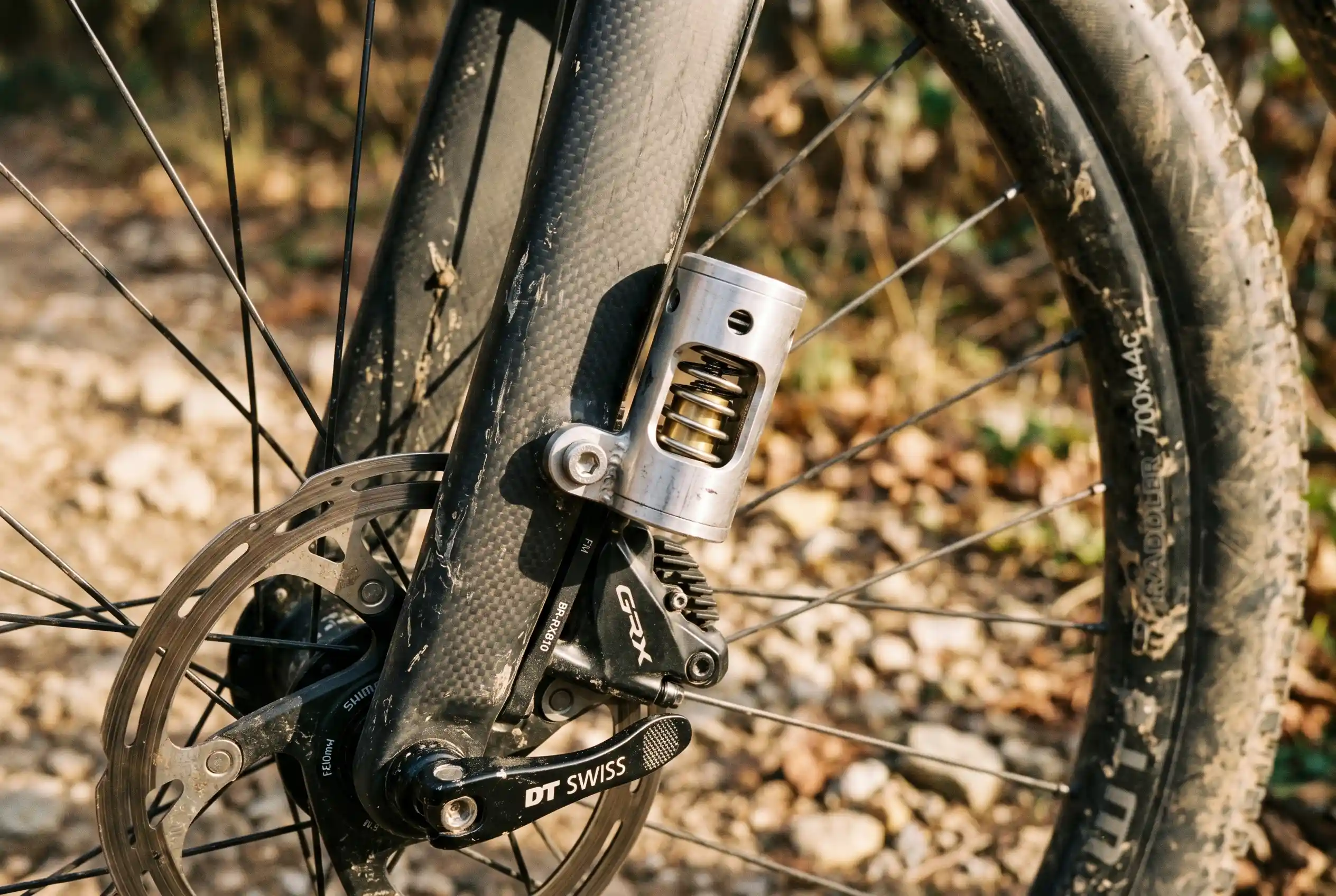
The Rimpact Gravel TMD bolts to a fork’s flat-mount adapter, with compatibility listed for 140 mm or 160 mm rotors. Inside a metal tube, a weight sits between two springs that compress in turn when the fork deflects over a bump. Rimpact’s accelerometer testing, as described to Velo, measured the same total energy reaching the headtube with and without the sprung mass in place, the only change being a smaller, broader peak at the rider. Rimpact’s engineer says the device is not tuned to one frequency and has no hydraulic damping.
A name that doesn’t fit the physics
The Taipei 101 tower in Taiwan holds one of the world’s best-known tuned mass dampers, a 660-ton mass suspended between the 87th and 92nd floors of a 508-meter skyscraper. Viscous-fluid shock absorbers link that mass to the structure, and when high winds push the tower, the suspended weight stays put at first, damping the sway. Civil engineering TMDs are tuned to a specific frequency of vibration, so they target one resonant peak and shrink it.
A gravel rider is exposed to a wide range of vibrational frequencies, not one. Velo’s June 11, 2026 first look put the issue plainly: the Rimpact Gravel TMD is neither tuned, nor damped. The same piece noted that ‘in gravel cycling, the bike and rider are exposed to a vast array of vibrational frequencies, and so there is little to be gained in targeting any particular one.’ The Gravel TMD works differently from a Taipei 101 damper, and the brand’s own engineer is the one saying so.
What an ‘energy delay’ device does at the headtube
The Rimpact Gravel TMD’s published geometry is simple. It bolts to a fork via a modified flat-mount adapter, sits against 140 mm or 160 mm rotor hardware, and houses a weight between two springs inside a metal tube.
When the front wheel hits a bump, the fork deflects upward and the lower spring compresses, dropping the weight’s position inside the tube relative to the housing. The spring rebounds and the weight shifts back up, compressing the upper spring. Across a single bump event, the suspended weight oscillates between its two springs, while the tube around it moves with the fork.
The result is a delayed response at the headtube, a phase shift between input force and rider force. Rimpact’s test setup, as described to Velo, mounted accelerometers at the headtube and compared a real TMD against a fake unit of the same weight with the mass locked static. The total energy measured at the headtube was the same in both cases, with the real TMD producing a smaller, broader peak. The Velo piece called the effect ‘take the edge off.’
Dan Hicks, the engineer behind the project, describes the Rimpact TMD as more of an ‘energy delay’ device. Of course, energy cannot ever be created or lost, only converted into other forms. To be clear, Dan isn’t claiming that this device breaks the First Law of Thermodynamics, but he is claiming it reduces the initial peak force of energy experienced at the headtube following a given bump.
Hicks says the TMD ‘would sit in the realm of a compliant handlebar, for example’ when it comes to comfort, per Velo. On a rigid gravel fork, the device handles vibration a suspension fork would have absorbed before reaching the rider’s hands.
The Downhill halo, by the numbers
Downhill is where the idea lives, and the World Cup paddock is the evidence. Velo reported that close to half the field of Elite riders used Rimpact’s steerer-housed TMD last season. Many other riders used a competing TMD from CounterSycle’s external head-tube damper, which weighs 550 g and lists at $275. Bikerumor’s coverage of the Rimpact TMD V2 named Trek Factory Racing, Canyon CLLCTV, Scott Factory DH, Cube Factory Racing, and NukeProof Axess Racing as World Cup DH teams running Rimpact products, and Rimpact’s own homepage adds the Commencal MUC/OFF team to that list.
The Rimpact Gravel TMD is a different device from the steerer-housed V2. Rimpact told Bikerumor the V2 is ‘not compatible with gravel bikes’ because of the bolt-on flat-mount geometry, and the V2’s 1 1/8 inch metallic steerer fitment makes no sense on a rigid gravel fork. The gravel unit is its own product, sharing the sprung-mass principle but a different shape, and the existing V2 spec sheet confirms a 420 g unit weight with a 250 g brass mass suspended between two springs.
- ~50% of the 2024 World Cup DH Elite field reported to have used Rimpact’s steerer-housed TMD (Velo)
- March 16, 2026 shipping start for the Rimpact TMD V2 mountain bike unit (Bikerumor)
- 660 tons is the mass of the Taipei 101 tuned mass damper (Velo, for context)
- 80% maximum spring travel, by design, in the Rimpact TMD V2 to extend spring life (Rimpact product page)
- 1 second per minute is the time Jesse Melamed says the TMD saved him in racing (Rimpact product page)
| Attribute | Rimpact Gravel TMD | Rimpact TMD V2 (MTB) | CounterSycle DH |
|---|---|---|---|
| Price | £229.99 | £199.99 | $275.00 |
| Unit weight | 400 g | 420 g | 550 g |
| Mounting | Bolt-on to fork via flat-mount adapter | Hidden inside 1 1/8 inch steerer | External, outside head tube |
A 400-gram bolt-on for a gravel bike without suspension
The Rimpact Gravel TMD is priced higher than the existing TMD V2 for mountain bikes, while adding a flat-mount adapter to a fork that, on most gravel bikes, has no hydraulic suspension to do the heavy lifting. Velo’s writer called the result a ‘seriously hard sell’ and admitted at the end of the first look that he has ‘no idea’ if it works. The same piece proposed a blinded test against a fake unit as the only way to settle it. The asking price is for a product whose only published test is Rimpact’s own.
On a rigid gravel fork, the damper handles vibration a suspension fork would have absorbed, a different job from the one Rimpact’s downhill customers bought it for. The same piece says the Rimpact TMD ‘would sit in the realm of a compliant handlebar’ in comfort terms. The Rimpact Gravel TMD arrives in a discipline where the suspension fork that made the principle useful in downhill is often absent.
The brand is small. Rimpact’s official site and team profile says the company was founded in 2018 and is ‘a team of four passionate riders.’ Marketing for a four-person team leans on engineering credibility, not advertising reach, and a misnomer product name makes that harder in a discipline where most buyers have not yet ridden a TMD on a rigid fork.
Where the TMD fits in the comfort toolkit
Rimpact’s own ranking of comfort upgrades runs like this. In Rimpact’s own ordering, a suspension fork is the most impactful change, high-volume tires are the second, and the TMD lives in the same band as a compliant handlebar or grip upgrade. It is a refinement, not a foundation, and the engineer is the one placing it there.
Bikerumor flagged the gravel direction in 2025, when the TMD V2 launched, noting that Rimpact ‘states that the TMD V2 is not compatible with gravel bikes, but that a gravel-specific unit is in the works.’ That gravel-specific unit is the new bolt-on on sale, aimed at rigid-fork gravel riders who have already tried wider tires, lighter grips, and a more compliant bar. Few riders have exhausted those earlier options. For those planning a Scotland-based first season, Galloway’s quiet gravel network as a training ground is worth a look.
The damping Time once built into a road fork
Rimpact is not the first bike brand to put a mass damper in a steerer. Time, the French fork maker, built one into the Aktiv fork on its Alpe d’Huez climbing bike, and that one was actually damped, with a viscous fluid inside slowing the mass’s movement. SRAM has since bought Time, and Velo’s writer noted that ‘to my knowledge there is no current production version of that fork.’
The Aktiv was a real damper, the Rimpact unit is a sprung mass with very small sliding friction that the Velo piece describes as ‘negligible.’ Same name, different physics, and a gravel rider who picks the Rimpact ends up with the cheaper, simpler version of an idea a defunct fork once executed properly.
Rimpact’s product page notes the V2 springs are designed to use no more than 80% of their available travel, which the company says extends spring life. The Aktiv used a viscous fluid as its damping medium, a real physical damper. The Gravel TMD uses sliding friction the Velo piece calls ‘negligible,’ with no hydraulic circuit at all.
Frequently Asked Questions
What is a tuned mass damper on a gravel bike?
A tuned mass damper suspends a weight inside a frame, fork, or steerer tube so the weight moves out of phase with the structure, and the relative motion absorbs vibration. On the Rimpact Gravel TMD, a weight sits between two springs inside a metal tube that bolts to a gravel fork’s flat-mount adapter. Rimpact’s engineer calls the gravel version an ‘energy delay’ device rather than a tuned or damped one.
How much does the Rimpact Gravel TMD cost and weigh?
The Rimpact Gravel TMD is priced at £229.99 in the UK and adds 400 grams to a bike, per Velo’s June 11, 2026 first look. The existing Rimpact TMD V2 for mountain bikes costs £199.99, weighs 420 grams, and houses a 250-gram brass mass inside a 1 1/8 inch metallic steerer optimized for steerer lengths of 180 mm or longer.
Has the Rimpact Gravel TMD been independently tested?
No blinded, back-to-back test on a gravel bike has been published. Rimpact’s own accelerometer tests, described to Velo, compared a real sprung mass against a same-weight static mass on the headtube and measured the same total energy in both cases, with the real TMD producing a smaller, broader peak. Velo’s writer proposed a blinded test against a fake unit as the only way to confirm a real-world comfort effect on a gravel bike.
Why are so many World Cup Downhill riders using Rimpact?
Velo reported that close to half the World Cup DH Elite field used Rimpact’s steerer-housed TMD last season. Bikerumor’s coverage of the V2 names Trek Factory Racing, Canyon CLLCTV, Scott Factory DH, Cube Factory Racing, and NukeProof Axess Racing as teams running the device, and Rimpact’s own website lists the Commencal MUC/OFF World Cup DH team among its endorsers. Downhill riders use it on suspension forks, where peak headtube forces are large enough to move the mass, and Hicks says road riding, with smaller bumps, would not benefit.
Why does Rimpact say the V2 isn’t gravel-compatible?
The V2 is built to hide inside a 1 1/8 inch metallic steerer, optimized for steerer lengths of 180 mm or longer. Most gravel forks have rigid legs, shorter steerers, and no head tube cavity to mount in. The new Gravel TMD is the bolt-on shape, designed to work with the 140 mm or 160 mm rotor mounts that gravel forks already have. The full Rimpact TMD V2 spec sheet is on the manufacturer’s product page.
 Chrome 149 Patches 28 Security Flaws, 12 Memory-Safety Bugs
  NYT Strands Hints and Answers for Friday, June 12, 2026
  iPhone 18 Pro Max Leak Reveals Dark Cherry, Light Blue and Black
  WhatsApp Rolls Out Multi-Account Support to iPhone Users
  Wikipedia’s ‘Which Came First?’ History Game Arrives on iPhone
  UFC 6 Launches June 19 With a Brazilian Engineer’s Build Behind It