
 Ishan Crawford
 More than 200 angry residents packed Jedburgh town hall on Saturday as southern Scotland officially joined the Highlands and north-east in demanding an immediate pause on large-scale renewable energy projects. Fed up with feeling ignored, community leaders from the Borders, Dumfries and Galloway, East Lothian and South Lanarkshire stood shoulder to shoulder and warned the Scottish countryside is being turned into an industrial zone just to hit government net zero numbers.
This is no longer a handful of isolated voices. It is a full-blown rural revolt.
What Happened in Jedburgh This Weekend
Over 30 community councils sent representatives to the biggest anti-renewables gathering southern Scotland has ever seen. Speakers described a planning system that treats local people as an inconvenience rather than stakeholders.
One after another, residents told the same story: huge wind farms, 200-metre turbines, and endless lines of steel pylons marching across fields and hills with almost no meaningful consultation.
A retired farmer from the Lammermuirs received applause when he said: “They tell us this is for the climate, but they’re destroying the very landscape that makes Scotland worth saving.”
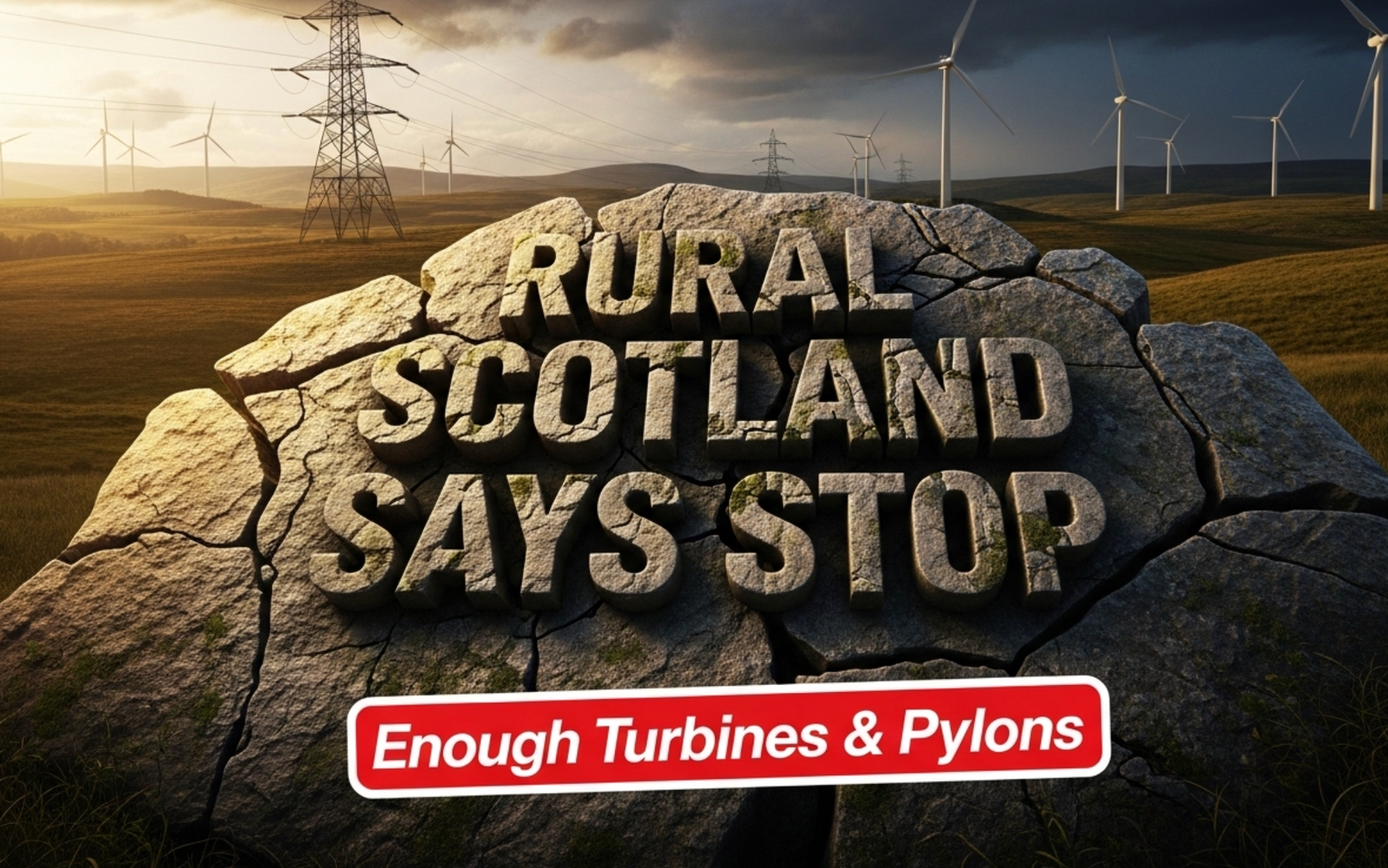
The Numbers Behind the Anger
Scotland already generates more than 100% of its electricity demand from renewables on windy days. Yet the Scottish Government wants onshore wind capacity to double again by 2030.
That means thousands more turbines and hundreds of kilometres of new high-voltage transmission lines.
Key figures that came out at the Jedburgh convention:
- Over 1,200 individual wind turbine applications currently in the Scottish planning system
- SSEN Transmission plans four new major grid corridors from the north and west to England
- More than 60 community councils across Scotland have now passed motions calling for a moratorium
- Zero successful community objections upheld at public inquiry in the last three years
Why People Say They’re Being Ignored
Time and again speakers pointed to the same problem: national targets override local democracy.
Planning decisions for projects over 50MW are taken out of council hands and decided in Edinburgh. Local authorities can object, but ministers almost always approve.
One East Lothian councillor told the hall: “We get six weeks to respond to a 500-page environmental statement written by consultants paid by the developer. It’s rigged.”
Many residents feel the Scottish Government’s own “community benefit” funds, usually £5,000 per MW per year, are nothing more than bribes.
The Bigger Picture Nobody in Edinburgh Wants to Admit
Scotland is rushing headlong into renewable energy while England drags its feet. That means Scottish beauty spots are carrying the load for the whole UK.
Saturday’s convention heard that Beauly to Spittal transmission upgrade will see 400kV pylons cross some of the most scenic parts of the Borders, purely to export power south.
Communities say they support green energy in principle, but not when it means industrialising every quiet valley and hill.
They want:
- An immediate pause on all new large-scale applications
- Proper cumulative impact assessments
- Real community veto rights on projects that change their landscape forever
- Much more focus on rooftop solar, micro-hydro and energy efficiency instead of giant turbines
The Political Response So Far
Scottish Conservative MSP Rachael Hamilton and Labour MSP Colin Smyth both attended the Jedburgh event. Both pledged to take the moratorium demand to Holyrood.
Yet the Scottish Government continues to insist the pace must accelerate if Scotland is to remain a “world leader” in renewables.
One SNP source told The Scotsman the calls for a pause were “deeply irresponsible” and risked jobs and investment.
But for the people in that Jedburgh hall on Saturday, the real irresponsibility is covering Scotland’s irreplaceable countryside in steel and concrete while pretending local voices don’t matter.
The message from rural Scotland is clear: slow down, listen properly, or risk killing the golden goose of tourism and turning the country people love into one they no longer recognise.
What do you think? Should Scotland pause the headlong rush into giant wind farms and pylons, or is this the price we must pay for net zero? Drop your thoughts below.
 Coal India, BEL Miss Estimates as India’s Mid-Caps Surge Ahead
  HCLTech’s Neo.AI Unit Chases the Business Its Mid-Tier Rivals Built
  Nvidia in Talks to Guarantee $250 Billion for OpenAI’s Data Hub
  HDFC Bank Fines CEO and CFO, Refers MSRDC Case to RBI
  Hyderabad Gold Rate Rises as India’s New 15% Duty Bites
  Maruti Brezza Facelift Prices Fall Thanks to a Tax Rule