

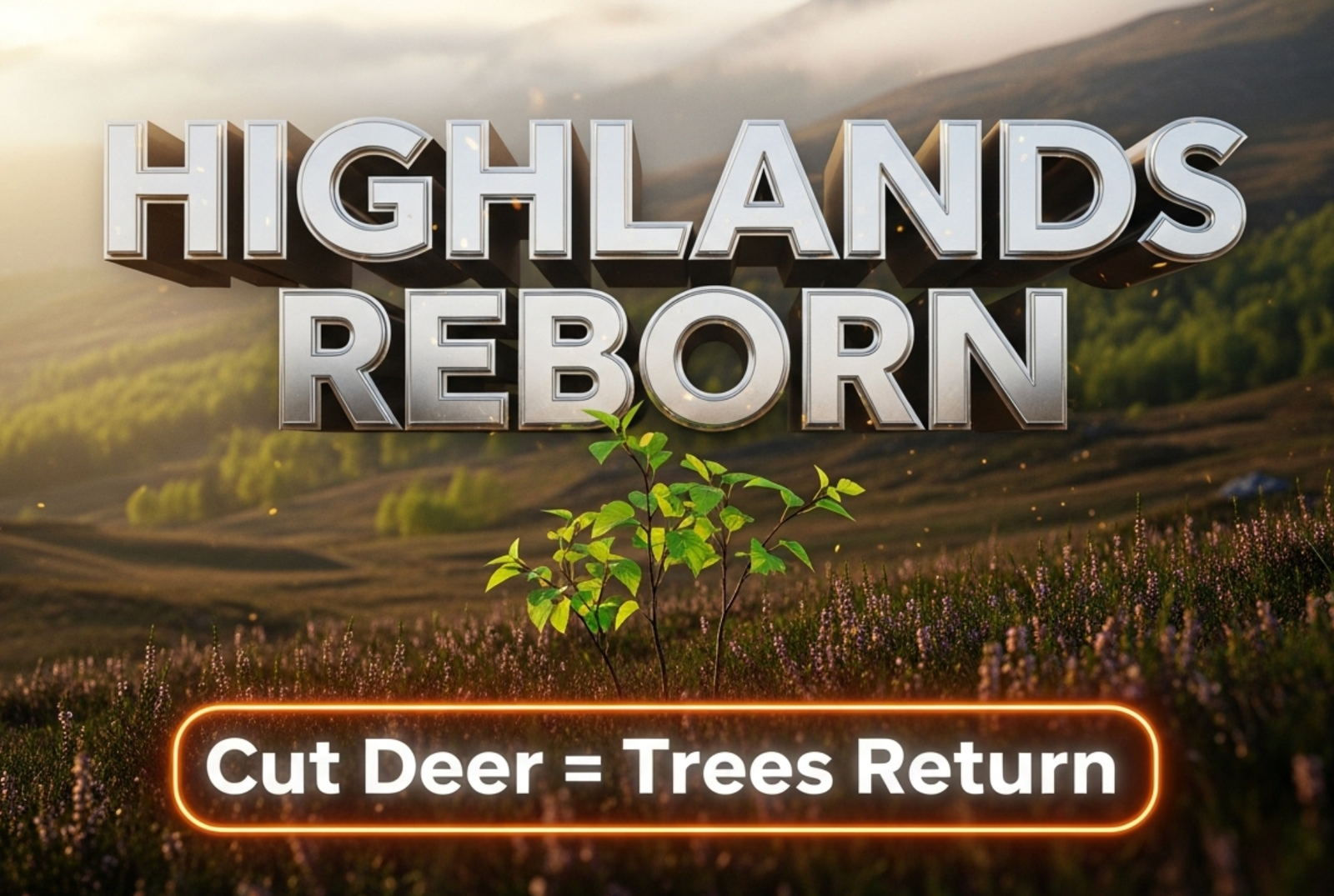
A groundbreaking six-year study proves that Scotland’s treeless Highlands are not natural. They are the result of too many deer. Cut red deer numbers below three per square kilometre and native mountain woodlands, including rare dwarf birch, can spread far beyond their bog refuges for the first time in centuries.
The University of Stirling research, published this month, delivers the clearest evidence yet that overgrazing, not climate or soil, is the main barrier stopping trees returning to the hills.
Dwarf Birch Tells the Story Most People Missed
Most Scots think of dwarf birch as a low, straggly shrub that only grows on wet blanket bogs. That is wrong.
Across Norway, Iceland, and the Alps, the same species forms dense mountain woodlands up to 1,200 metres. In Scotland it has been eaten into retreat, surviving only where deer struggle to reach or where deep bogs protect it.
Researchers planted 750 dwarf birch trees at three Highland sites: Ben Lawers National Nature Reserve, Corrour Estate, and Glen Finglas. They tested three habitats (blanket bog, upland grassland, and heath) under three deer pressure levels: zero grazing (fenced), low (1-3 deer/km²), and higher (7 deer/km²).
The results were dramatic.
In areas with seven deer per square kilometre, dwarf birch planted on grass and heath suffered heavy browsing and high death rates. The same trees planted on nearby blanket bog survived well because deer avoid deep, wet ground.
When deer density fell below three per square kilometre, survival rates became equally high across all three habitats. Some trees on heath and grass even grew faster than those on bog.
Lead researcher Sarah Watts says this proves blanket bog was never the ideal home. It was simply the last refuge.
Deer Numbers Still Far Too High in Most of the Highlands
Scotland carries some of the highest red deer densities in Europe. Many open-range areas hold 15–30 deer/km², with some glens exceeding 40–60.
The current national guideline from NatureScot remains 10 deer/km² on open hill ground. Even that target is rarely met outside fenced plantations.
At 10 deer/km², the Stirling study shows dwarf birch still struggles on grass and heath. Only below three does natural regeneration become possible without fences.
Watts says the science is now unambiguous: large-scale mountain woodland recovery needs landscape-scale deer reduction to below three deer/km².
Wider Benefits Reach Far Beyond Trees
Restoring mountain woodlands does more than bring back beauty.
Dwarf birch and associated species like downy willow, rowan, and juniper stabilise steep slopes, slow avalanche risk, and reduce flash flooding in glens below.
They store carbon twice as fast as commercial spruce plantations in the early decades because they grow on ground that was previously bare or grass.
They provide food and cover for black grouse, mountain hares, and rare invertebrates that have vanished from overgrazed hills.
And they reconnect fragmented Caledonian pinewood remnants with Atlantic hazel woods on the west coast, creating wildlife corridors that have not existed since the 1700s.
Real-World Sites Already Showing What Is Possible
At Glen Finglas (Woodland Trust Scotland), deer fences came down years ago after stalkers reduced numbers. Native trees are now leaping out across former sheepwalk.
Corrour Estate has cut deer density to around two per km² in parts of its 23,000 hectares. Visitors now walk through waist-high birch and willow where only rushes grew fifteen years ago.
These places are living proof that lowering deer numbers works. The Stirling experiment simply quantifies how low is low enough for the most sensitive species.
Time to Change the Target
Conservation bodies and landowners agree more deer control is needed, yet progress remains slow outside a few flagship estates.
Sarah Watts and co-author Dr Nadia Barsoum from Forest Research want policymakers to adopt a new national target of two to three red deer per km² across open hill ground where woodland or scrub restoration is a priority.
They also call for more rural jobs in deer management. Skilled stalkers are needed to bring numbers down and then maintain them at sustainable levels.
Scotland has the land, the native seed sources, and now the evidence.
All that is missing is the political will to treat high deer numbers as the national emergency they have become.
If we act in the next decade, our children could walk through flowering mountain woodlands that have not existed for hundreds of years.
If we keep arguing, the chance will be eaten, twig by twig, before it ever grows.
What do you think: should Scotland finally set a proper deer density target for nature recovery? Share your view below and use #BringBackTheTrees if you are posting on social media.


