

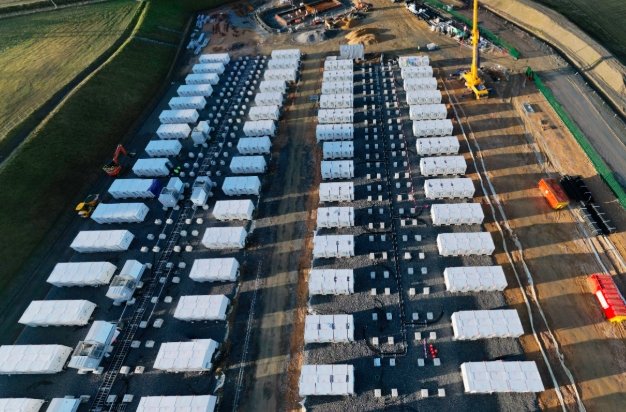
The largest battery energy storage system in Europe is now online. Wärtsilä has successfully delivered a 200 MW / 400 MWh facility to Zenobē in Blackhillock, Scotland, marking a major milestone in the UK’s transition to a cleaner, more stable power grid.
A Breakthrough for Grid Stability in Scotland
The Blackhillock site is the first of its kind, offering stability services to the National Grid Electricity System Operator (NESO). By providing short-circuit level and synthetic inertia, the system fills the gap left by the phasing out of fossil fuel power plants. This means a stronger, more resilient electricity grid that can support the UK’s growing reliance on wind and solar energy.
James Basden, Founder and Director at Zenobē, highlights the impact: “Our batteries at Blackhillock are the first to use advanced power electronics to enable a much higher uptake of renewable power on the grid. This dramatically reduces costs to consumers and increases reliability.”
Consumer Benefits and Cost Savings
Beyond supporting renewables, the project has financial benefits. According to Zenobē, the site will save UK consumers over £170 million in the next 15 years. The system helps reduce electricity price fluctuations by managing excess power during peak wind generation and supplying energy when demand is high.
- The battery stores energy when renewable output is high and releases it when needed.
- It prevents wind farms from shutting down during times of low demand, ensuring full utilization of generated power.
- The result? Lower costs, better efficiency, and reduced carbon emissions.
Cutting Carbon While Maximizing Wind Power
Located near three major offshore wind farms in the North Sea, Blackhillock is strategically placed to prevent energy waste. By integrating more wind power into the grid, the system is expected to prevent 2.6 million tonnes of CO₂ emissions over the next 15 years. That’s equivalent to removing hundreds of thousands of cars from the roads.
A key component of this effort is Wärtsilä’s GEMS Digital Energy Platform, which allows Zenobē to monitor and optimize energy flow in real time. GEMS uses data intelligence to balance supply and demand efficiently, improving grid stability while maximizing renewable energy usage.
What’s Next? Kilmarnock South on the Horizon
Wärtsilä isn’t stopping at Blackhillock. A second energy storage site, Kilmarnock South, is already in the works. With a capacity of 300 MW / 600 MWh, it will be even larger and is expected to be operational by the end of 2025. This project, also part of the Stability Pathfinder programme, further cements Scotland’s role as a leader in renewable energy innovation.
Andrew Tang, Vice President of Wärtsilä Energy Storage & Optimisation, underscores the importance of these systems: “As Britain increases its reliance on renewable energy sources such as wind and solar, systems like Blackhillock will ensure that excess power can be stored and then used during times of increased demand.”
With projects like Blackhillock and Kilmarnock South, the UK is taking tangible steps towards a net zero power grid by 2030. These large-scale battery systems aren’t just futuristic concepts—they’re here, they’re working, and they’re changing how energy flows across the country.