
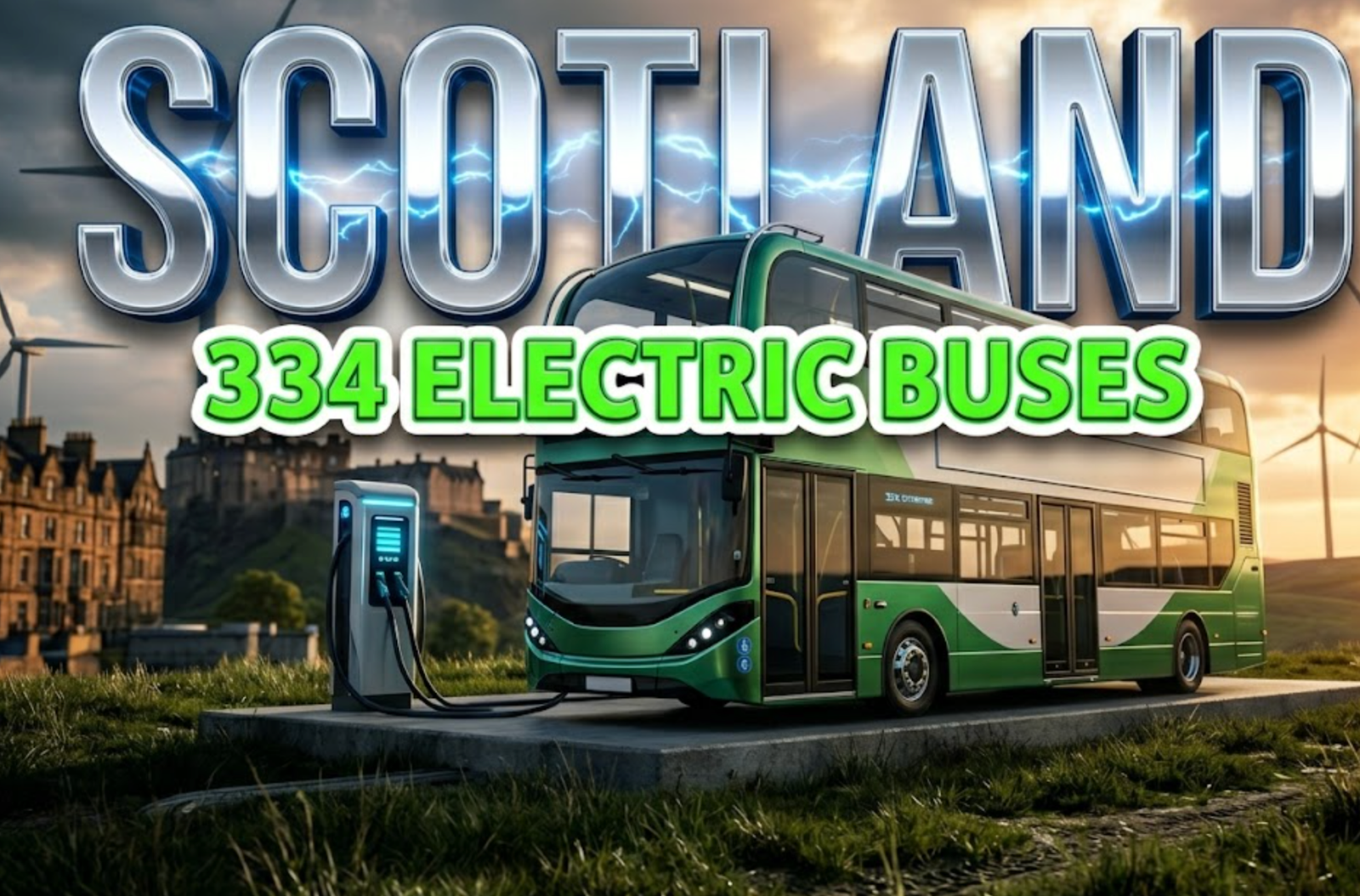
Scotland has announced a major push toward greener public transport with a £45 million investment that will bring 334 electric buses and coaches to its roads. The funding, confirmed under the third round of the Scottish Zero Emission Bus Challenge Fund, marks a decisive step in the nation’s efforts to eliminate emissions from its bus network while putting pressure on neighboring England to keep pace.
Scotland Closes Gap with Final Zero Emission Bus Fund
The Scottish government has approved the third and final round of its Zero Emission Bus Challenge Fund, injecting £45 million into the country’s electric bus transition. This investment will support the deployment of 334 zero-emission vehicles alongside essential charging infrastructure across multiple regions.
The announcement comes just weeks after England revealed plans to fund 484 electric buses across 10 regions, creating a competitive race between the nations to lead the UK’s transport electrification efforts. Scotland’s investment leverages significant private sector commitment, with fleet operators contributing over £163 million to the total project cost.
Total public and private funding combined will exceed £118 million, demonstrating strong industry confidence in zero-emission technology. Each pound of public money is generating approximately £2.50 in private investment, a ratio that Scottish officials highlight as proof of successful public-private partnership models.
Major Fleet Operators Commit to Electric Transition
Five leading bus and coach operators will receive funding to electrify their fleets, with vehicles sourced from both British and international manufacturers. The allocation breaks down across 227 buses and 107 coaches, representing one of Scotland’s largest single procurement efforts for clean transport.
Rock Road leads the charge with plans to acquire 93 vehicles, including 14 Alexander Dennis double-deck buses, 69 Alexander Dennis single-deck units, and 10 Wrightbus single-deck models. First Bus will repower 15 existing double-deck buses while adding 22 new Yutong double-deck vehicles to its fleet.
Ember has secured funding for 100 Yutong coaches, marking a significant expansion of zero-emission intercity travel options. Stagecoach will introduce 44 vehicles from Yutong, comprising 7 coaches, 21 single-deck buses, and 16 double-deck buses.
Lothian rounds out the allocation with 60 double-deck buses split between Volvo/Alexander Dennis and Wrightbus manufacturers. The diverse supplier mix ensures competitive pricing while supporting both domestic manufacturing jobs and international technology partnerships.
Four Years of Investment Delivers 800 Clean Buses
The ScotZEB3 programme represents the culmination of Scotland’s sustained effort to transform its bus sector since 2020. Over the past four years, cumulative investment through the Zero Emission Bus Challenge Fund and the Scottish Ultra-Low Emission Bus Scheme has reached £154 million.
This funding wave has enabled the deployment of approximately 800 buses and associated charging infrastructure across Scotland. The programme has established a clear pathway for large fleet operators to transition away from diesel, creating a model that other UK regions are now studying and replicating.
ScotZEB3 marks the final round of direct capital funding from the Scottish government specifically targeted at large bus operators. Future support mechanisms may shift toward smaller operators or focus on maintaining and expanding charging infrastructure as the initial fleet transformation nears completion.
The government’s decision to conclude direct capital funding reflects confidence that the market has matured enough for operators to proceed with electrification using commercial financing. Industry experts suggest this signals a transition from market creation to market sustainment.
Scotland Positions Itself as UK Electric Transport Leader
Cabinet Secretary for Transport Fiona Hyslop framed the investment as evidence of Scotland’s commitment to climate action through practical infrastructure development. She emphasized that the £45 million represents more than vehicle procurement, highlighting the collaborative framework between government and industry.
“This final investment signals our commitment to a zero-emission future for Scotland’s bus sector,” Hyslop stated. She pointed to the 2.5 to 1 private investment ratio as proof that government intervention can catalyze transformative climate action when structured effectively.
The timing positions Scotland competitively within the broader UK context. While England’s recent 484-bus announcement represents a larger absolute number, Scotland’s per-capita investment and completion timeline may deliver zero-emission coverage more rapidly across its population centers.
The investment also addresses concerns about regional inequality in clean transport access. By distributing vehicles across multiple operators and regions, the programme ensures that both urban centers and smaller communities benefit from improved air quality and reduced carbon emissions.
Scotland’s electric bus rollout arrives as European nations accelerate their own transitions, with Norway maintaining its leadership position through aggressive electrification mandates. The UK as a whole remains behind Scandinavian peers but continues closing the gap through programmes like ScotZEB and England’s regional funding initiatives.
The 334 buses and coaches funded through this final round will begin appearing on Scottish roads throughout 2026 and into 2027, fundamentally changing the daily commute for thousands of passengers. As charging infrastructure expands and operators gain experience with electric fleet management, the programme’s success will likely influence transport policy across the United Kingdom and beyond.
What do you think about Scotland’s electric bus investment? Share your thoughts on social media and let us know if your region should follow this model for cleaner public transport.