
 Dayna Bass
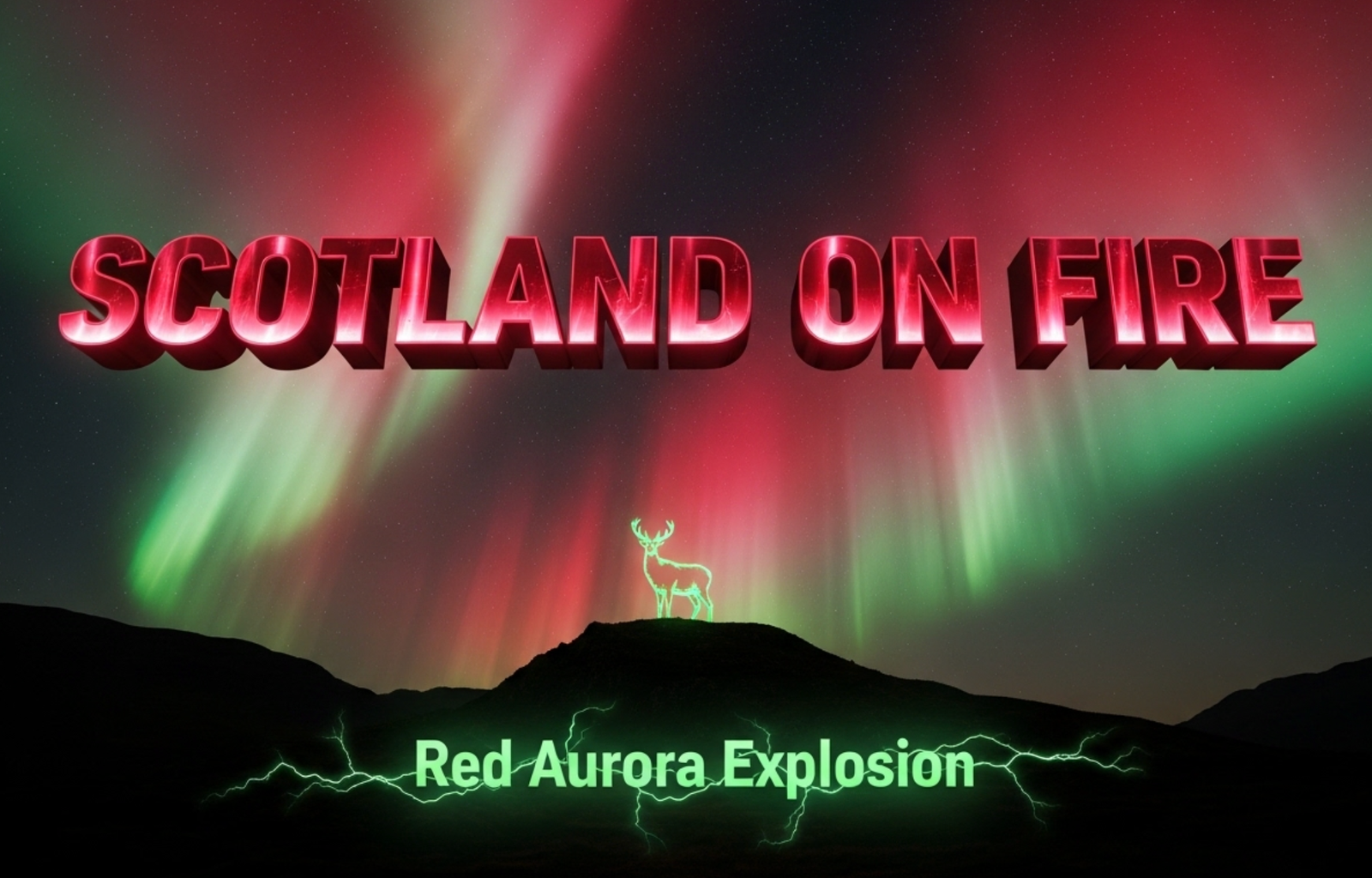
 Scotland woke up to one of its most intense aurora displays in years on Thursday night as a powerful solar storm turned the sky blood-red and emerald green from Orkney to the Borders.
Tens of thousands of people stepped outside or pulled over on dark roads to watch the spectacle, with phones raised and jaws dropped as the Northern Lights put on a show few had ever seen so far south.
Why This Display Was Different
The aurora reached extreme levels because of a G4 (severe) geomagnetic storm triggered by two coronal mass ejections that slammed into Earth on Thursday.
The US National Oceanic and Atmospheric Administration (NOAA) recorded Kp 8 conditions for several hours, high enough to push vivid red auroras to mid-latitudes. Red auroras come from oxygen atoms glowing at very high altitudes (above 150 miles), something usually only seen in the Arctic Circle.
AuroraWatch UK issued its rare Red Alert at 6pm on Thursday, warning that the lights could be visible “with the naked eye across all of the UK”. They were right.
Where the Sky Burned Brightest
The strongest activity peaked between 10pm and 2am.
Social media lit up with photographs from every corner of Scotland:
- Shetland and Orkney saw curtains of scarlet and purple directly overhead
- Caithness and Sutherland had pillars of green and red dancing above the Flow Country
- Moray and Aberdeenshire captured the aurora reflecting in the North Sea
- Skye and the west coast had the lights framing Eilean Donan Castle and the Cuillin
- Even Glasgow and Edinburgh saw strong green arcs low on the northern horizon
- Dumfries and Galloway and the Borders recorded deep red SAR (Stable Auroral Red) arcs, a rare phenomenon last seen widely in Scotland in 2003
One of the standout images came from Gourock on the Clyde, where the aurora hung above the town lights like a cosmic fire.
“I’ve Never Seen Red Like That”
Long-time aurora chaser Mikey Smith from Inverness told The Press and Journal: “I’ve been hunting the lights for 15 years and this is only the second time I’ve seen proper red overhead in Scotland. It felt apocalyptic in the best possible way.”
On X, the hashtag #NorthernLights trended in the UK top 10 overnight, with more than 28,000 posts from Scotland alone by Friday morning.
Families who had never seen the aurora before described children screaming with excitement and strangers hugging in lay-bys as the sky exploded in colour.
More Chances Coming This Weekend
The Sun is near the peak of its 11-year cycle (Solar Cycle 25), and experts say this storm is just the beginning.
Space weather forecasters expect continued high activity through the weekend, with a possible G3 storm on Saturday night and lingering effects into Sunday.
Dr Tamitha Skov, a leading space weather physicist, posted on X: “Scotland still has a very good shot at seeing aurora again Saturday and Sunday night. Keep looking north after 10pm.”
The best advice remains simple: get away from city lights, let your eyes adjust for 10-15 minutes, and look north to north-east.
For photographers, keep ISO between 800-3200, use a tripod, and shoot 3-8 second exposures with wide-angle lenses.
Scotland rarely gets treated to auroras this powerful and this widespread. When nature delivers a show like Thursday night, it reminds every one of us how small we are and how beautiful our planet can be when the Sun throws a tantrum.
If you caught the lights, drop your best photo or location in the comments below and tag #NorthernLightsScotland so we can all relive the magic together.
 HDFC Bank Fines CEO Jagdishan Weeks Before Reappointment Call
  Zepto’s IPO Valuation Target Sinks to $3 Billion From $7 Billion
  Man Jailed Under a Rare Lifelong Order for Edinburgh Rape
  Tata Power’s ₹6,675 Crore Bet on Solar Self-Reliance in Odisha
  South Korea and Japan Chip Stocks Crash as China Surges
  Scotland’s Social Work Registration Overhaul Carries a Staffing Cost