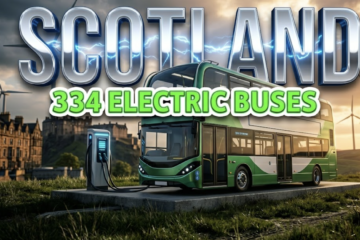

Scotland has unveiled a massive £45 million funding package to electrify its public transport network, marking a decisive push toward zero-emission travel across the nation. The announcement confirms deployment of 334 electric buses and coaches through the final round of the Scottish Zero Emission Bus Challenge Fund, cementing Scotland’s position as a leader in sustainable transport within the United Kingdom.
Final Push for Fleet Electrification
The ScotZEB3 funding represents the culminating chapter of Scotland’s direct capital investment strategy for large bus operators. Since 2020, the Scottish government has channeled £154 million through various schemes, enabling approximately 800 zero-emission vehicles to hit the roads alongside essential charging infrastructure.
This latest allocation demonstrates remarkable leverage of public funds. Every £1 of government money has attracted over £2.50 in private investment, with fleet operators collectively committing more than £163 million to the initiative. Combined public and private contributions will exceed £118 million, showcasing genuine partnership between government and industry.
Cabinet Secretary for Transport Fiona Hyslop emphasized the historic nature of this investment, stating it signals unwavering commitment to transforming Scotland’s bus sector into a zero-emission powerhouse.

Major Fleet Operators Lead the Charge
The 334 vehicles will be distributed among Scotland’s most prominent transport providers, with deliveries spanning both urban buses and long-distance coaches. The deployment strategy focuses on practical implementation across diverse operational environments.
Rock Road emerges as the largest single recipient, securing 93 vehicles including 14 Alexander Dennis double-deck buses, 69 single-deck units from the same manufacturer, and 10 Wrightbus single-deck models. This substantial fleet expansion positions the operator to serve growing passenger demand while slashing emissions.
First Bus plans a dual approach combining innovation with new procurement. The company will repower 15 existing double-deck buses while acquiring 22 brand new Yutong double-deckers, demonstrating that electrification can extend beyond simply purchasing new vehicles.
Ember has committed to the largest single-model order, procuring 100 Yutong coaches designed for intercity and regional routes. This deployment signals confidence in electric technology for longer-distance operations beyond traditional urban environments.
Infrastructure and Manufacturing Winners
The funding breakdown reveals significant diversity in vehicle sourcing, spreading economic benefits across multiple manufacturers:
• Alexander Dennis: 83 vehicles (69 single-deck, 14 double-deck)
• Yutong: 144 vehicles (22 double-deck buses, 100 coaches, plus Stagecoach orders)
• Wrightbus: 26 vehicles (10 single-deck, 16 double-deck)
• Volvo/Alexander Dennis partnership: Portion of 60 Lothian double-deckers
Stagecoach will introduce 44 vehicles comprising 7 coaches, 21 single-deck buses, and 16 double-deck buses, all sourced from Chinese manufacturer Yutong. Meanwhile, Lothian will deploy 60 double-deck buses split between Volvo/Alexander Dennis partnerships and Wrightbus, strengthening Edinburgh’s green transport credentials.
The charging infrastructure component represents a critical but often overlooked element. Each depot location requires significant electrical upgrades, charging equipment installation, and grid connection enhancements to support overnight charging operations.
Racing Against English Rivals
Scotland’s announcement comes just weeks after England revealed plans for 484 electric buses across 10 regions, creating friendly competition in the race toward transport decarbonization. While England’s deployment numbers edge ahead, Scotland’s per-capita investment and completion of a structured multi-year programme demonstrates strategic planning excellence.
The timing reflects broader UK momentum toward electrifying public transport. Both nations face 2035 targets for phasing out new diesel and petrol vehicle sales, making fleet electrification an urgent priority for operators and governments alike.
Norway remains the global gold standard for electric vehicle adoption, but the United Kingdom is accelerating efforts to close the gap. Public transport electrification offers advantages beyond private car adoption, delivering immediate emissions reductions in population centers while improving air quality for thousands of daily passengers.
What Happens After ScotZEB3
The designation of ScotZEB3 as the final round of direct capital funding raises questions about future support mechanisms. Fleet operators will need to transition toward market-based financing and operational savings to continue electrification beyond this programme.
However, the £154 million cumulative investment since 2020 has established crucial momentum. Operators now possess technical expertise, charging infrastructure, and operational experience that reduces barriers for future conversions. Maintenance costs for electric buses typically run 30 to 40 percent lower than diesel equivalents, while fuel savings compound over vehicle lifespans exceeding 12 years.
Scotland’s structured approach through SULEBS and three ScotZEB rounds has created a roadmap other regions may follow. The phased deployment allowed operators to build competence gradually while manufacturers scaled production and improved technology.
As Scotland prepares to welcome 334 new zero-emission vehicles to its roads, the nation positions itself at the forefront of the UK’s green transport revolution. The combination of government vision, industry investment, and public demand creates conditions for sustained progress beyond current funding cycles. Future generations of Scottish travelers will inherit cleaner air and quieter streets thanks to decisions made today.
What are your thoughts on Scotland’s electric bus investment? Share your views in the comments below and join the conversation about sustainable public transport.