

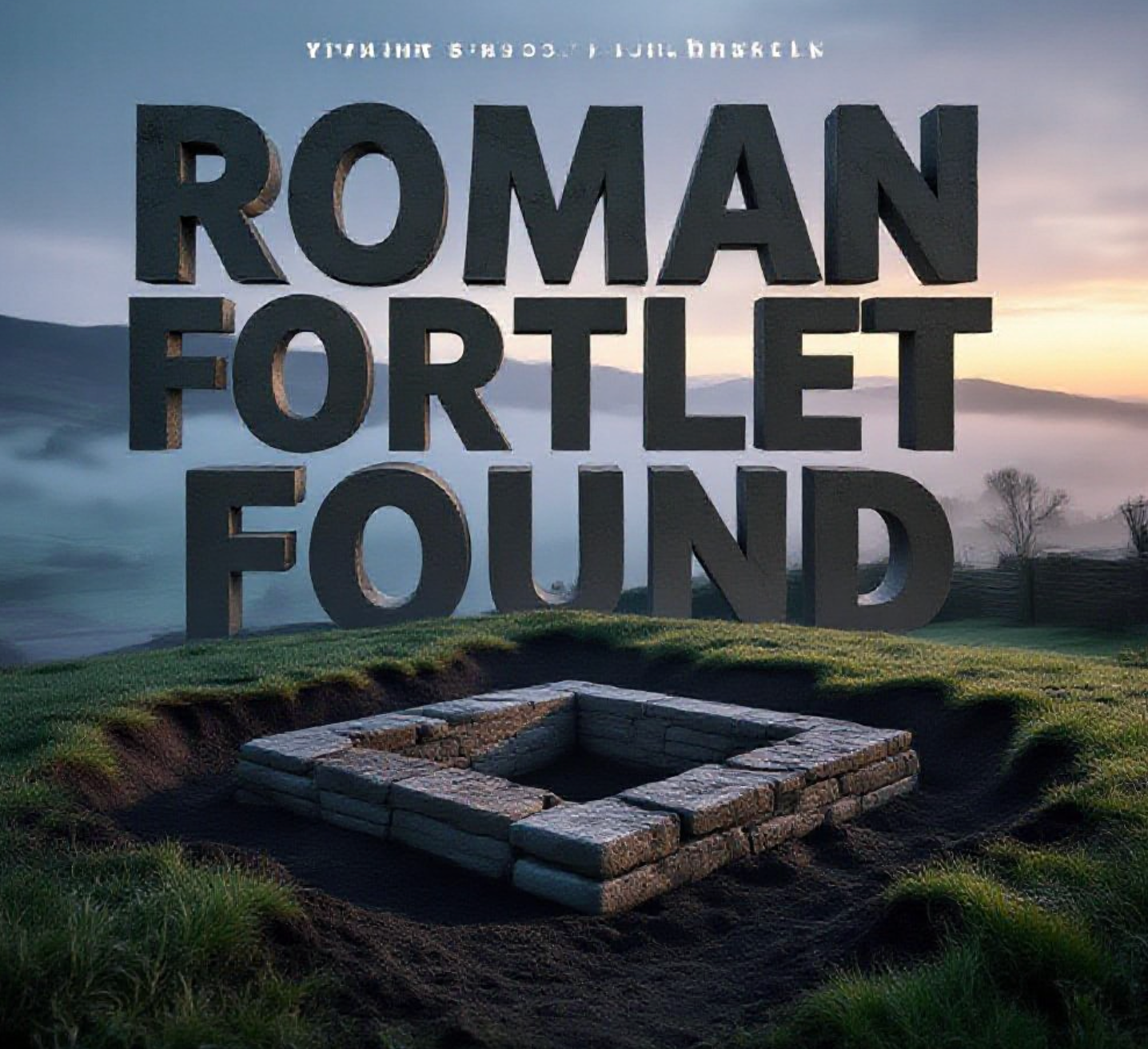
Archaeologists just uncovered a complete Roman fortlet built right next to the Antonine Wall in a quiet suburb of Glasgow. The tiny outpost, hidden for 1,800 years beneath modern gardens in Bearsden, offers the first clear proof that Roman commanders placed small defensive posts south of the wall to watch the dangerous northern frontier.
Surprise Discovery in Modern Gardens
Residents in Bearsden never imagined their manicured lawns sat on top of a Roman military site.
It started in 2017 when one homeowner hired archaeologists ahead of extension work. GUARD Archaeology arrived expecting nothing major. Instead, they found the stone foundation of a small rectangular fortlet measuring roughly 20 by 25 meters, tucked only meters south of the Antonine Wall itself.
The location is stunning. Built on a natural ridge, the fortlet had perfect views north across the Kilpatrick Hills and Clyde Valley, exactly the wild territory Rome never managed to conquer.
Radiocarbon dates from charcoal in the foundation trench place construction between 142 and 165 AD, the exact period Emperor Antoninus Pius pushed the frontier 100 miles north of Hadrian’s Wall.
A Forgotten Piece of the Antonine Wall System
Most people know Hadrian’s Wall. Fewer remember that Rome tried again, twenty years later, to draw the line farther north.
The Antonine Wall ran 39 miles from modern Bo’ness to Old Kilpatrick. Built mostly of turf on a stone base, it was studded with at least 17 large forts and dozens of smaller fortlets every Roman mile, about every 1.3 kilometers.
Until now, almost every known fortlet sat north of the wall to guard the structure itself. The Bearsden discovery is the first confirmed example south of the wall, proving the Romans created a deeper defensive screen facing the unconquered Caledonian tribes.
Excavation director Iraia Arabaolaza calls it “a missing link.” The little outpost could house 20 to 50 soldiers and likely worked in direct visual contact with the much larger Bearsden Roman fort and bathhouse just 400 meters away.
What the Fortlet Looked Like
Digital reconstruction by Eduardo Pérez-Fernández shows exactly how impressive the site once was.
Two timber buildings stood inside stone walls. Two corner watchtowers rose high enough to see for miles. A deep ditch and outer bank wrapped the entire structure.
Soldiers standing on those towers could spot movement across the entire northern horizon and flash signals to the main fort in minutes. In an age before radios, that vantage point was priceless.
The stone base found under the gardens matches exactly the construction style seen at other Antonine Wall sites. Burnt material in the foundation hints the fortlet may have been deliberately dismantled when the Romans abandoned Scotland around 165 AD.
Why This Changes the History Books
Scholars long assumed the Antonine Wall relied only on forward positions. The Bearsden fortlet proves commanders worried just as much about attacks from the rear or flanking moves through the river valleys south of the wall.
Dr. Louisa Campbell, Roman Scotland expert at Glasgow University, told reporters the find “forces us to redraw our maps of how Rome defended its most northern frontier.”
It also humanizes the story. These were young men, many from modern Belgium or the Netherlands, standing on a windy Scottish hill watching for warriors who knew the terrain far better than they ever would.
They held the post for maybe twenty years before orders came to pull back to Hadrian’s Wall. Then they burned what they could and marched south, leaving only stones buried under heather and, centuries later, suburban flower beds.
The quiet Bearsden gardens have given us something loud: proof that Rome’s grip on Scotland was tighter, more anxious, and far more sophisticated than anyone realized.