

A groundbreaking new poll suggests Scotland’s political landscape is on the verge of a dramatic transformation, with the SNP poised to secure a historic fifth term while Labour faces potential wipeout and Reform UK prepares for a seismic breakthrough north of the border.
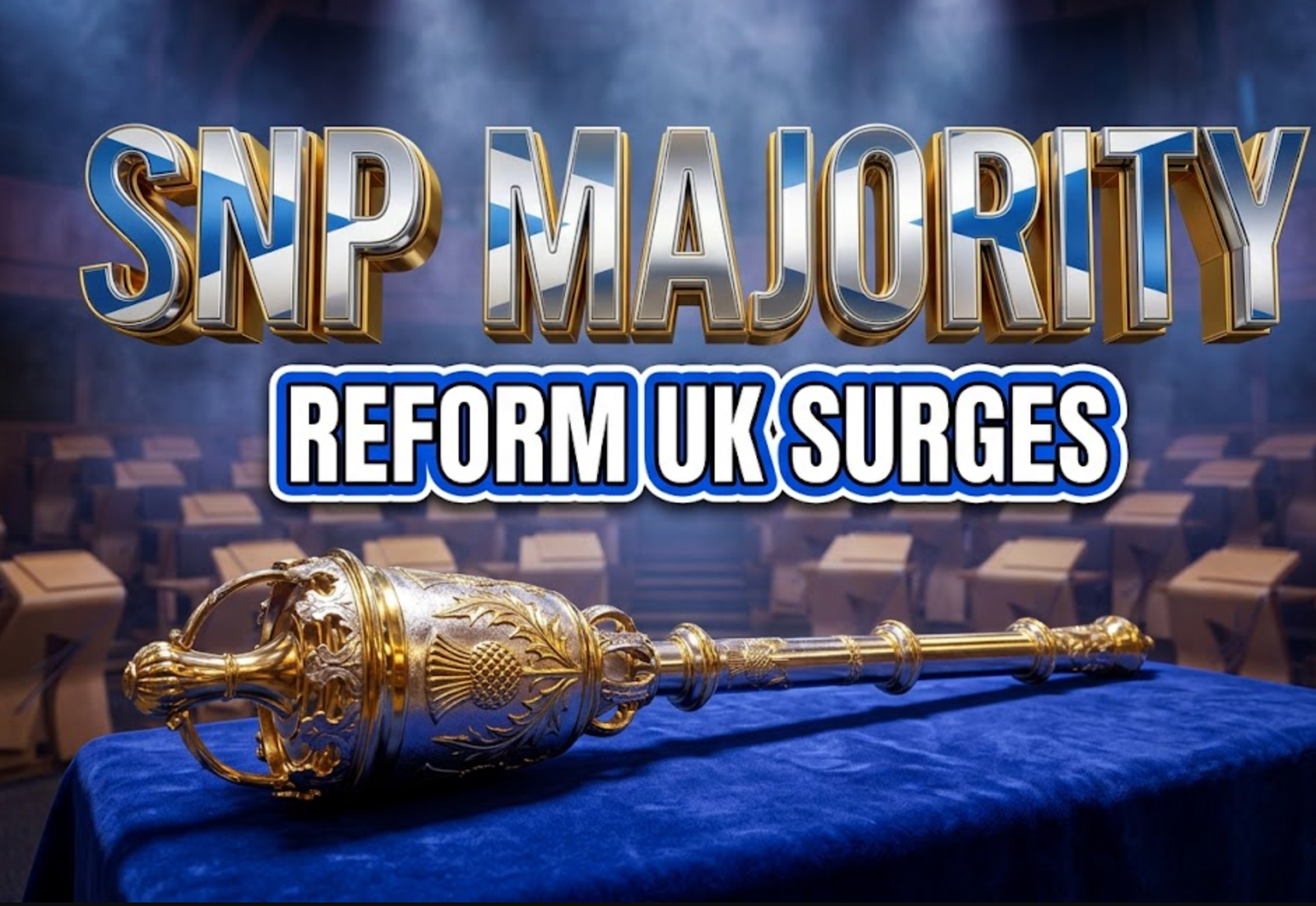
The first YouGov MRP projection for the 2026 Holyrood election reveals the SNP could win 67 seats, a razor-thin five-seat majority that would cement John Swinney’s position as First Minister and reignite independence debates across Scotland.
SNP Dominance Continues Despite National Uncertainty
The nationalist party stands on the brink of achieving what many political analysts thought impossible just months ago: a clear parliamentary majority.
YouGov’s sophisticated Multi-Revel Regression and Post-stratification model, based on responses from nearly 4,000 Scottish adults surveyed between March 23 and April 8, shows the SNP winning in 89% of all simulated election outcomes. This statistical weight suggests the party’s path to victory is not just possible but highly probable.
The projected 67 seats would represent a slight improvement on their 2021 performance of 64 seats. While the model indicates a range between 63 and 69 seats for the SNP, the consistency across simulations points to sustained support for Scottish nationalism despite recent political turbulence.
John Swinney’s leadership appears to have stabilized the party following a period of internal challenges. The First Minister has maintained focus on core independence messaging while addressing everyday concerns about public services and living costs.
Reform UK Eyes Historic Scottish Breakthrough
Perhaps the most stunning revelation in the polling data is Reform UK’s projected rise from complete obscurity to becoming Scotland’s second largest party.
The party that secured just 0.2% of votes in 2021 now stands to win 20 seats at Holyrood. This would mark the first time in Scottish Parliament history that a party positioned to the right of the Conservatives has achieved parliamentary representation.
Reform UK’s surge mirrors patterns seen across other parts of Britain, where the party has capitalized on voter frustration with traditional parties. In Scotland, this breakthrough could fundamentally reshape the unionist political bloc.
The party has focused campaign messaging on immigration controls, economic sovereignty outside both Westminster and Brussels influence, and opposition to what it terms progressive overreach in Scottish policy.
Labour Faces Catastrophic Scottish Collapse
The projections spell disaster for Scottish Labour, with the party forecast to win zero constituency seats across the entire country.
According to the MRP model, Labour would secure just 15 seats total, all coming from regional list allocations. This represents a collapse from their position as Scotland’s traditional political powerhouse and would mark their worst performance in any Scottish election.
The timing could hardly be worse for Labour, coming as the party governs at Westminster. Scottish voters appear to be rejecting Labour’s pitch, potentially viewing the party as too aligned with London politics or insufficiently committed to defending Scottish interests.
Former Labour strongholds in Glasgow and the central belt now appear firmly beyond reach. The party’s struggle to articulate a clear constitutional position on Scotland’s future within the UK has left it squeezed between nationalist and unionist alternatives.
Conservative Support Hits Rock Bottom
The Scottish Conservatives face their own existential crisis, with projections showing them falling to just 8% of the vote.
This would represent the worst performance by the Conservative Party in Scotland at any election in recorded history. The model even suggests the possibility of a sixth-place finish, an unthinkable outcome for a party that was Scotland’s main opposition just years ago.
The Conservative collapse opens questions about the party’s long-term viability in Scotland. Their strong unionist stance, once a rallying point, now appears insufficient to maintain voter coalition in the face of Reform UK competition and broader dissatisfaction with Conservative governance.
| Party | Projected Seats | Vote Share | Change from 2021 |
|---|---|---|---|
| SNP | 67 | Not specified | +3 |
| Reform UK | 20 | Not specified | +20 |
| Labour | 15 | Not specified | Significant loss |
| Scottish Greens | 11 | Not specified | +3 |
| Liberal Democrats | 9 | Not specified | Modest change |
| Conservatives | Not specified | 8% | Historic decline |
Greens and Liberal Democrats Make Gains
The Scottish Greens are projected to achieve their best ever Holyrood result with 11 seats, representing a gain of three from 2021.
Most remarkably, the model suggests the Greens could win Edinburgh Central as a constituency seat by the narrowest of margins. This would be a symbolic victory in Scotland’s capital and demonstrate the party’s growing appeal beyond traditional regional list support.
The Liberal Democrats are forecast to secure nine seats, maintaining their presence as a steady if unspectacular force in Scottish politics. The party has focused on local issues and positioned itself as a moderate alternative to both nationalism and hard-line unionism.
Independence Bloc Reaches Historic High
When combined, pro-independence parties are projected to win between 69 and 82 seats, with the central estimate suggesting 78 seats total.
This would represent the highest number of pro-independence MSPs in any Scottish Parliament since devolution began in 1999. The SNP and Greens together would command a comfortable majority, likely intensifying pressure for a second independence referendum.
Unionist parties, by contrast, face a combined range of just 45 to 58 seats. This fragmentation across Labour, Conservative, Liberal Democrat and potentially Reform UK makes coordinated opposition to independence policies increasingly difficult.
The mathematics of the parliament would give independence supporters their strongest mandate yet, though questions remain about whether Westminster would grant the legal authority for another referendum.
What This Means For Scotland’s Future
The polling snapshot captures a Scottish electorate pulled in multiple directions. While independence support remains strong, the rise of Reform UK suggests some voters prioritize other concerns including immigration and cultural issues.
The potential collapse of Labour and the Conservatives as Scotland’s main unionist parties creates a power vacuum that Reform UK appears positioned to fill. Whether this represents a temporary protest vote or lasting realignment remains unclear.
For the SNP, a majority would provide political capital but also renewed responsibility. Voters will expect delivery on public services, economic growth and constitutional progress. The party cannot rely solely on independence messaging if everyday governance falters.
The Scottish political landscape stands at a crossroads, with traditional party structures crumbling and new forces emerging. As Scotland approaches this critical election, the choices voters make will echo for generations, potentially determining not just who governs but whether Scotland remains part of the United Kingdom.
The 2026 Holyrood election promises to be one of the most consequential in Scottish democratic history. These projections suggest voters are ready to deliver verdicts that could reshape the nation’s political foundation and constitutional future.
What do you think these projections mean for Scotland’s future? Share your thoughts in the comments below.