
 Dayna Bass
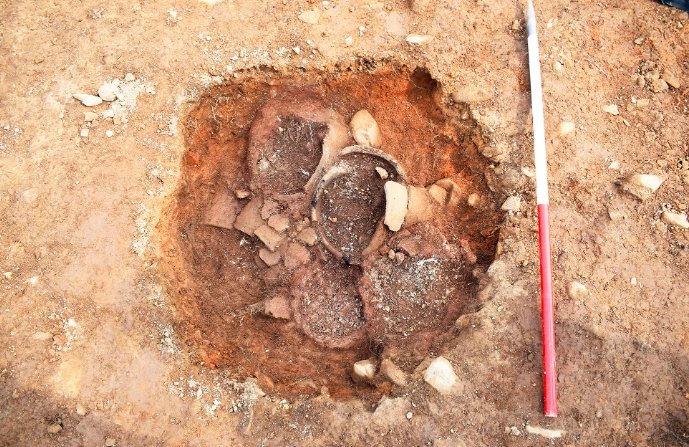
 Archaeologists in Scotland have uncovered 3,300-year-old cremated remains of at least eight people buried in five urns, pointing to a sudden and mysterious disaster during the Bronze Age. The discovery, made near Sanquhar in Dumfries and Galloway, suggests these individuals died in a catastrophic event like disease or famine, buried quickly in a single pit that remained untouched for centuries.
Discovery Site and Excavation Details
Experts from Guard Archaeology found the burial site during digs in 2020 and 2021 ahead of wind farm construction at Twentyshilling Hill. The remains sat in a small pit at the center of a barrow, a mound of earth and rocks typical of Bronze Age funerals.
Radiocarbon dating of charcoal and other materials places the burial between 1439 and 1287 B.C., aligning with a time of shifting climates and social changes in prehistoric Britain. Unlike many sites reused over generations, this one shows a one-time event, with urns packed tightly together.
The team noted plough damage from modern farming but no signs of later disturbances, preserving the scene as a rare snapshot of ancient crisis.
Signs of a Sudden Disaster
Analysis shows the cremations involved at least eight people, including adults and possibly children, based on bone fragments. Researchers believe a “horrible event” struck the community, leading to hasty burials.
Possible causes include infectious disease outbreaks, which spread quickly in close-knit groups, or famine from poor harvests during the Bronze Age’s variable weather. Some experts point to violence, though no direct evidence like weapon marks appears on the bones.
This mass burial differs from standard practices where bodies were often exposed before cremation and mounds reused. The quick, collective interment hints at urgency, perhaps to contain disease or honor the dead amid chaos.
- Infectious diseases: Could have wiped out families rapidly, similar to later plagues in history.
- Environmental factors: Droughts or floods might have caused food shortages, leading to starvation.
- Social unrest: Conflicts over resources in a changing climate may have played a role.
Broader Context in Bronze Age Britain
Bronze Age Scotland featured small farming communities with advanced metalworking and trade networks across Europe. This period saw population growth but also challenges like cooler, wetter weather around 1300 B.C., which strained agriculture.
Similar finds elsewhere, such as mass graves in England from violent clashes, suggest not all was peaceful. For instance, recent studies of bones from Charterhouse Warren reveal massacre and possible cannibalism, challenging views of a tranquil era.
In Scotland, sites like Must Farm offer glimpses of daily life, with preserved wooden homes destroyed by fire. These discoveries connect to broader patterns of upheaval, including migrations and technological shifts.
| Key Bronze Age Sites in Britain | Location | Significance | Approximate Date |
|---|---|---|---|
| Must Farm | Cambridgeshire, England | Well-preserved village destroyed by fire, showing everyday life | 1000-800 B.C. |
| Charterhouse Warren | Somerset, England | Evidence of massacre and butchering | Around 2000 B.C. |
| Twentyshilling Hill | Dumfries and Galloway, Scotland | Mass cremation suggesting catastrophe | 1439-1287 B.C. |
| Penmaenmawr Druid’s Circle | Wales | Child cremations in urns, predating Bronze Age | Around 3000 B.C. |
Implications for Modern Understanding
This find reshapes ideas about prehistoric resilience and vulnerability. It highlights how sudden events could devastate small groups, much like natural disasters today.
Ongoing research, including DNA analysis of the bones, may reveal family ties or migration patterns. Experts hope to uncover more about health and diet through isotope studies, linking to current climate concerns.
The site’s location near a wind farm ties ancient history to modern renewable energy efforts, showing how development uncovers the past.
Ongoing Research and Future Insights
Teams continue to study the urns and surrounding artifacts for clues on rituals and society. Public interest has grown, with exhibits planned in local museums to share these stories.
Comparisons with other European sites could reveal if similar catastrophes hit wider areas. As of late 2025, this discovery joins a wave of archaeological breakthroughs, including new facial reconstructions of ancient humans.
Share your thoughts on this ancient mystery in the comments below, and spread the word by sharing this article with fellow history enthusiasts.
 Windows 11 KB5095093 Lands With Point-in-Time Restore and 35-Day Pause
  Meta Cuts Smart Glasses to $299 to Outflank Snap and Apple
  Messi Leads the 2026 World Cup Golden Boot Race After Two Matches
  Australia March On as Athapaththu Ton Lights Up T20 World Cup
  Galaxy Z Fold 8 Leak Reveals Colors, Storage, and a New Ultra Variant
  Ronaldo’s Six-World-Cup Record Leads a Matchday Full of Milestones